

The quickest way to remove warehouse markings is often the fastest way to permanently scar your facility’s floor. When you’re weighing shot blasting vs grinding for line removal, the decision isn’t just about erasing old paint; it’s about the technical preparation required for your next layout. You’ve likely dealt with “ghost lines” (faint, permanent shadows left in the concrete) or the frustration of new epoxy peeling because the surface wasn’t etched correctly. Most facility managers agree that a rushed removal job creates more long-term costs than it saves in initial labor.
This guide compares these two mechanical methods to help you secure a clean, OSHA-compliant floor while protecting your infrastructure. We’ll show you how to achieve the correct Concrete Surface Profile (a standardized measure of surface roughness) to ensure your new markings actually stick. You’ll learn how to manage respirable crystalline silica dust to meet the strict 50 µg/m³ PEL (permissible exposure limit) standards, ensuring your facility stays operational and safe throughout the process. We’ll provide the technical clarity you need to choose the most reliable, cost-effective method for your specific environment.
Key Takeaways
- Understand why mechanical removal is the industrial benchmark for safety, as chemical strippers (solvent-based liquids) often introduce hazardous fumes into enclosed warehouse environments.
- Evaluate the technical trade-offs of shot blasting vs grinding for line removal to determine which method offers the fastest execution during your next scheduled facility shutdown.
- Identify how specific Concrete Surface Profiles (CSPs) impact the bond strength of your new markings, ensuring they withstand heavy forklift traffic without peeling.
- Learn to mitigate the risk of permanent floor scarring and “ghosting” (visual remnants of old lines) by matching the removal intensity to your specific concrete density and existing coating type.
Mechanical Surface Prep: Understanding Shot Blasting and Grinding
Mechanical surface preparation is the only reliable way to eliminate legacy markings without compromising the structural integrity of your facility’s floor. While some may consider chemical strippers, these liquid agents are rarely suitable for large-scale industrial environments. Chemicals often introduce toxic fumes and hazardous waste into enclosed workspaces, creating significant safety risks and logistical delays. Mechanical methods provide a clean, dry, and immediate solution that allows for faster project completion. A successful removal project focuses on two critical outcomes: completely erasing the old marking and profiling the concrete (creating a textured surface) to accept a new coating.
The goal of professional removal isn’t just about what you take away; it’s about what you leave behind. Selecting the right mechanical method, such as shot blasting vs grinding for line removal, requires an understanding of how each machine interacts with the concrete. We look at the existing slab conditions to ensure the process doesn’t cause unnecessary damage. StripeGuys Warhouse Line Striping utilizes decades of field experience to match the specific removal technique to your floor’s unique density and coating history. This seasoned expertise ensures that the removal process protects your asset while preparing it for long-term service.
What is Shot Blasting?
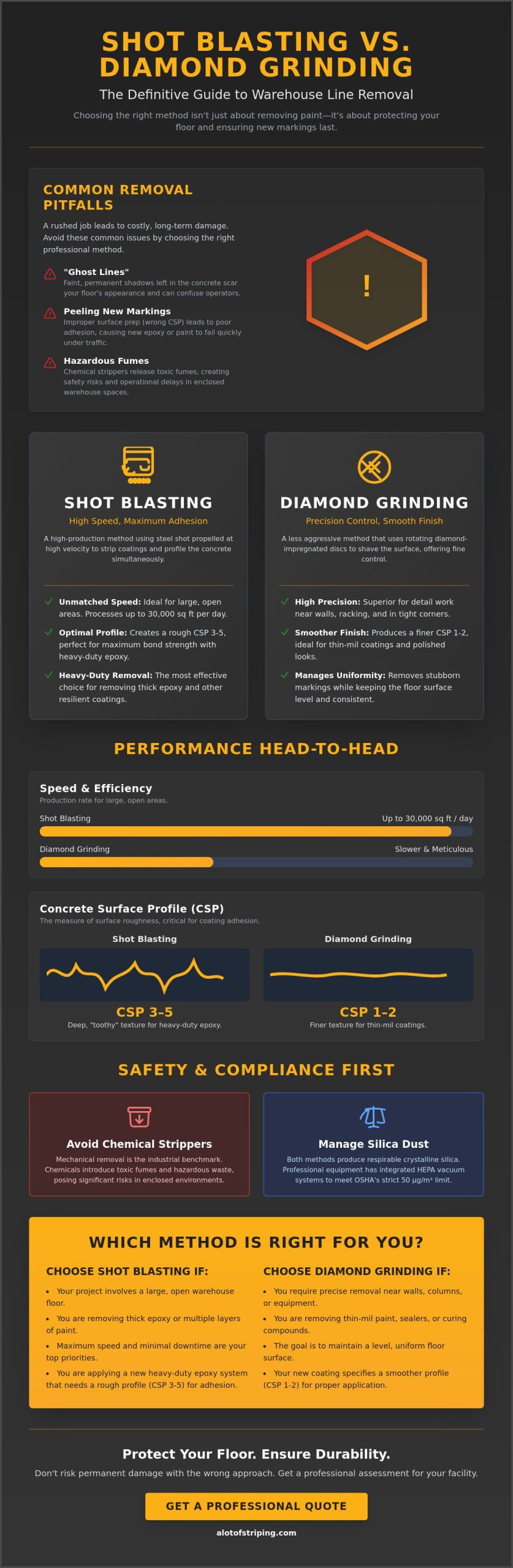
Shot blasting is a high-production method that uses centrifugal wheels to propel steel shot at the floor at extreme velocities. This process, which is a specialized form of abrasive blasting, strips away the existing paint while simultaneously creating a textured Concrete Surface Profile (CSP). It’s the most effective choice for heavy epoxy removal in high-volume industrial facilities. Because modern shot blasting equipment features integrated dust collection systems, it’s a relatively clean process that prepares the slab for maximum adhesion with a new epoxy warehouse striping application.
What is Diamond Grinding?
Diamond grinding uses horizontal rotating discs embedded with industrial diamond segments to shave the surface of the concrete. This method is less aggressive than shot blasting and provides a smoother finish. It’s an excellent choice for removing thin-mil paints or prepping floors where a level, polished appearance is required. Grinding is often preferred for facilities that need to maintain a lower CSP (a measure of surface roughness) to prevent the new markings from appearing overly porous. It’s a precise tool that allows a warehouse line striping company to remove stubborn markings while keeping the floor surface uniform and manageable.
Performance Comparison: Speed, Profile, and Dust Control
The physical reality of an industrial shutdown is a race against the clock. When evaluating shot blasting vs grinding for line removal, speed of execution is often the primary driver for facility managers. Every hour of downtime impacts your operational throughput. While both methods are effective, they offer different performance benchmarks regarding production rates, surface texture, and environmental cleanliness. Understanding these trade-offs allows you to select a method that balances your immediate schedule with the long-term durability of your floor markings.
Production Rates and Efficiency
Shot blasting is the industry standard for high-volume efficiency on open warehouse floors. High-capacity shot blasting equipment can process up to 30,000 square feet per day, making it the superior choice for large-scale logistics hubs. Grinding is a more meticulous process and is typically slower in terms of square footage per hour. However, grinding offers superior precision near walls, under racking, and in tight corners where larger blast heads cannot reach. For most facilities, the labor-to-cost ratio favors shot blasting for main aisles while reserving grinding for detail work and perimeter preparation.
The Role of Concrete Surface Profile (CSP)
The bond strength of your new epoxy warehouse striping is dictated by the Concrete Surface Profile (CSP). This is a standardized measure of the roughness of the slab. Shot blasting typically produces a CSP 3 to 5, which creates a deep, “toothy” texture ideal for heavy-duty epoxy systems that must withstand constant forklift traffic. Grinding produces a finer CSP 1 to 2, which is better suited for thin-mil coatings or facilities maintaining a polished look. Choosing the wrong CSP is the leading cause of premature line delamination (the paint peeling away from the concrete), as the coating cannot mechanically lock into the surface. If you are unsure which profile your new layout requires, consult with our team for a technical assessment of your slab.
Dust mitigation is a non-negotiable requirement in active distribution centers or food-grade plants. To meet the strict OSHA respirable crystalline silica regulation (which limits exposure to 50 micrograms per cubic meter of air), StripeGuys Warhouse Line Striping employs high-efficiency HEPA-filtered vacuum systems. These units connect directly to our removal equipment for near-dustless operation. This ensures your inventory remains clean and your facility stays compliant with safety standards throughout the removal process. Our commitment to clean operation allows us to work in sensitive environments without the need for extensive product shielding or secondary cleanup.
The Challenge of Ghosting and Surface Integrity
Effective line removal is measured by what remains after the equipment is powered down. One of the most persistent issues in facility management is “ghosting,” which occurs when the concrete under old lines remains a different color or texture than the surrounding slab. This happens because the concrete covered by the previous marking was protected from UV light, chemical exposure, and physical wear. Even when the paint is technically gone, these “shadow lines” remain visible. When deciding between shot blasting vs grinding for line removal, you must account for this visual residue. If left unaddressed, ghosting confuses forklift operators and can lead to safety citations during inspections.
Improper technique during the removal process can also compromise the structural integrity of your floor. Amateur operators often cause “pitting” (small holes in the concrete) or deep scars that require expensive grout repairs before new markings can be applied. StripeGuys Warhouse Line Striping utilizes a specialized “feathering” technique to ensure a clean transition between the removed area and the existing floor. This is particularly critical when preparing pedestrian walkways and safety aisles, where a smooth, uniform surface is required for both safety and aesthetics.
Why Ghosting Happens
Ghosting is a result of concrete porosity differences. The area under a line is often “fresher” and less porous than the rest of the floor, which has been subjected to years of traffic. UV exposure also plays a significant role, as it fades the exposed concrete while the protected area retains its original hue. We minimize these shadow lines through strategic over-blasting or wide-path grinding. By extending the removal slightly beyond the original line, we blend the textures to create a more uniform appearance across the entire slab.
Protecting the Structural Slab
Maintaining the health of your concrete requires constant equipment adjustment. A common mistake is “trenching,” which happens when a removal operator stays in one spot too long, creating a permanent dip in the floor. We calibrate our equipment pressure based on the concrete’s hardness (measured in PSI). Harder concrete requires more aggressive steel shot or diamond segments, while softer slabs need a lighter touch to prevent damage. In cases where extremely thick, failed coatings are present, we may recommend scarifying to remove the bulk of the material before finishing with a blaster or grinder.
If your facility has multiple layers of old paint or visible floor scarring, you need a technical solution that restores your floor’s integrity. Contact StripeGuys Warhouse Line Striping today to schedule a site evaluation and receive a professional removal plan.
Decision Matrix: Choosing the Right Method for Your Facility
A professional warehouse line striping company doesn’t rely on guesswork. They conduct a technical evaluation of the slab before recommending a specific mechanical approach. When you’re deciding between shot blasting vs grinding for line removal, your choice should be dictated by three primary variables: the chemistry of the existing coating, the specifications of your new markings, and your operational timeline. Selecting the wrong prep method can lead to either unnecessary floor damage or premature line failure, both of which impact your long-term maintenance budget.
Consider the future of your facility layout. If you’re upgrading from standard traffic paint to high-performance epoxy, your surface preparation must be aggressive enough to ensure a permanent mechanical bond. Conversely, if you’re operating in a retail-facing warehouse where aesthetics are a priority, a lighter touch might be necessary to avoid deep shadowing. StripeGuys provides national consultation services to help facility managers align their technical preparation needs with their budgetary constraints, ensuring the floor is ready for immediate re-striping.
When to Choose Shot Blasting
- Thick Coating Removal: This is the most effective method for stripping away heavy epoxy, urethane, or failed resinous coatings that have built up over years of service.
- High-Traffic Environments: Shot blasting is mandatory for facilities moving to a heavy-duty forklift traffic layout, as it provides the deep CSP required for industrial-grade adhesion.
- Large-Scale Efficiency: It’s the preferred choice for large, open warehouse bays where speed is the primary priority and thousands of linear feet must be cleared in a single shift.
When to Choose Diamond Grinding
- Thin-Mil Paints and Tape: Grinding is optimal for removing thin traffic paint or stubborn temporary tape residue without over-etching the concrete.
- Aesthetic Requirements: It’s the best choice for facilities that require a smooth, level finish where the visual “profile” of the removal needs to be kept to a minimum.
- Precision Work: Grinding equipment is designed for tight aisles, corners, and detail work around fixed racking or sensitive manufacturing equipment.
Every facility has unique physical constraints. Whether you’re managing a food-grade distribution center or a heavy manufacturing plant, the goal is a clean, safe, and OSHA-compliant floor. By matching the removal method to your specific slab conditions, you protect your infrastructure while ensuring your new safety markings stay in place for years to come.
Secure Your Facility’s Operational Future
Choosing between shot blasting vs grinding for line removal is a strategic decision that directly affects the safety and longevity of your industrial workspace. You now understand that while shot blasting offers high-volume efficiency and the aggressive mechanical bonding required for heavy epoxies, diamond grinding provides the precision needed for thin-mil coatings and detail work around fixed equipment. Prioritizing the correct Concrete Surface Profile (CSP) and addressing “ghosting” early prevents the costly cycle of premature line peeling and permanent floor scarring.
StripeGuys brings 29+ years of industrial experience to every project, offering national coverage for large-scale facilities that require rapid, professional turnaround times. We prioritize your facility’s safety by employing HEPA-filtered dustless removal technology to capture respirable silica at the source, keeping your environment clean and compliant with current OSHA standards. Don’t leave your floor preparation to chance; partner with a contractor that understands the high stakes of industrial infrastructure.
Request a Professional Line Removal Quote from StripeGuys to ensure your facility is ready for its next phase of service.
Frequently Asked Questions
Does shot blasting create a lot of dust in the warehouse?
Modern shot blasting is a near-dustless process when performed with professional-grade industrial equipment. These machines feature integrated HEPA-filtered vacuum systems that capture particulates at the point of impact. This setup ensures compliance with the OSHA respirable crystalline silica limit (the 50 µg/m³ PEL standard). It allows for safe operation in active distribution centers without the risk of contaminating inventory or affecting employee respiratory health.
Can you grind off lines without damaging the concrete underneath?
You can grind off lines without damaging the slab by selecting the appropriate diamond-impregnated segments and adjusting machine pressure. Grinding is a precision method that shaves the concrete surface rather than impacting it. It’s an ideal choice for removing thin traffic paint or tape residue while maintaining a smooth finish. Experienced operators monitor the removal depth constantly to prevent trenching (creating permanent depressions in the concrete floor).
How long does it take to remove 5,000 linear feet of warehouse lines?
A professional crew can typically remove 5,000 linear feet of warehouse markings within a single 8 to 10 hour shift. The exact timeline depends on the thickness of the existing coating and the chosen equipment. Shot blasting generally offers the fastest production rates for long, straight aisles. Grinding may take slightly longer if the layout includes numerous corners or tight spaces that require smaller, hand-held units.
Will the old lines still be visible (ghosting) after shot blasting?
Ghosting (the faint visual shadow of an old line) can occur because the concrete under the line was protected from UV light and traffic wear. While mechanical removal erases the paint, the contrast in concrete color may remain. We minimize this by feathering (blending) the edges of the removal path to match the texture of the surrounding floor. This technical approach reduces visual confusion for forklift operators and safety inspectors.
Is shot blasting more expensive than grinding for line removal?
Shot blasting is generally more cost-effective for large-scale industrial projects because of its high production speed. While the equipment is more specialized, the reduced labor hours often result in a lower total project cost for high-volume removals. The decision for shot blasting vs grinding for line removal ultimately depends on the coating type; thick epoxies are removed much more efficiently with shot blasting than with traditional grinding discs.
Can new lines be painted immediately after mechanical removal?
New lines can be applied immediately after mechanical removal is complete. Because shot blasting and grinding are dry processes, there is no waiting period for moisture to evaporate or for chemical residues to neutralize. Once the area is vacuumed clean, the floor is ready for new markings or epoxy applications. This efficiency is a primary reason why mechanical prep remains the industrial standard for time-sensitive facility shutdowns.


