Most facility managers treat warehouse line painting as a simple janitorial task, but lasting results require a mechanical engineering approach where durability is 90% preparation and only 10% application. You’ve likely dealt with the cycle of constant re-striping and the frustration of seeing lines peel just months after paying the $2 to $4 per linear foot industry average for professional service. Between 2000 and 2017, forklift incidents caused 614 deaths, making clear floor markings a critical safety requirement rather than a cosmetic choice. We understand that your priority is maintaining OSHA compliance without shutting down operations every few months for maintenance.
At StripeGuys, we’ve provided industrial authority since 1994 by focusing on functional outcomes that survive heavy forklift traffic. This guide reveals how to achieve warehouse markings that last 3+ years and meet all ANSI Z535 standards. We will explain the necessity of diamond grinding (mechanically roughing up the concrete surface) to ensure paint adhesion and how high-performance epoxy coatings create permanent paths of egress. You’ll learn a systematic approach to facility organization that reduces safety violations, protects your budget, and optimizes your operational flow.
Key Takeaways
- Learn why mechanical surface preparation, such as diamond grinding (roughing up the smooth surface), is the only way to prevent line failure caused by laitance.
- Discover how professional warehouse line painting utilizes high-performance coatings to withstand heavy forklift traffic for three or more years.
- Identify the specific OSHA 1910.22 requirements for permanent aisle markings and paths of egress (safe exit routes) to ensure your facility remains compliant.
- Master the strategy of phased installation and 24/7 scheduling to complete your project without interrupting production or forklift flow.
- Understand how a consultative approach, backed by expertise since 1994, helps you balance safety requirements with strict operational budgets.
The Science of Warehouse Line Painting: Why Most Lines Fail
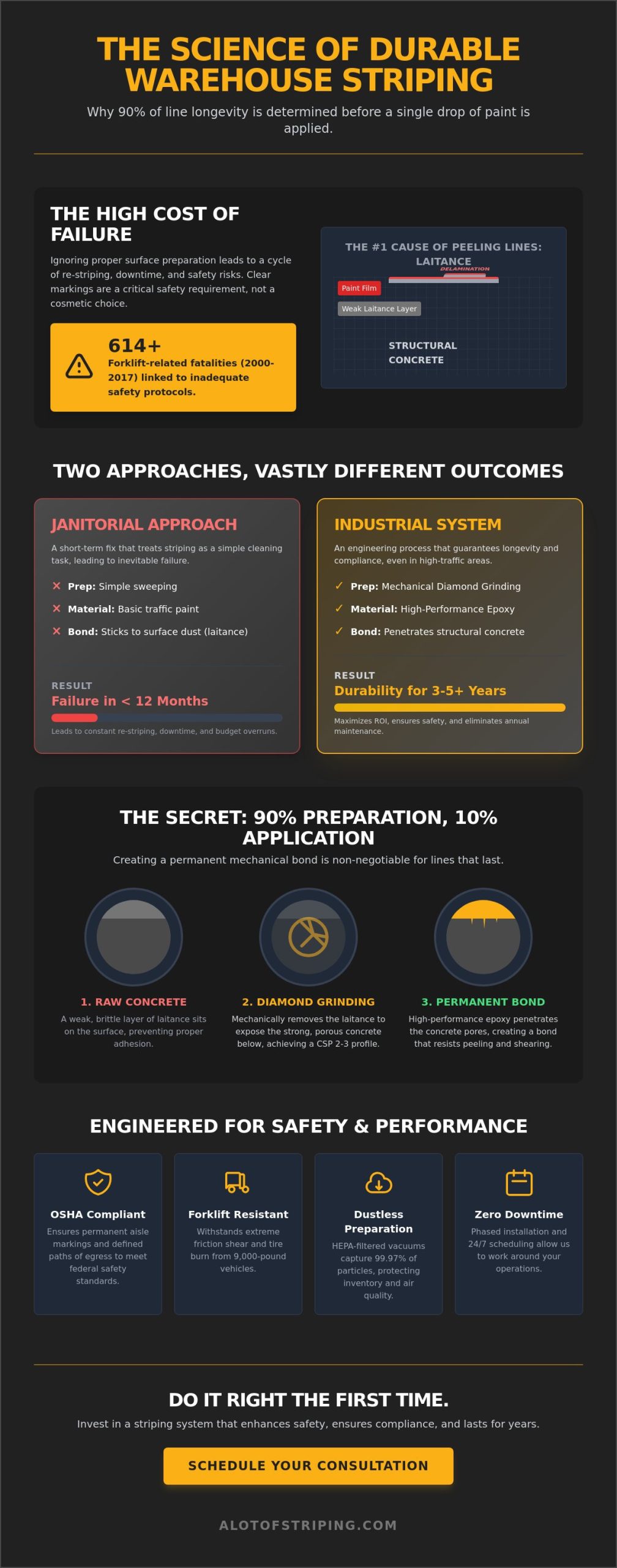
Professional warehouse line painting is a multi-stage mechanical engineering process, not a cosmetic upgrade. Most facility managers treat striping as a janitorial task, which leads to the #1 cause of coating failure: poor adhesion to laitance. Laitance is the weak, brittle layer of cement and fine particles that settles on the top of a concrete slab during the curing process. If you apply paint directly to this layer, the bond will fail because the paint is sticking to dust rather than the structural concrete. Since 1994, we’ve approached every project through a triad of safety, quality, and communication to ensure markings survive the rigors of industrial use.
There is a massive gap between janitorial-grade painting and industrial-grade striping systems. A janitorial approach involves rolling traffic paint onto a swept floor. An industrial system involves diamond grinding (mechanically roughing up the smooth surface) to create a profile that allows high-performance resins to bite into the slab. Without this mechanical bond, even the most expensive epoxy will peel under the weight of a standard forklift. We focus on functional outcomes that prioritize your operational needs over simple aesthetics.
The High Cost of Frequent Re-Striping
Cheap traffic paint is a trap for your maintenance budget. While standard application might cost $2 to $4 per linear foot, the true expense lies in the frequency of the work. If a facility requires annual re-striping to maintain OSHA compliance, the cumulative labor costs and operational downtime quickly exceed the investment of a high-durability system. A professional epoxy system designed to last five years provides a far better return on investment by eliminating four cycles of facility preparation and the logistical headache of clearing racks for a crew. It’s more cost-effective to do the job right once than to do it poorly every twelve months.
Understanding Forklift Impact on Floor Markings
Forklifts create extreme friction shear and “tire burn” when they turn or accelerate on a smooth floor. This mechanical force literally tears surface-applied paint away from the concrete. While some facilities use warehouse floor marking tape for basic 5S organization, these adhesives often fail under the weight of a 9,000-pound forklift. In high-traffic staging areas and loading docks, specialized chemical resistance is mandatory to prevent degradation from leaked fluids. We often recommend “inlaid” markings (grinding a shallow channel into the floor before filling it with resin) for the highest-traffic zones. This ensures the lines remain flush with the surface and protected from the constant scraping of forklift blades and pallets.
Surface Preparation: The Secret to Permanent Warehouse Striping
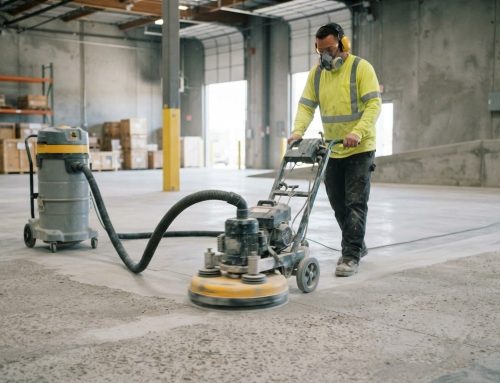
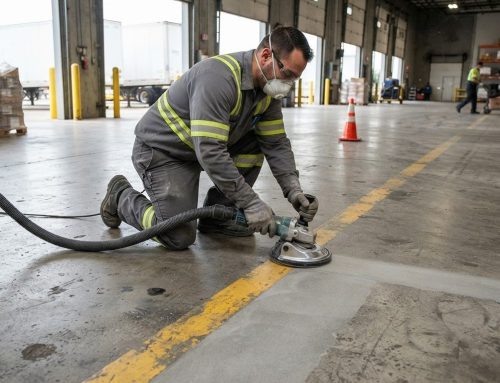
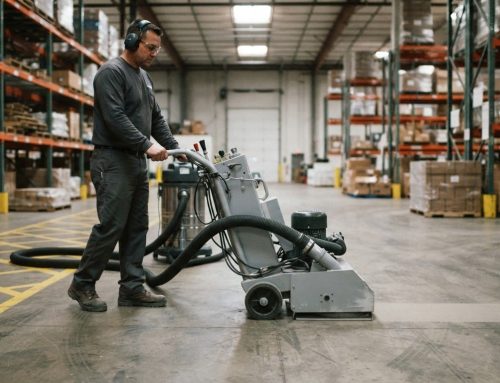
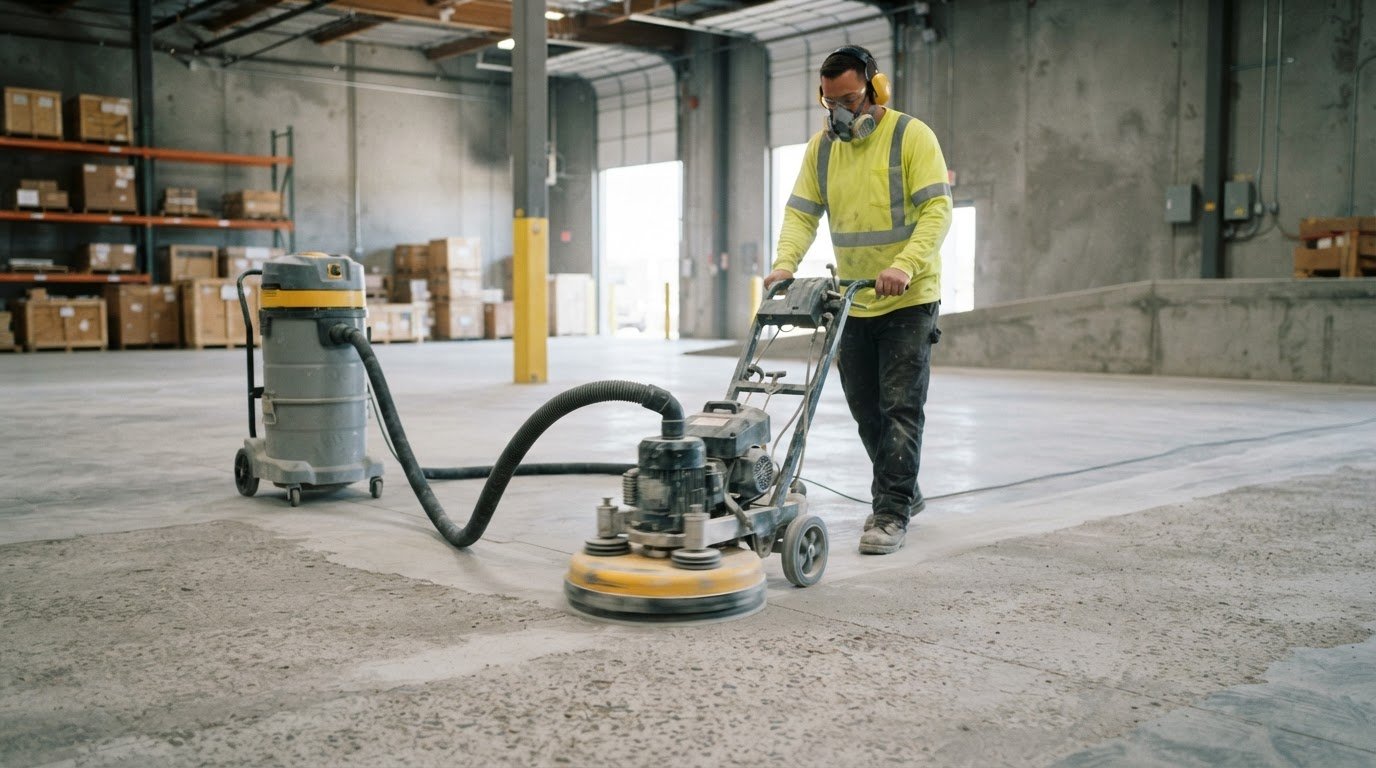
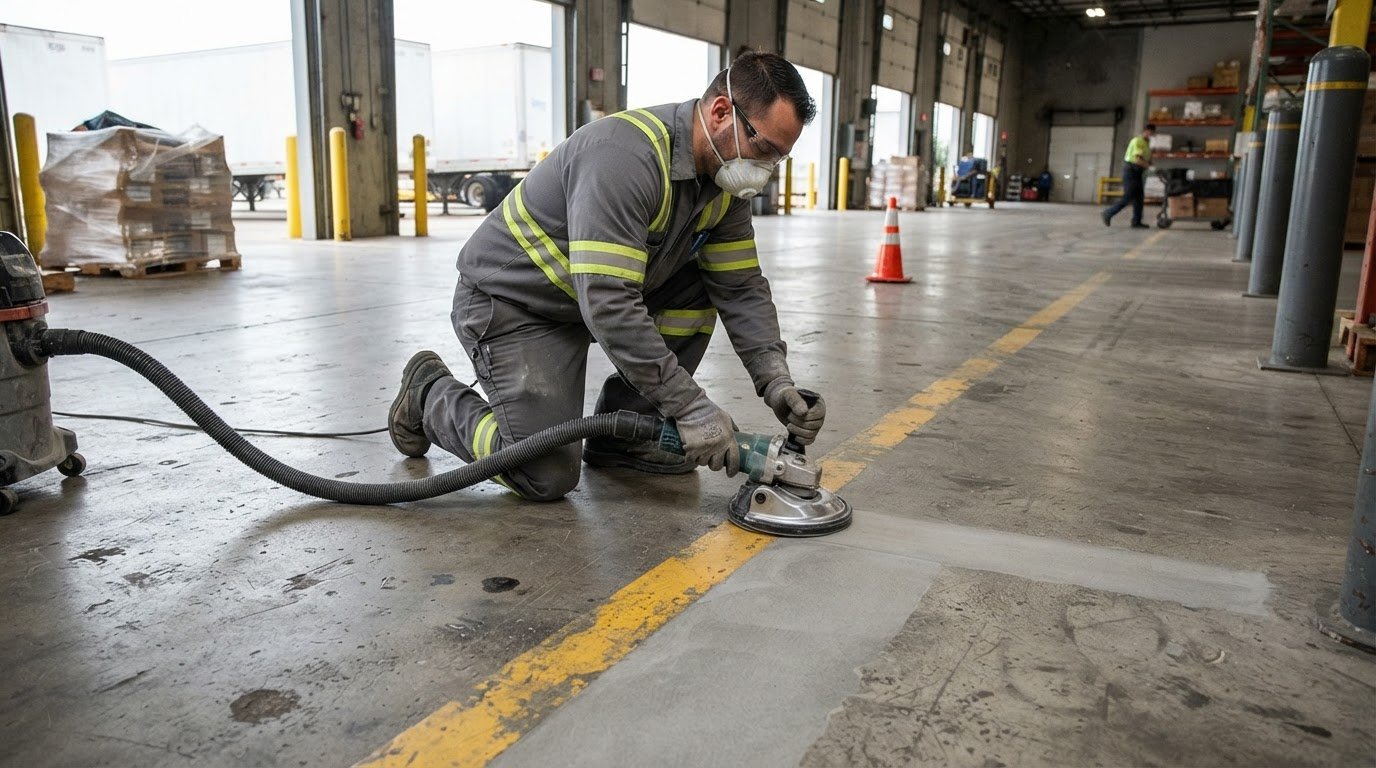
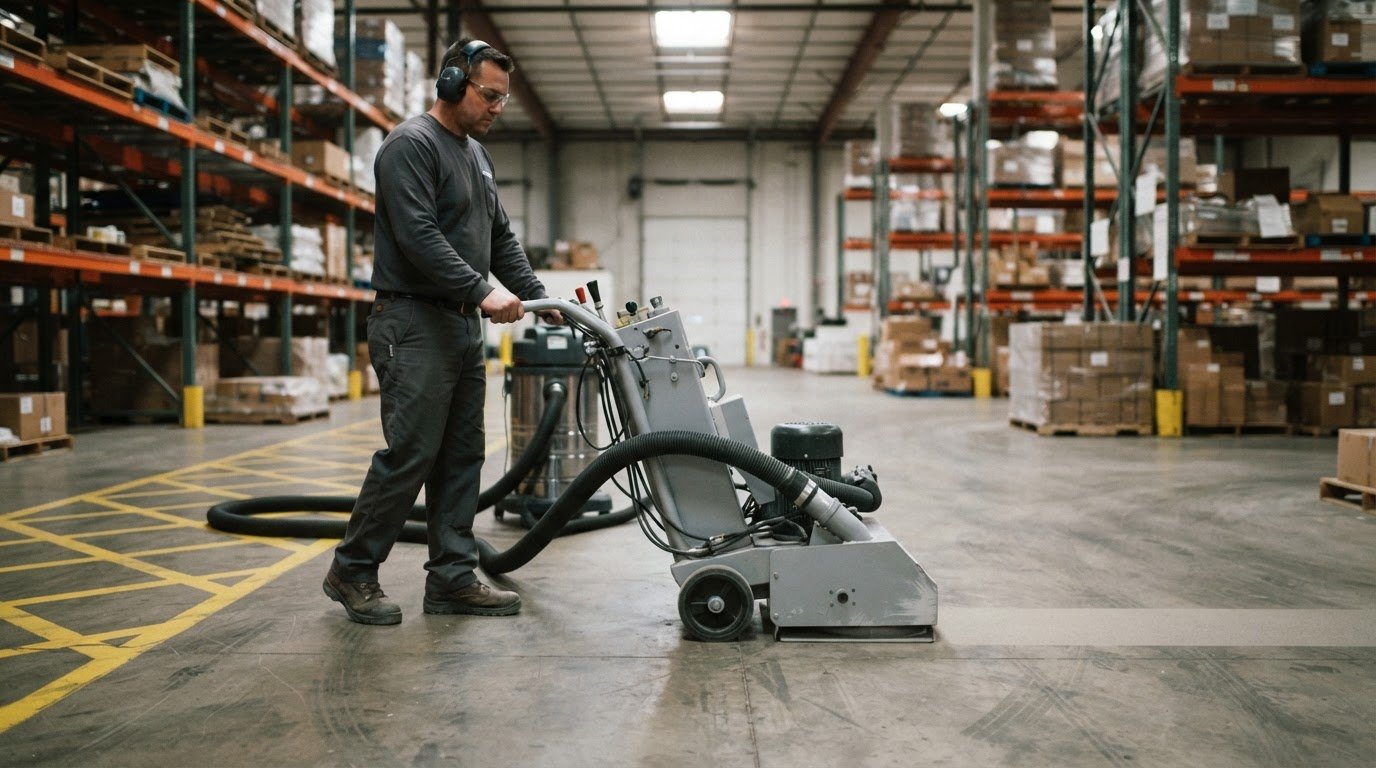
Surface preparation is the most critical phase of professional warehouse line painting. We use the International Concrete Repair Institute (ICRI) standards to determine the correct Concrete Surface Profile (CSP), which is a numerical rating from 1 to 9 that measures the texture of the slab. For high-durability epoxy striping, we typically target a CSP 2 or 3. This requires diamond grinding (using industrial diamonds to remove the top layer of concrete) to ensure the resin can penetrate the pores of the floor. If we don’t remove old, failing lines mechanically, you’ll experience “ghosting.” This occurs when the old markings telegraph through the new ones, eventually leading to delamination because the new paint is only as strong as the failing layer beneath it.
For food-grade facilities or clean rooms, we prioritize dustless preparation. We utilize industrial vacuums equipped with HEPA filtration connected directly to our grinders to capture 99.97% of particles at the source. This ensures your inventory remains uncontaminated while we create the mechanical bond necessary for long-term durability. Since 1994, we’ve refined these methods to provide a clean, safe environment for every project.
Shot Blasting vs. Diamond Grinding
Selecting the right preparation method depends on the condition of your slab and the thickness of the planned coating. Shot blasting uses high-velocity steel pellets to deep-clean the concrete and create a heavy profile, making it the gold standard for thick-film coatings. Diamond grinding is more precise for standard striping and works best for smoothing out pitted or uneven surfaces. Below is a comparison of these industrial methods:
| Method | Best Use | Dust Level | Bond Strength |
|---|---|---|---|
| Shot Blasting | Heavy-duty/thick coatings | Low (contained) | Extreme |
| Diamond Grinding | Striping/Thin-mil epoxy | Very Low (HEPA) | High |
Chemical Cleaning and Densifiers
When concrete is oil-saturated from years of forklift use, mechanical preparation alone might fail. We use specialized industrial degreasers and densifiers (chemicals that react with the concrete to increase surface density) to stabilize the substrate before painting. We never use acid etching because it introduces moisture and produces inconsistent results that jeopardize your investment. This level of technical detail ensures your facility meets OSHA Compliance and Warehouse Safety Layouts without the risk of premature peeling. If you’re unsure which method fits your floor, you can request a facility assessment to see our specialized approach in action.
OSHA Compliance and Warehouse Safety Layouts
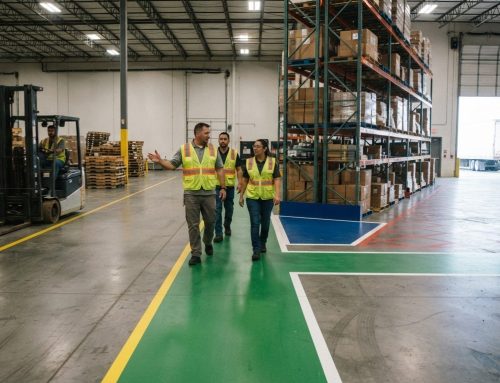
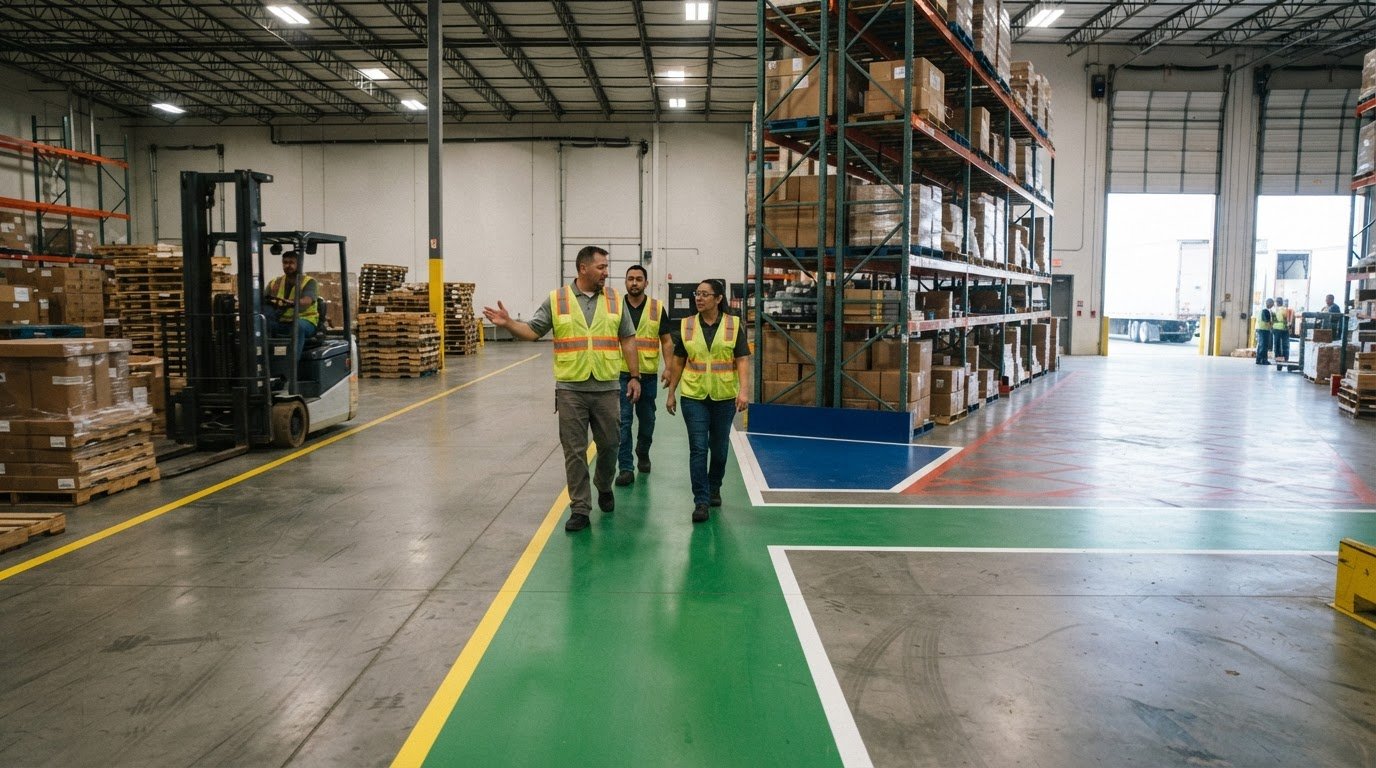
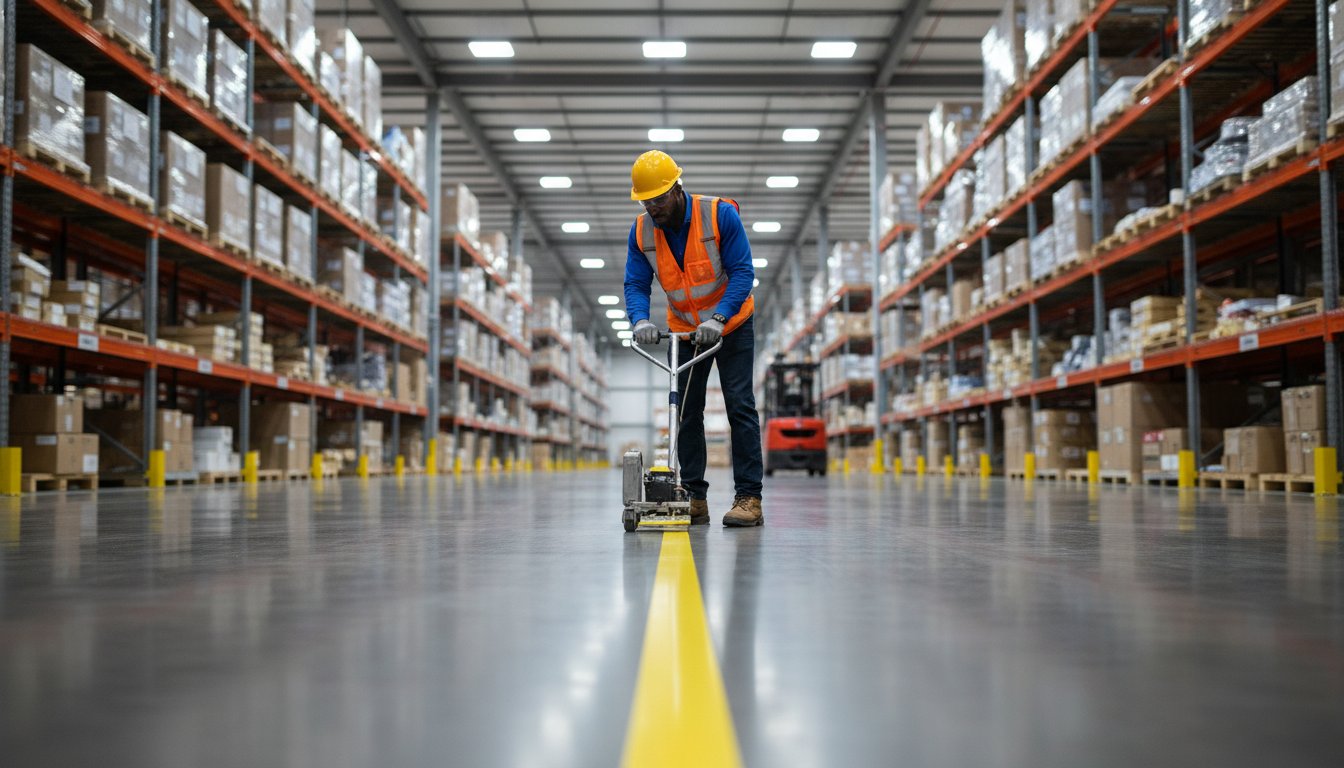
Adhering to OSHA standard 1910.22 is a legal necessity for any facility manager. This regulation mandates that all permanent aisles and passageways must be appropriately marked to ensure safe passage for both personnel and mechanical equipment. Professional warehouse line painting provides the visual structure required to meet these federal mandates. Beyond simple compliance, clear boundaries have a significant psychological impact on forklift operator behavior. When an operator sees a crisp, 4-inch boundary, they’re statistically more likely to respect the designated traffic lane, which reduces the risk of collisions in high-traffic zones.
A critical component of any safety layout is the identification of paths of egress (safe exit routes that remain unobstructed during emergencies). These paths must be clearly defined and lead directly to an exit. Since 1994, our team has applied the triad of safety, quality, and communication to help facilities navigate these complex requirements. To audit your current floor markings, use this checklist:
- Are all aisles at least 3 feet wider than your largest equipment?
- Are pedestrian walkways physically separated from forklift lanes?
- Are fire extinguishers and electrical panels marked with “no-blocking” zones?
- Are your lines at least 2 inches wide (though 4 inches is the industry standard for visibility)?
The Standard Industrial Color Code
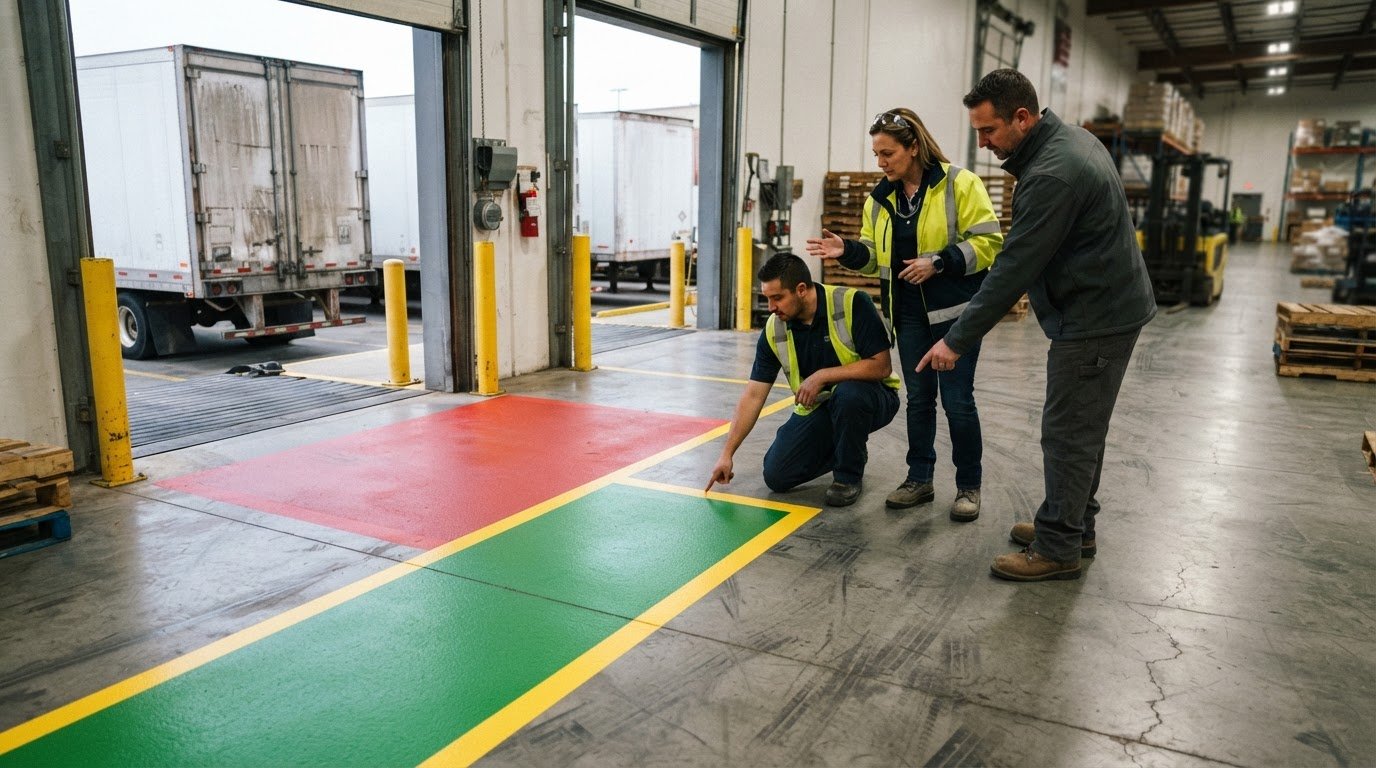
While OSHA doesn’t mandate a specific color for every scenario, most facilities follow industry standards for floor marking colors to maintain a universal language of safety. Using a consistent color palette ensures that employees can identify hazards instantly without reading a sign.
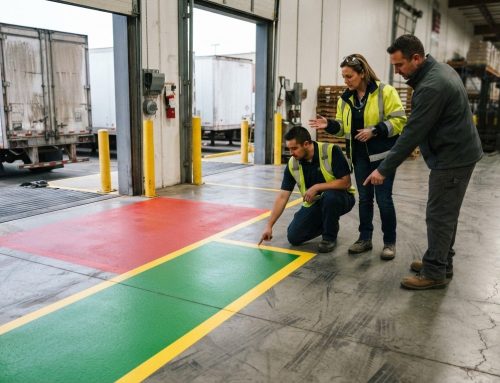
- Yellow: Used for traffic lanes, aisle-ways, and work cells to denote caution.
- Red: Reserved for fire equipment, danger zones, and emergency stop areas.
- Blue or Green: Typically used for information zones, first aid stations, and safety equipment storage.
Optimizing Traffic Flow and Pedestrian Safety
Effective facility layout design goes beyond straight lines. We specialize in creating “no-go zones” around hazardous areas like battery charging stations and heavy machinery. By using specialized stencils for directional arrows and pallet positions, we help reduce congestion and improve the efficiency of your forklift flow. We recommend 4-inch wide lines for standard visibility because they’re easier to see from a distance in dimly lit warehouse environments. This structured approach minimizes operational friction and ensures your facility remains a safe, productive environment for all staff.
Execution Logistics: Painting Without Stopping Production
A primary concern for facility managers is the potential for operational downtime during a safety upgrade. We address this logistical stress through our “day and night” availability, ensuring that warehouse line painting fits into your specific shipping schedule rather than disrupting it. Since 1994, we’ve successfully managed national projects by utilizing a phased installation approach. This means we isolate specific zones of your facility, allowing forklift traffic to continue in neighboring aisles while our crews perform surface preparation (mechanically roughing up the concrete) and coating application. Communication is the third pillar of our safety, quality, and communication triad; we provide real-time updates so your team knows exactly when a zone is ready for traffic.
Curing times are a critical variable in project scheduling. Standard high-solids epoxy typically requires 8 to 12 hours of cure time before it can handle light foot traffic, and up to 24 hours for heavy forklift loads. For facilities that cannot afford a full day of closure, we offer polyaspartic coatings. These specialized materials can cure in as little as 2 to 4 hours, allowing for rapid return-to-service. We analyze your traffic flow to recommend the material that balances your need for durability with your operational timeline. We focus on functional outcomes that prioritize your time and budget.
Managing Fumes and Air Quality
Maintaining air quality is paramount, especially in food-grade facilities or pharmaceutical distribution centers. We use low-VOC (volatile organic compounds) and solvent-free epoxies to eliminate the harsh odors often associated with industrial painting. In cold storage environments, we implement specific ventilation strategies to ensure proper curing at low temperatures. For areas exposed to harsh battery acids or industrial cleaners, we utilize novolac epoxy (a highly cross-linked resin designed for extreme chemical resistance). This ensures the markings remain intact even in the most corrosive environments without compromising the health of your staff.
The StripeGuys Mobilization Process
Handling multi-state distribution centers requires a disciplined mobilization strategy. Our process begins with a detailed pre-project walk-through to identify “high-friction” zones, such as tight turn radiuses where forklifts exert the most shear force on the floor. We adjust our preparation intensity in these areas to ensure a deeper mechanical bond. Following the installation, we provide post-installation inspections to ensure every path of egress meets our quality standards. If you’re ready to upgrade your facility without pausing production, schedule a consultation with our project managers to discuss your 24/7 operational needs.
Why Experience Matters: The StripeGuys Industrial Advantage
Selecting a contractor for warehouse line painting is a decision that impacts your facility’s safety and your bottom line for years. Since 1994, we’ve focused exclusively on the physical realities of forklift environments, providing a level of seasoned expertise that general painting companies cannot match. We don’t just apply paint; we act as safety-conscious consultants who prioritize functional outcomes over aesthetic flair. This consultative approach allows us to align your floor markings with both your operational needs and your specific budget constraints.
Our reliability is rooted in the safety, quality, and communication triad that has defined our work for nearly three decades. We understand the high stakes of industrial environments, where a single missed deadline or a failing path of egress can lead to significant logistical stress. Because we’ve navigated the industry since 1994, we’ve developed the specialized skills necessary to manage complex, high-profile projects (installations involving hundreds of thousands of linear feet) without compromising on quality or safety.
Nationwide Coverage for Large-Scale Facilities
Corporate clients with multi-state footprints require a single-source contractor to maintain consistency across their entire network. We provide nationwide coverage for airports, distribution hubs, and massive manufacturing plants, ensuring that every facility adheres to the same marking standards. This consistency simplifies the work of property managers and ensures that employees moving between locations encounter familiar safety layouts. By handling the logistics of multi-location mobilization ourselves, we alleviate the administrative burden on your team while maintaining a steady beat of reliable service.
A Legacy of Safety and Reliability
Our longevity in the industry is a shorthand for reliability. Having worked in this specialized field for nearly three decades, our veteran crews have the experience to prevent common rookie mistakes, such as misjudging the bond strength of a specific concrete densifier. We maintain extreme accessibility throughout the project lifecycle; you can always reach out to us day or night. We even invite you to text our company directly for immediate answers to your logistical questions. If you’re ready to secure your facility with durable, OSHA-compliant markings, Get a Professional Warehouse Striping Quote to start your facility assessment today.
Secure Your Industrial Facility with Durable Safety Systems
Achieving a high-performance floor layout requires moving past temporary fixes and focusing on a mechanical bond that survives years of heavy forklift traffic. We’ve established that durable results depend on proper concrete profiling and a disciplined approach to OSHA 1910.22 compliance. Since 1994, major distribution centers have trusted us to deliver specialized, long-term solutions that protect both staff and budgets. Our national crews remain available 24/7 to handle your most complex logistics without stopping your production flow.
Professional warehouse line painting is an investment in your facility’s long-term organization and safety culture. By prioritizing functional outcomes and technical surface preparation, you eliminate the stress of constant re-striping and potential safety violations. We’re ready to act as your safety-conscious consultant to optimize your facility’s efficiency and traffic flow. Request Your Industrial Striping Evaluation Today and let our nearly three decades of experience secure your operation. We look forward to helping you build a safer, more productive environment that meets every federal standard.
Frequently Asked Questions
What is the most durable material for warehouse floor striping?
High-solids epoxy and polyaspartic coatings are the most durable materials for warehouse line painting. These resins offer superior resistance to friction shear and tire burn caused by 9,000-pound forklifts. While standard traffic paint sits on the surface, these industrial systems penetrate the concrete pores for a permanent bond that lasts 3 to 5 years.
How long does warehouse line painting take to cure before forklifts can drive on it?
Cure times depend on the specific resin used for your facility. Polyaspartic coatings allow for a rapid return-to-service in as little as 2 to 4 hours. Standard high-solids epoxy systems generally require 8 to 12 hours for foot traffic and a full 24 hours before heavy mechanical handling equipment can safely operate on the new markings.
Does OSHA require specific colors for warehouse floor markings?
OSHA standard 1910.176 requires that permanent aisles be appropriately marked but does not mandate a specific color code. Most facilities follow the ANSI Z535 voluntary standard, using yellow for traffic lanes and red for fire protection equipment. We recommend 4-inch wide lines to ensure maximum visibility and adherence to federal safety guidelines.
What is the difference between shot blasting and diamond grinding for floor prep?
Shot blasting uses steel pellets to create a heavy profile for thick-film coatings, while diamond grinding uses industrial diamonds to smooth out pitted concrete. For most warehouse line painting projects, diamond grinding is the preferred method for “roughing up the smooth surface.” This ensures epoxy adhesion without the aggressive surface damage caused by shot blasting.
Can you paint warehouse lines in cold storage or freezer environments?
Yes, we apply specialized low-temperature resins like polyurea that are engineered to cure in temperatures as low as -20 degrees Fahrenheit. This allows for safety upgrades in cold storage hubs without requiring a full temperature pull-up. Maintaining these markings ensures your freezer environment remains organized and OSHA-compliant without wasting energy on facility shutdowns.
How much does warehouse line painting cost per linear foot?
Professional warehouse striping typically costs between $2 and $4 per linear foot in 2026. This rate includes mechanical surface preparation and high-performance industrial coatings. While DIY options appear cheaper, they lack the mechanical bond of professional systems, often leading to a 200% increase in long-term maintenance costs due to frequent peeling.
How often should warehouse floor markings be refreshed?
High-durability epoxy systems should be refreshed every 3 to 5 years depending on your specific forklift traffic volume. If your facility uses standard traffic paint, you’ll likely need to re-stripe every 12 months to maintain safety standards. Since 1994, we’ve focused on extending this lifecycle through superior surface preparation and high-performance resins.
Do you provide line removal services for old, peeling paint?
We provide full mechanical line removal services to eliminate failing paint and prevent “ghosting” (where old lines telegraph through the new ones). We use diamond grinders equipped with HEPA vacuums to remove every trace of previous markings. This process ensures your new safety system bonds directly to the structural concrete for maximum longevity.