With the warehousing industry reporting 4.8 recordable injuries for every 100 full-time workers (a rate more than double the private sector average), an oversight in your safety layout is a significant liability. It is difficult to manage high-traffic facilities while worrying about OSHA safety audits and the constant threat of forklift-pedestrian accidents. You need a warehouse floor marking color code that functions as a silent supervisor to direct traffic and mark hazards. We understand that logistical stress increases when lines fade or standards become confused, which is why we prioritize functional outcomes that protect your personnel and your budget.
This 2026 guide will help you master industry-standard color codes to ensure total OSHA compliance and peak operational flow. We provide the technical clarity required to bridge the gap between mandatory OSHA regulations and ANSI best practices. You will learn the specific meanings of the standard color palette, the durability benefits of professional epoxy (a high-performance resin coating) over hardware-store tape, and the maintenance thresholds required to pass every inspection. This article provides a clear roadmap for a facility that remains safe, organized, and efficient for years to come.
Key Takeaways
- Understand the critical intersection between OSHA 1910.144 mandates and ANSI Z535.1 best practices to ensure your facility passes every safety audit.
- Implement a standardized warehouse floor marking color code to clearly differentiate between pedestrian walkways, forklift lanes, and hazardous equipment zones.
- Evaluate the five-year total cost of ownership for marking materials, prioritizing professional epoxy applications to ensure durability under heavy industrial traffic.
- Adopt a phased re-striping strategy that allows for facility modernization without interrupting 24/7 operational workflows or causing costly downtime.
- Leverage the expertise of a national industrial contractor to maintain consistent safety standards and visual layouts across multi-site logistics portfolios.
The Standardized Warehouse Floor Marking Color Code for 2026
A standardized warehouse floor marking color code is a foundational element of industrial infrastructure that transforms a chaotic floor into a controlled environment. In modern logistics, these markings serve as a visual communication system that functions without the need for constant supervision. By establishing clear boundaries, facility managers can direct the flow of heavy machinery and protect pedestrian traffic simultaneously. For maximum visibility and durability, the industry benchmark remains line widths between 2 and 4 inches. This specific width ensures that markings are prominent enough to be seen from the seat of a forklift while remaining narrow enough to conserve valuable floor space.
OSHA vs. ANSI: Navigating Regulatory Requirements
Safety managers often find themselves caught between mandatory regulations and industry best practices. OSHA standard 29 CFR 1910.144 is the legal baseline, specifically requiring red for fire protection and danger, and yellow for caution and physical hazards. However, OSHA is relatively narrow in its scope. To achieve a truly efficient facility, most professionals look to the ANSI Z535.1 standard. This expanded palette allows for a more nuanced 5S workplace organization strategy, using colors like green for first aid and white for general storage. Failing to clearly mark permanent aisles and passageways where mechanical equipment is used is a direct violation of OSHA 1910.176(a), which can result in significant fines during a safety audit.
The Financial Impact of Standardized Markings
Implementing a professional warehouse line striping plan is a strategic investment that yields measurable ROI. Clear visual boundaries drastically reduce the frequency of forklift-pedestrian accidents, which are among the most expensive workplace injuries to resolve. Beyond safety, standardized layouts decrease onboarding time for new staff because the floor itself provides the necessary directional cues. Many commercial insurance providers also recognize the risk-mitigation value of compliant markings, often leading to lower premiums for facilities that demonstrate a commitment to standardized safety protocols.
As we move through 2026, the rise of automated facilities has increased the demand for high-contrast markings. Autonomous Mobile Robots (AMRs) and Automated Guided Vehicles (AGVs) rely on clear, consistent lines to navigate safely alongside human workers. A well-executed color code ensures that your facility is prepared for both current regulatory demands and future technological integration.
Interpreting the Industrial Color Palette: A Functional Breakdown
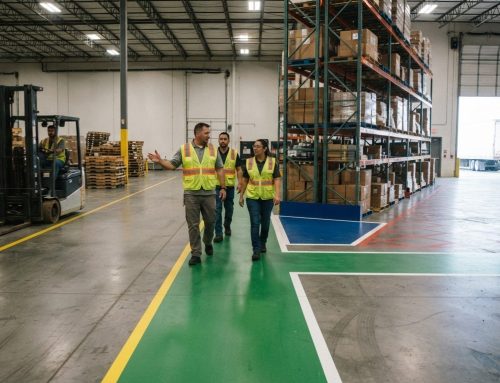
Every color on your floor should communicate a specific command or warning to your staff. While OSHA provides the legal framework, a comprehensive warehouse floor marking color code utilizes the ANSI Z535.1 Safety Color Standard to eliminate guesswork. This system categorizes markings into two primary groups: safety colors that signal immediate hazards and organizational colors that define workflow and storage boundaries. Consistency is the goal. When an employee sees a specific color, they should immediately know the protocol for that area without checking a manual or asking a supervisor.
Primary Safety and Traffic Colors
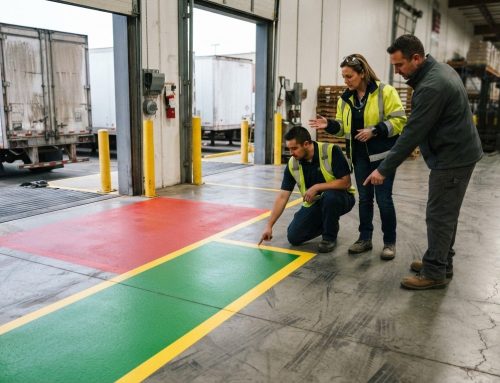
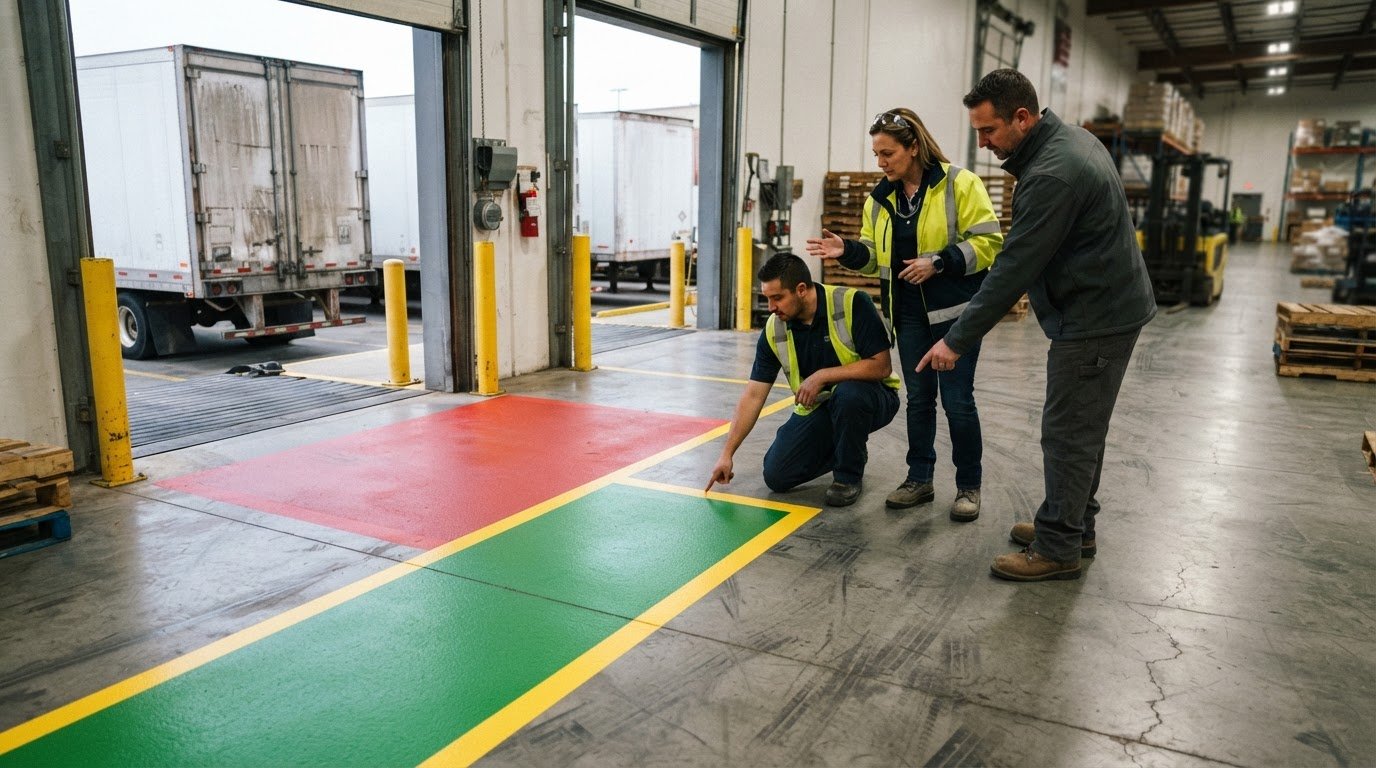
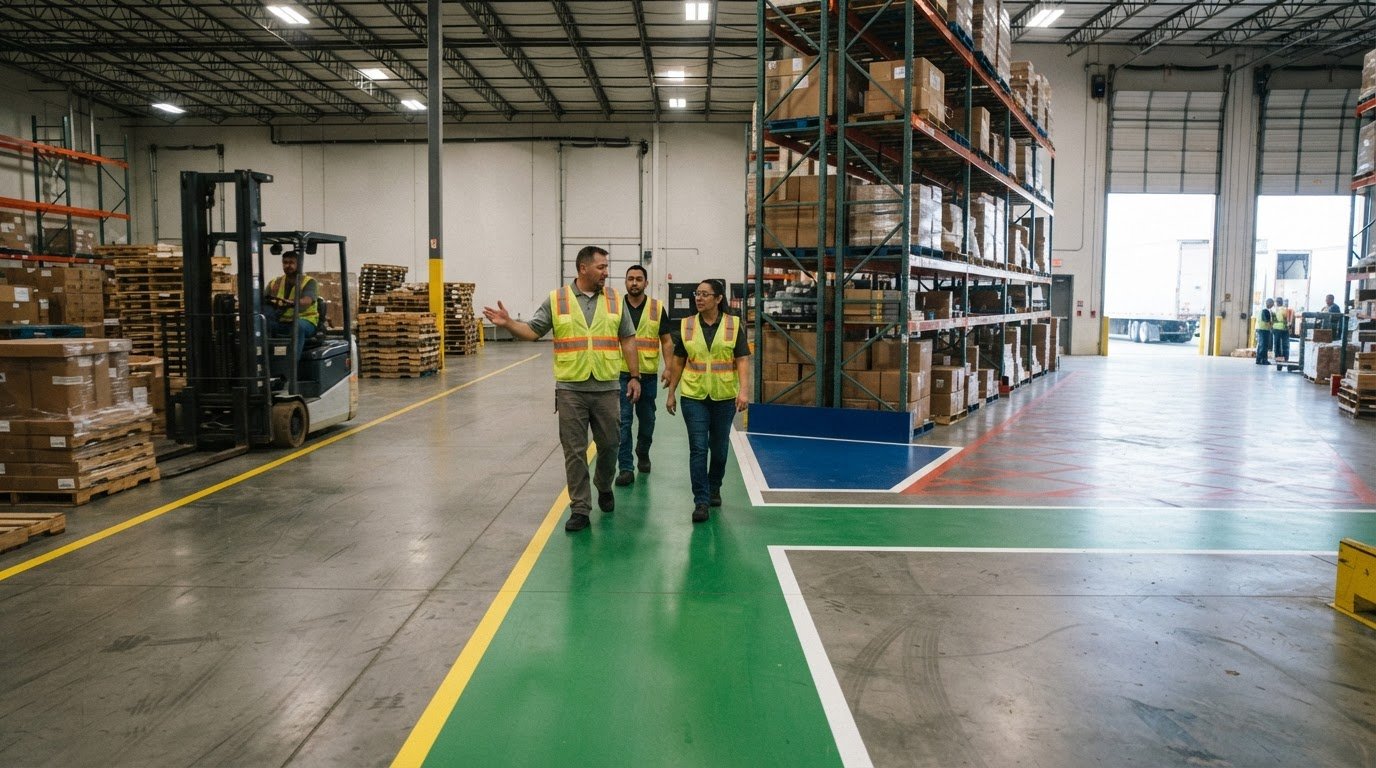
Safety-critical colors are non-negotiable because they prevent collisions and identify life-saving equipment. Yellow remains the standard choice for delineating main traffic lanes, work cells, and pedestrian walkways. Red is strictly reserved for fire protection equipment, emergency exits, and “Do Not Enter” zones where unauthorized access poses a danger. We use Orange to identify energized equipment or dangerous machine parts that require specialized training to operate. For areas with physical hazards like low clearance, protruding equipment, or tripping risks, we utilize “Tiger Tooth” (Black and Yellow) diagonal stripes to command immediate attention from forklift operators and foot traffic alike.
Organizational and Specialty Zone Colors
Operational efficiency relies on clear visual cues for inventory and equipment placement. Blue is often designated for raw materials, works-in-progress, or specialized zones like forklift battery charging areas. Green identifies finished goods and safety equipment locations such as first-aid kits and eyewash stations. White serves as the general-purpose marker for production equipment, racks, and office boundaries. We also implement custom stenciling for pallet positions and dock numbering to ensure every square foot of your facility is accounted for. Implementing a consistent warehouse floor marking color code reduces confusion and speeds up throughput. If you aren’t sure which layout maximizes your space, you can consult with our safety layout experts to design a compliant system that fits your specific operational needs.

Material Selection: Why Industrial Paint Outperforms Tape
Choosing the right material for your warehouse floor marking color code determines whether your safety system lasts for years or just a few months. While many hardware providers suggest heavy-duty floor tape for its ease of installation, this material often fails at forklift pivot points and high-traffic loading docks. Tape tends to peel or “flag” when subjected to heavy pallet dragging or the constant shearing forces of industrial machinery. Professional-grade paint, specifically two-part epoxy, bonds directly to the concrete substrate to provide a permanent solution that resists physical abrasion.
Epoxy and Solvent-Based Coatings for Longevity
Industrial solvent-based paints are necessary for proper concrete adhesion in facilities that operate 24/7. These materials are far superior to standard acrylics because they penetrate the surface pores. For specialized environments, such as forklift battery stations, acid-resistant coatings protect the concrete from chemical spills that would instantly dissolve adhesive tape. Consider these durability benchmarks:
- Lifespan: Professional epoxy typically lasts 36 months in high-traffic zones, whereas tape often requires replacement every 6 months.
- Chemical Resistance: Essential for maintaining compliance with OSHA 29 CFR 1910.144 in hazardous material handling areas.
- Bond Strength: Solvent-based markings are immune to the edge-lifting common with adhesive products.
Implementing epoxy warehouse striping ensures your color codes remain vibrant and compliant without the constant need for manual patch repairs.
Surface Preparation: Shot Blasting vs. Grinding
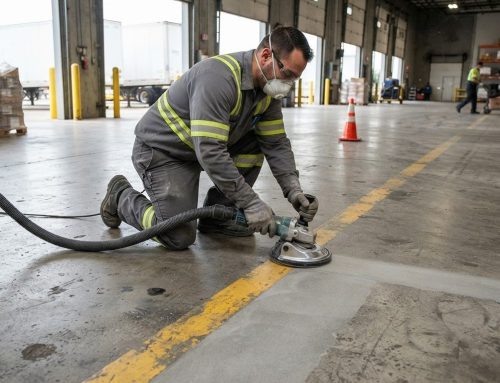
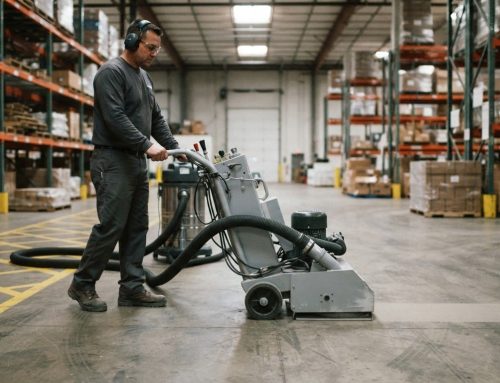
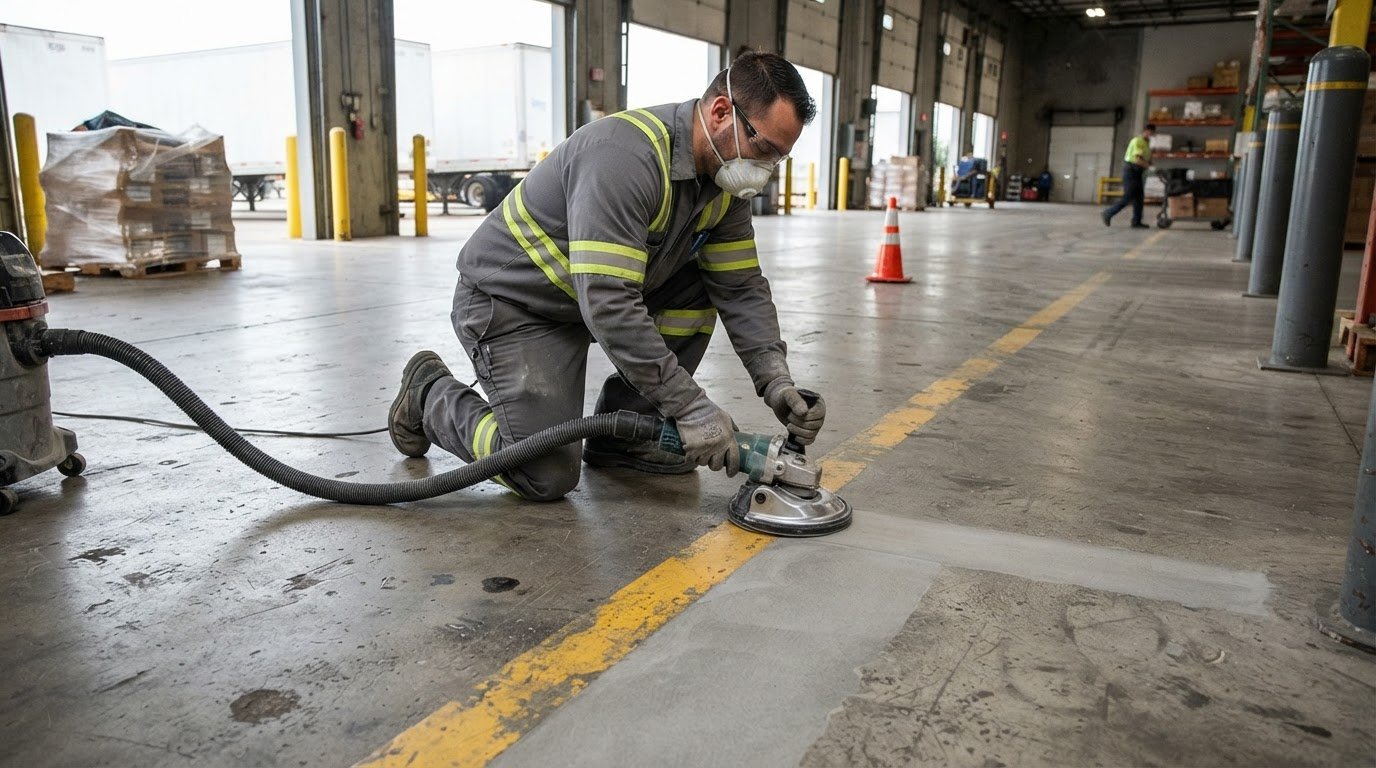
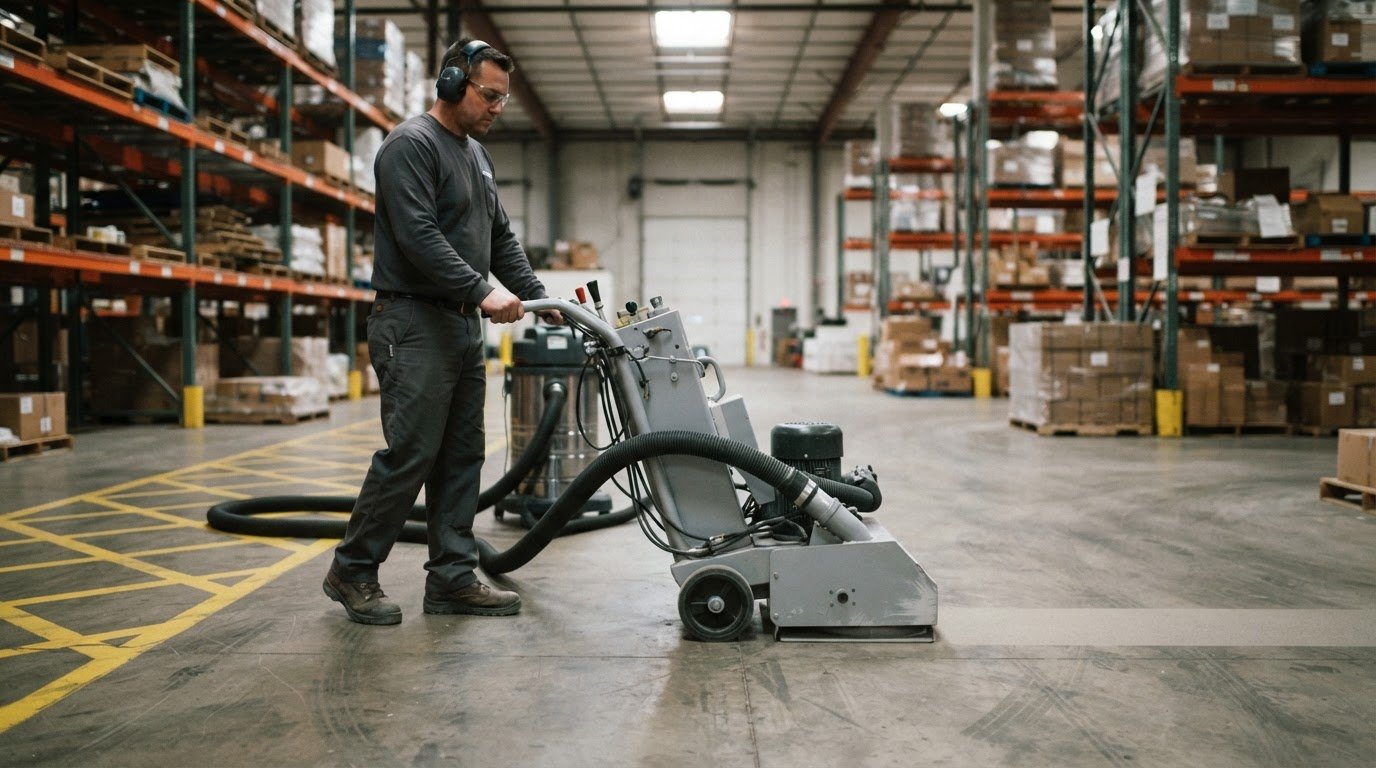
The secret to a durable warehouse floor marking color code isn’t just the paint; it’s the preparation. Mechanical removal of old lines is mandatory for any 2026 facility upgrade to prevent “ghosting.” Ghosting occurs when the remnants of previous markings are visible under new paint, creating confusion for operators and safety auditors alike. We use shot blasting to propel high-velocity steel grit against the floor, stripping away old contaminants and creating a specific profile for the epoxy to grip. While grinding can smooth out imperfections, shot blasting provides the superior mechanical bond required for high-performance resins.
Total cost of ownership calculations prove that while professional painting has a higher upfront cost, it saves thousands in labor and material replacement over a five-year cycle. You can request a professional site evaluation to determine the best material and preparation method for your specific floor conditions.
Implementing a Professional Marking Strategy in 2026
Upgrading your facility shouldn’t force a halt in production. Implementing a professional warehouse floor marking color code requires a logistical strategy that respects your 24/7 operational needs. We utilize a phased approach to re-striping, which involves cordoning off specific zones (such as individual work cells or loading docks) to minimize disruption. By coordinating closely with your shift supervisors, we ensure that while one area undergoes surface preparation and painting, the rest of your facility continues to meet its throughput targets. This method prevents the significant revenue loss associated with total facility closures.
To ensure your facility remains ready for a surprise safety audit, follow this final readiness checklist:
- Maintenance Check: Verify that no more than 25% of any safety line is faded, peeling, or obscured by tire marks.
- Hazard Visibility: Confirm that all physical hazards, such as low-clearance beams, are marked with high-contrast black and yellow stripes.
- Width Compliance: Ensure aisle markings maintain the industry-standard width of 2 to 6 inches for maximum visibility.
- Clearance Zones: Check that area in front of electrical panels and fire extinguishers are marked with red and white safety stripes.
Managing National Mobilization and Multi-Site Standards
For logistics managers overseeing multi-regional portfolios, consistency is the primary challenge. Hiring a single point of contact for national warehouse line striping ensures that your safety standards are identical in every state. This standardization simplifies training for employees who move between locations and reinforces brand consistency across your infrastructure. We optimize mobilization fees by scheduling projects along a geographic route, allowing you to secure high-volume pricing while maintaining a rigorous safety layout at every site.
Selecting an Industrial Partner with Proven Tenure
A successful striping project depends on the contractor’s ability to handle the physical realities of industrial concrete. Our 29+ years of experience is critical for managing complex parking garage and warehouse projects that require heavy-duty shot blasting and industrial-grade epoxy. We prioritize functional outcomes by using specialized equipment that traditional parking lot painters don’t possess. This seasoned expertise ensures that your markings don’t just look professional on day one, but stay compliant and durable through years of heavy forklift traffic. Consult with our safety experts on your 2026 marking plan to secure a layout that protects both your personnel and your operational ROI.
Securing Your Facility’s Operational Future
Your facility’s safety layout is a long-term infrastructure investment that directly impacts your bottom line. By mastering the industry-standard warehouse floor marking color code, you eliminate the ambiguity that leads to accidents and regulatory fines. We’ve established that professional epoxy applications (a high-performance resin coating) significantly outperform temporary tape solutions by resisting the daily wear of heavy forklift traffic. Implementing these standards across your entire portfolio ensures a consistent visual language that protects your staff and streamlines your logistics.
StripeGuys Warhouse Line Striping brings over 29 years of industrial expertise to every project, offering national coverage for distribution centers and logistics hubs. We are specialists in OSHA and ANSI compliance, ensuring your markings pass every audit while maintaining peak operational flow. Don’t let fading lines or confusing layouts compromise your facility’s safety. We provide the technical expertise required to modernize your workspace with precision and reliability.
Get a Professional Quote for Your Warehouse Marking Project
Frequently Asked Questions
What is the standard width for warehouse floor marking lines in 2026?
The industry standard for warehouse floor marking lines ranges between 2 and 6 inches in width. While 2 inches is the minimum required for visibility, many high-traffic facilities prefer 4 or 6-inch lines to ensure operators can see boundaries from a distance. This increased width improves safety in areas where mechanical handling equipment operates. Selecting the appropriate width ensures your facility remains compliant with visibility requirements while optimizing floor space.
Does OSHA require specific colors for pedestrian walkways?
OSHA does not mandate a specific color for pedestrian walkways, but standard 29 CFR 1910.176(a) requires that permanent aisles and passageways be clearly marked. Most industrial facilities adopt a yellow warehouse floor marking color code for walkways to signify caution. This alignment with ANSI Z535.1 standards provides a uniform visual language that safety auditors recognize. Using a consistent color for foot traffic helps prevent accidents by separating human movement from heavy machinery.
Can I use any yellow paint for warehouse aisle markings?
You shouldn’t use standard residential or commercial paint because it lacks the chemical bonding properties required for concrete adhesion. High-traffic aisles require industrial-grade solvent-based or two-part epoxy coatings that can withstand the weight and friction of heavy forklifts. Professional-grade paints (coatings designed for industrial durability) prevent the premature peeling and fading that leads to OSHA non-compliance. Investing in the correct material ensures your markings remain vibrant and functional for years rather than months.
How often should warehouse floor markings be refreshed in high-traffic areas?
Floor markings must be refreshed whenever more than 25% of the marking is faded, peeling, or otherwise obscured. In high-traffic zones like loading docks or main thoroughfares, this threshold may be reached more quickly due to constant tire friction and pallet dragging. Regular inspections help identify when your warehouse floor marking color code no longer provides clear direction. Maintaining these lines is essential for passing safety audits and ensuring the continuous flow of facility operations.
Is floor tape or epoxy paint better for 5S color-coding?
Epoxy paint is the superior choice for permanent 5S color-coding because it bonds directly to the floor. While tape is easier to apply initially, it frequently fails under the shearing forces of forklift tires. Professional epoxy applications provide a long-term solution that resists chemicals and physical abrasion. For facilities prioritizing total cost of ownership and 24/7 operational reliability, industrial coatings offer a much higher return on investment than adhesive products.
What color should be used for hazardous chemical storage zones?
OSHA standard 29 CFR 1910.144 specifies that yellow should be used for marking physical hazards and caution. For hazardous chemical storage, many facilities also utilize orange to identify energized equipment or dangerous materials as per ANSI best practices. Combining these colors with specific stenciling provides the highest level of clarity for staff. Using a standardized color code ensures that employees immediately recognize zones that require specialized personal protective equipment or handling procedures.