With an injury rate of 4.8 cases per 100 workers, the warehousing sector remains nearly twice as dangerous as the average private industry. You understand the high stakes of a busy facility where forklift near-misses and loading dock congestion don’t just slow down production; they create significant liability. Implementing a robust warehouse traffic flow management plan is the only way to maintain a safe, organized environment while avoiding OSHA penalties that can now reach $165,514 for willful violations.
This guide provides a professional roadmap to mastering industrial traffic management so you can eliminate operational bottlenecks and protect your workforce. We will examine the specific steps required to create a clear, OSHA-compliant layout that utilizes durable floor markings (industrial-grade applications that resist heavy forklift wear). You’ll also learn about the 2026 regulatory landscape, including California’s AB 98, ensuring your facility remains ahead of new standards and operates with the efficiency of a seasoned industry veteran.
Key Takeaways
- Learn how to develop a comprehensive warehouse traffic flow management plan that balances high-volume operational throughput with strict safety protocols.
- Identify the critical layout components for incident prevention, including total pedestrian-vehicle segregation and one-way traffic systems for narrow aisles.
- Understand why technical surface preparation is the foundation of a successful implementation, accounting for 90% of the longevity of your floor markings.
- Compare the durability of professional-grade epoxy against standard warehouse floor paint to ensure your markings withstand heavy forklift traffic and chemical exposure.
- Establish a proactive quarterly audit and maintenance schedule to maintain OSHA compliance and adapt your facility layout as your logistical needs evolve.
What is a Warehouse Traffic Flow Management Plan?
A warehouse traffic flow management plan is a comprehensive strategic blueprint that dictates the movement of vehicles, pedestrians, and materials within an industrial facility. It functions as the foundation of your operational logic, ensuring that every forklift path and walking route is intentional rather than accidental. The dual purpose of this plan is to maximize operational throughput while simultaneously minimizing safety risks. In 2026, the shift toward high-density automated facilities has made these plans even more critical. Because autonomous robots and AGVs operate with tighter tolerances than human drivers, your facility requires a precise Traffic management strategy to prevent collisions. Professional warehouse floor striping acts as the essential language of the floor, communicating boundaries and right-of-way instructions to everyone in the building.
The Cost of Poor Traffic Management
Poorly planned traffic routes lead to more than just near-misses; they create a massive financial drain. Forklift accidents account for approximately 25% of all warehouse injuries, often resulting in expensive worker compensation claims and equipment repairs. When loading docks become congested due to a lack of clear directional markings, the delays ripple through the entire supply chain, causing missed deadlines and carrier surcharges. Beyond the balance sheet, an unorganized floor impacts your workforce. Employees are more likely to stay with a company that maintains a clean, predictable workspace. A well-executed plan reduces logistical stress and proves you’re a safety-conscious partner invested in their well-being.
OSHA Standards and Legal Requirements
Safety compliance is governed by strict federal standards that demand consistent execution. OSHA regulation 1910.22 requires that all permanent aisles and passageways are kept clear and properly marked to prevent tripping and collision hazards. These markings must be “permanent and clear,” which means that faded or incorrect lines can result in significant fines. As of 2026, OSHA penalties for willful violations can reach as high as $165,514. To maintain compliance for forklift traffic, aisles must be at least three feet wider than the widest equipment in use or maintain a minimum width of four feet. Our pedestrian walkways and safety aisles ensure your facility meets these legal mandates while protecting your most valuable assets.
Key Components of an Effective Traffic Management Strategy
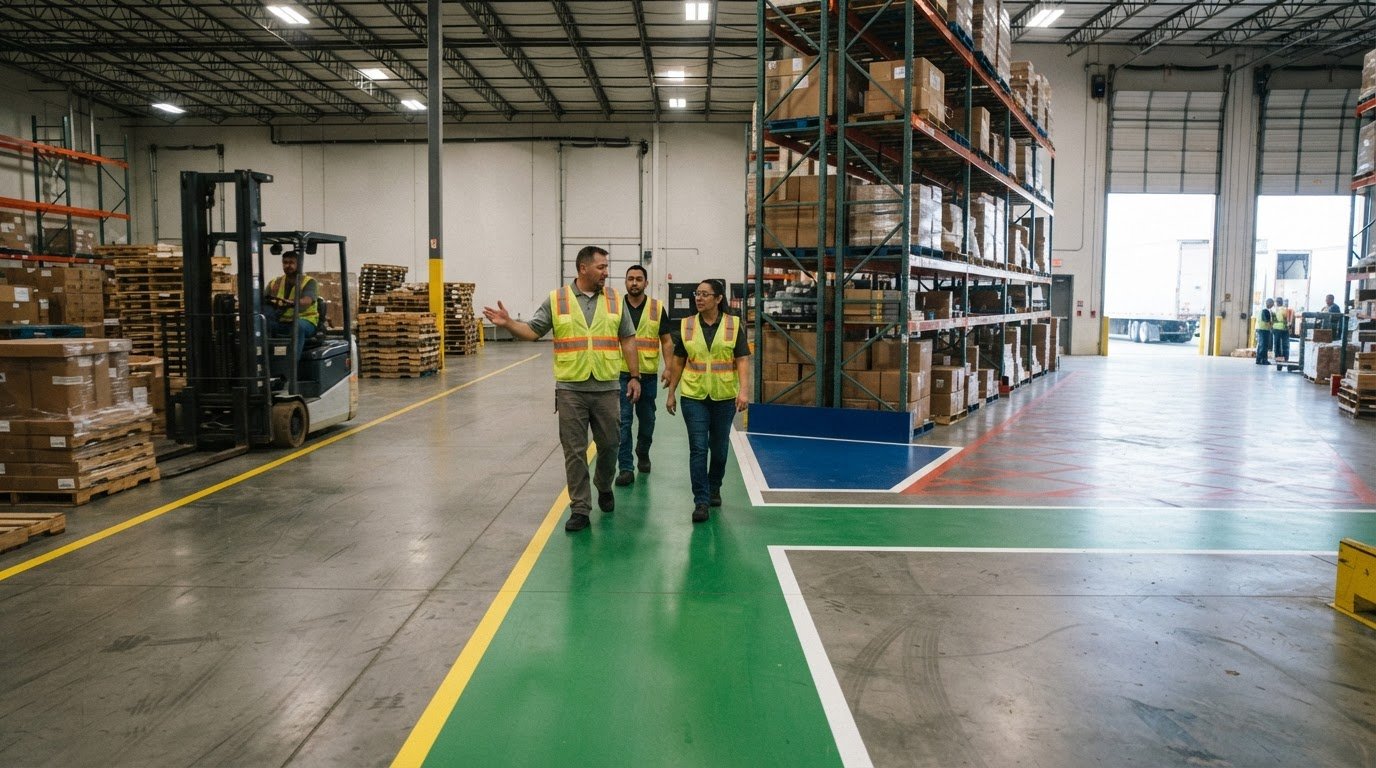
A successful warehouse traffic flow management plan relies on the total segregation of pedestrians and heavy machinery. This is the industry gold standard for risk mitigation. By creating dedicated zones for each, you eliminate the primary cause of forklift-related incidents (which currently account for 25% of all warehouse injuries). One-way traffic systems are another critical component. These systems (predetermined directional paths that prevent head-on vehicle encounters) are particularly vital in narrow aisles where visibility is limited. When vehicles only travel in one direction, drivers can focus on load stability rather than scanning for oncoming traffic.
Designated staging areas and ‘Safe Zones’ for palletized goods prevent clutter from encroaching into active traffic lanes. When inventory spills into aisles, it forces forklift operators to maneuver around obstacles, increasing the likelihood of a collision. Integrating physical barriers like bollards alongside industrial floor markings provides a multi-layered defense. While paint defines the rules, steel bollards (impact-resistant safety posts) enforce them by providing physical protection at structural columns and high-traffic corners.
Pedestrian Walkways and Safety Aisles
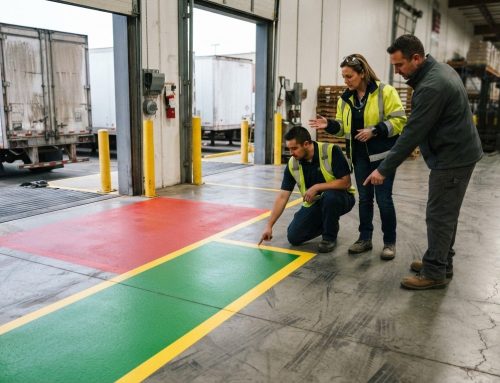
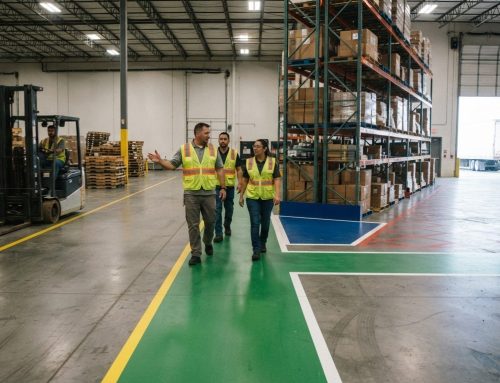
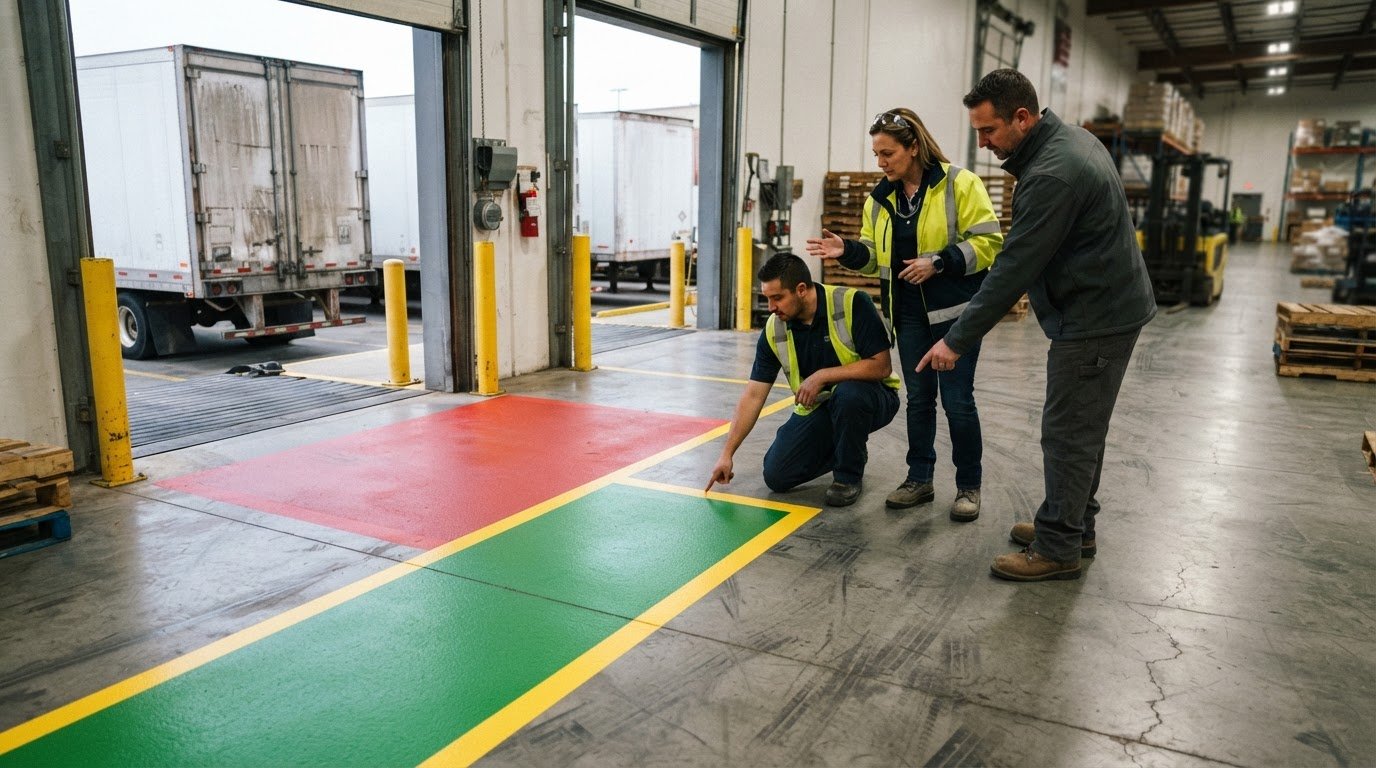
Visual clarity is paramount when designing pedestrian walkways and safety aisles. In high-risk zones, we recommend using solid color fills rather than simple boundary lines. A solid green or yellow walkway is far more visible to a busy operator than a thin stripe. These paths should include ‘stop and look’ points at every aisle intersection and loading dock door. These designated pause areas (visual cues that require personnel to verify clear passage) are essential for preventing blind-spot accidents. If you need assistance designing these critical safety zones, you can reach out to our project consultants for a facility assessment.
Standardized Color Coding for 2026
Consistency across your facility ensures that every worker understands the floor’s ‘language’ instantly. The 2026 industry standards utilize a specific color palette to convey information without the need for excessive signage:
- Yellow: Used for traffic lanes, aisle boundaries, and general work areas to provide maximum visibility.
- Red: Reserved strictly for danger zones, fire suppression equipment, and emergency exits to signal immediate hazards.
- Green: Indicates safety equipment, first aid stations, and designated pedestrian-only walkways.
- Black and Yellow Stripes: Applied to physical hazards that cannot be moved (such as low-hanging structures or fixed machinery) to warn of potential impact.

Implementing the Plan: Floor Striping and Surface Prep
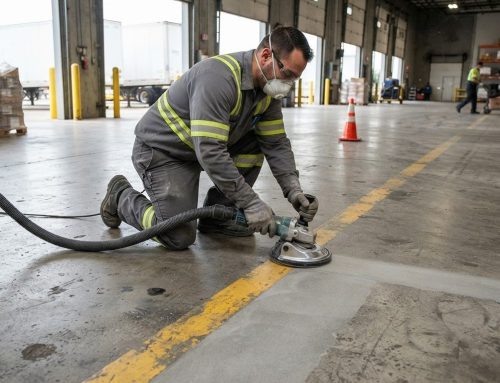
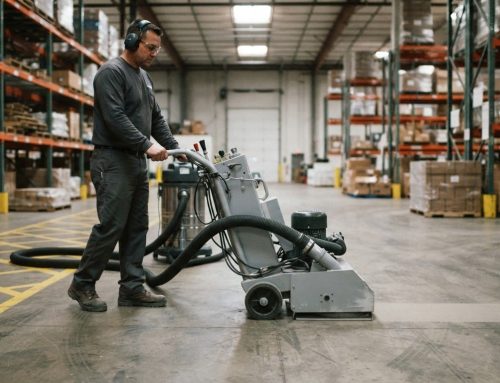
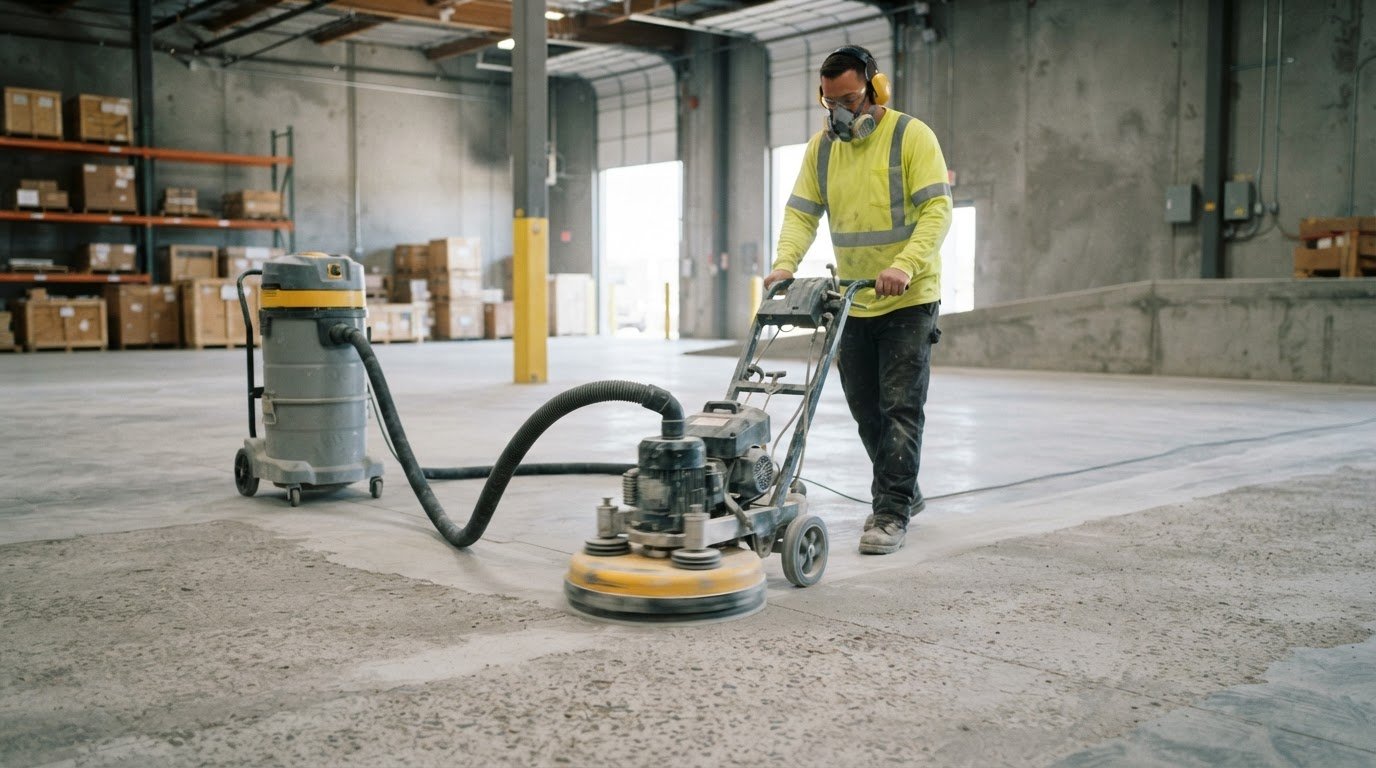
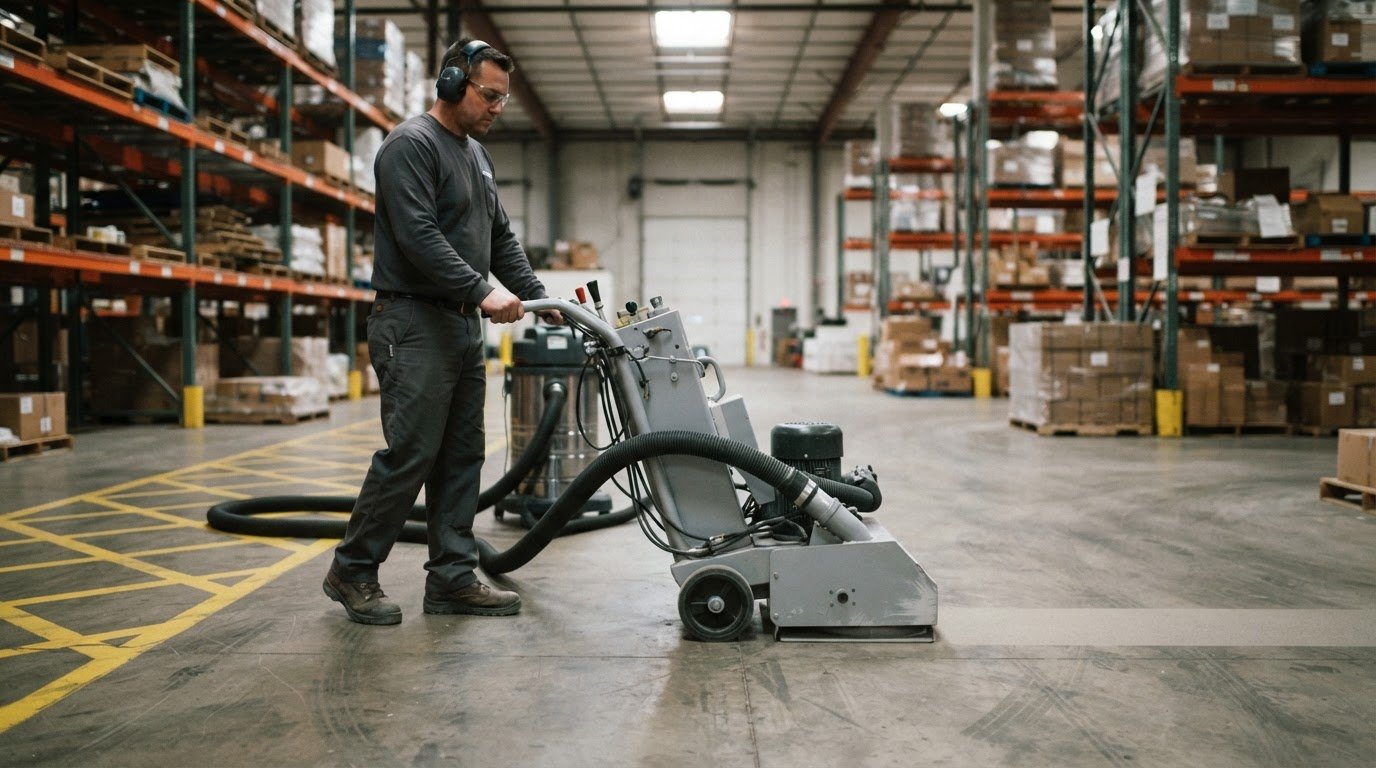
Surface preparation is the most critical phase of any facility upgrade. It represents roughly 90% of a successful warehouse traffic flow management plan implementation. Without proper mechanical preparation, new markings are simply sitting on top of dirt, oils, and old loose paint. This leads to premature peeling under the weight of heavy forklifts and pallet jacks. Professional contractors use specialized equipment like planetary grinders and shot blasters to ensure the floor is ready for industrial-grade applications. A plan is only as effective as the physical lines that enforce it; if those lines fail, the entire traffic strategy collapses.
Mechanical Removal and Shot Blasting
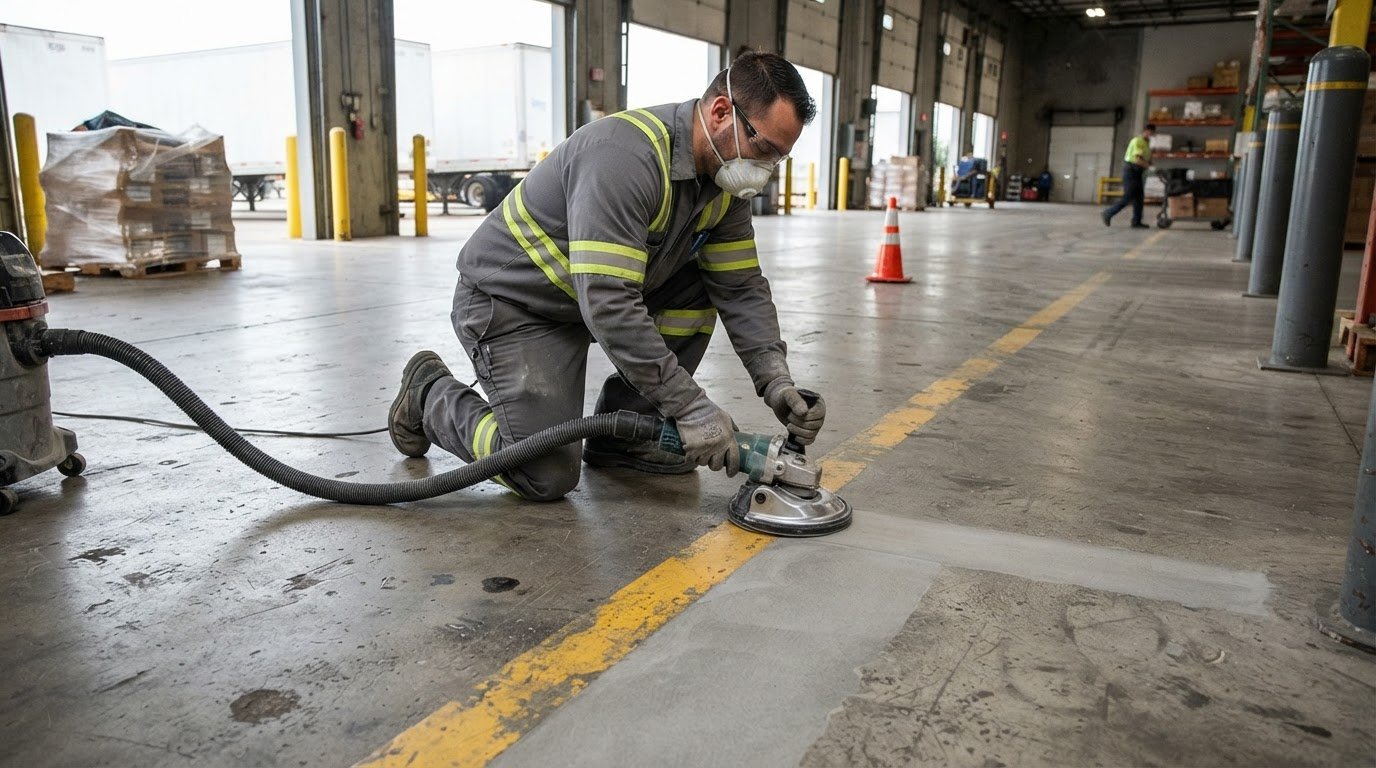
Shot blasting is the preferred method for superior adhesion. This process (which involves firing small steel beads at the floor to strip away contaminants) creates a specific texture or profile that allows epoxy to bond deeply with the concrete. You shouldn’t simply paint over old lines. Doing so creates ghosting, where the old layout remains visible under the new one, causing dangerous operator confusion at critical intersections. In sensitive environments like food-grade or pharmaceutical facilities, we utilize dustless removal technology to maintain strict air quality standards while achieving a perfect surface profile for new markings.
Choosing Materials: Epoxy vs. Paint
The choice of material determines how long your traffic plan remains functional. For high-traffic forklift lanes, epoxy warehouse striping is the standard for long-term durability. While standard warehouse floor paint is a lower-cost entry point, it lacks the chemical resistance and impact strength of a two-part epoxy system. Specialized zones require even more robust solutions. For example, forklift battery charging areas must be treated with acid-resistant coatings to prevent floor degradation from electrolyte spills. Linear footage pricing for these projects varies based on the material complexity and the level of surface preparation required.
If you’re ready to upgrade your facility with markings that withstand the rigors of 2026 logistics, you should contact our industrial striping specialists for a professional quote.
Maintaining Your Traffic Plan and Operational Flow
Establishing a warehouse traffic flow management plan is just the first step in a long-term safety commitment. Industrial environments are dynamic; your facility layout must evolve alongside your inventory levels and equipment upgrades. We recommend establishing a quarterly audit schedule to ensure your markings remain effective and compliant. When you treat your traffic plan as a living document, you prevent the gradual degradation of safety standards that often leads to regulatory citations. This proactive approach ensures that your facility remains a safe, high-performance environment for both personnel and equipment.
The Audit Checklist
A formal audit protects your workforce by identifying hazards before they cause an incident. Your checklist should focus on three primary areas to maintain operational standards:
- Visibility check: Determine if lines are obscured by tire marks, pallet dust, or general warehouse debris. If standard cleaning doesn’t restore clarity, it’s time for a professional refresh.
- Compliance check: Verify that your physical markings still match your current internal maps and fire code requirements. Changes in racking or machinery placement often necessitate layout updates to remain legal.
- Durability check: Inspect heavy-turn forklift zones for chipping or wear. Identifying these areas early allows for targeted maintenance rather than a full facility overhaul.
Managing maintenance in 24/7 facilities requires a strategic approach to minimize operational downtime. We utilize fast-cure materials and phased work schedules that allow you to maintain production while we refresh your markings. By sectioning off small areas at a time, we ensure that your warehouse traffic flow management plan remains active without halting your supply chain. This level of coordination is why facility managers view their striping contractor as a long-term partner in organizational efficiency. We prioritize your schedule to ensure safety upgrades don’t compromise your bottom line.
Scaling the Plan for Nationwide Facilities
For organizations with multiple distribution centers, consistency is the key to safety. Using a single contractor for nationwide projects ensures that a driver in your New Jersey hub encounters the same visual language as a driver in your California facility. This standardization reduces the learning curve for transferred employees and third-party carriers, which significantly lowers the risk of human error. StripeGuys Warhouse Line Striping brings over 29 years of industrial authority to every project, providing the national reach and seasoned expertise required to manage large-scale warehouse floor striping contracts. We provide the reliability of a veteran contractor with the efficiency needed for modern logistics hubs.
Securing Your Facility’s Operational Future
Implementing a comprehensive warehouse traffic flow management plan isn’t just a safety requirement; it’s an investment in your facility’s long-term operational health. By integrating clear pedestrian-vehicle segregation and utilizing durable industrial materials, you protect your workers and your bottom line. We’ve discussed the importance of mechanical surface preparation and the role of standardized color coding, both of which serve to eliminate the confusion that often leads to costly forklift accidents and regulatory fines.
StripeGuys Warhouse Line Striping brings over 29 years of industrial expertise to every project, offering the nationwide reach necessary for large-scale logistics operations. We specialize in developing OSHA-compliant safety marking systems that are built to withstand the physical realities of high-volume distribution centers. Our team handles the technical complexities of layout design and mechanical surface preparation, ensuring your facility operates with the precision of a veteran-managed workspace. We prioritize your operational needs, delivering results that satisfy both safety inspectors and production managers.
Get a Professional Warehouse Striping Quote from StripeGuys Warhouse Line Striping to finalize your facility’s traffic strategy. A safer, more organized environment is the foundation of industrial success, and we are ready to help you achieve it.
Frequently Asked Questions
What are the OSHA requirements for warehouse floor marking colors?
OSHA regulation 1910.144 requires red for fire protection equipment and danger, while yellow is the designated color for caution and physical hazards. While OSHA is less specific about other colors, following a standardized warehouse traffic flow management plan involves using yellow for traffic lanes and green for pedestrian paths to ensure universal understanding. We apply these standardized colors to improve visual communication and reduce reaction times for your equipment operators.
How wide should warehouse aisles be for safe forklift traffic?
Safety standards require aisles to be at least three feet wider than the largest equipment in use, or a minimum of four feet wide if no vehicles are present. For two-way forklift traffic, the aisle must be at least twice the width of the equipment plus additional clearance for safe maneuvering. Proper spacing prevents structural damage and reduces the risk of pedestrian-vehicle collisions in high-density zones where visibility is limited.
Is epoxy better than floor tape for traffic management plans?
Epoxy line painting is superior to floor tape in industrial environments because it creates a permanent chemical bond with the concrete. While tape provides a quick temporary solution, it frequently peels and cracks under the weight of heavy forklift turns; this creates tripping hazards and requires constant replacement. Epoxy withstands chemical spills and heavy machinery, providing a much lower total cost of ownership for your facility over time.
How often should warehouse floor markings be updated or repainted?
Most facilities should perform a formal audit every quarter, though high-traffic forklift lanes often require a professional refresh every 12 to 24 months. Environmental factors like tire scrubbing and aggressive floor cleaning schedules determine the longevity of your markings. You should update your warehouse traffic flow management plan whenever you change your racking configuration or introduce new automated equipment to maintain safety compliance and operational efficiency.
Can I implement a traffic management plan without shutting down operations?
You can implement new markings without halting production by using a phased approach and fast-cure industrial coatings. We coordinate with facility managers to work in specific zones during low-activity periods or off-shifts; this ensures that the rest of your warehouse remains operational. This strategy minimizes downtime while allowing for the precise application of safety markings and directional cues that protect your workforce without sacrificing output.
What is the best way to remove old warehouse floor lines?
Shot blasting line removal is the most effective method because it completely strips old material while preparing the concrete for new adhesion. Painting over old lines is a mistake that leads to ghosting (the faint outline of old markings) and confusion as the top layer wears away. Mechanical removal ensures a clean surface profile, which is essential for the long-term durability and clarity of your new facility layout.