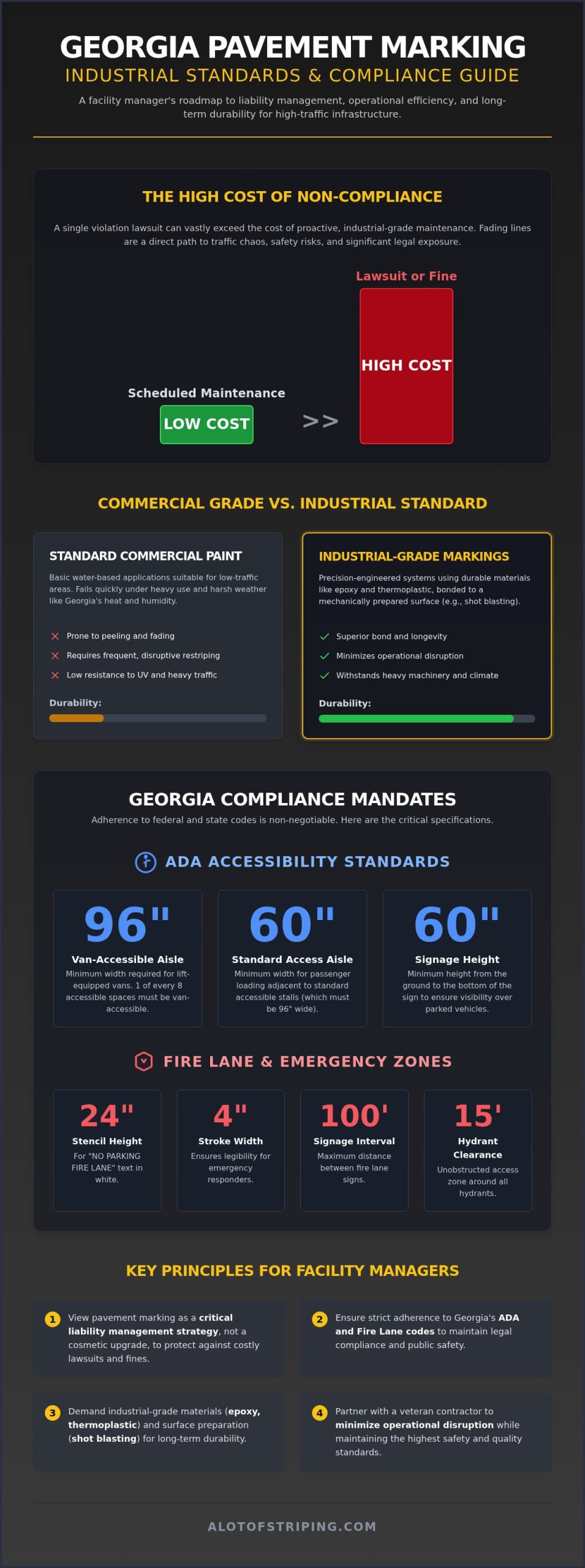
A single ADA non-compliance lawsuit or a Fire Lane violation can cost your facility significantly more than a decade of scheduled maintenance. You likely recognize that fading lines create more than just a messy appearance; they trigger traffic chaos and genuine safety risks for your visitors and staff. Managing a high-traffic facility requires a partner who understands that parking lot striping Georgia is a critical liability management strategy rather than a simple cosmetic upgrade. We understand the logistical stress of coordinating site maintenance while keeping your operations running at full capacity.
This guide provides the industrial-grade standards you need to master Georgia pavement markings, ensuring your facility remains legally compliant and operationally efficient. You’ll learn the precise technical requirements for van-accessible aisles (which must be at least 96 inches wide) and the specific 24-inch stencil heights required for fire lane enforcement. We will also outline how to achieve durable, clear markings that withstand the Georgia climate without disrupting your daily logistics. By the end of this article, you’ll have a clear roadmap for maintaining your infrastructure with the precision of a seasoned industrial veteran.
Key Takeaways
- Understand why transitioning from standard painting to industrial-grade pavement marking is essential for managing liability and traffic flow in high-traffic facilities.
- Learn the specific regulatory requirements for parking lot striping Georgia to ensure your property meets current ADA standards and fire lane codes.
- Discover how mechanical preparation techniques, such as shot blasting, create a superior bond for durable materials like epoxy and thermoplastic.
- Identify strategies to minimize operational disruption during the striping process by leveraging the expertise of a seasoned industrial contractor with 29+ years of experience.
- Gain insights into the operational standards that ensure long-term visibility and safety for your large-scale infrastructure.
The Essentials of Professional Parking Lot Striping in Georgia
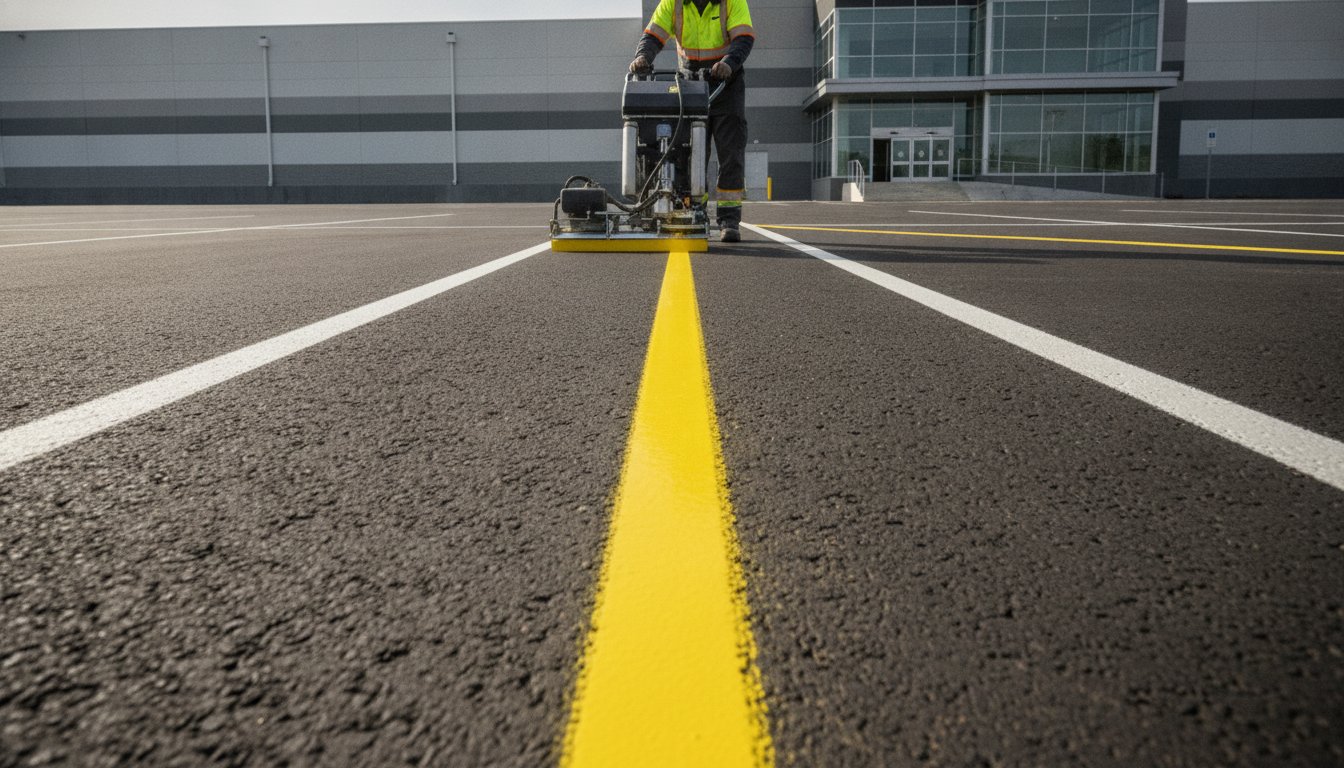
Effective facility management views parking lot striping Georgia as a foundational infrastructure component, not a decorative afterthought. For property managers, clear markings serve as the primary tool for reducing liability by directing traffic safely and preventing pedestrian incidents. Georgia’s specific environmental factors, particularly the high heat and humidity levels, demand a strategic approach to selecting pavement marking materials that won’t degrade or peel prematurely. Standard painting (simple water-based applications) often fails under these intense southern conditions, leading to frequent and costly restriping cycles. Transitioning to industrial-grade pavement marking ensures that your investment remains visible and functional through multiple seasons of heavy usage, extreme UV exposure, and heavy rain cycles common in the region.
Why Quality Striping Matters for Georgia Commercial Property
A well-designed parking layout acts as a silent traffic controller. When lines are crisp and strategically placed, you optimize traffic flow and significantly reduce the risk of low-speed collisions on your property. Precision layout design also allows you to maximize parking capacity without compromising safety margins, ensuring you get the most value out of your available square footage. Maintaining sharp, high-contrast markings reinforces a professional brand image and signals to clients that you prioritize organizational safety and meticulous facility maintenance. It’s a direct reflection of your operational standards.
Commercial vs. Industrial Striping Standards
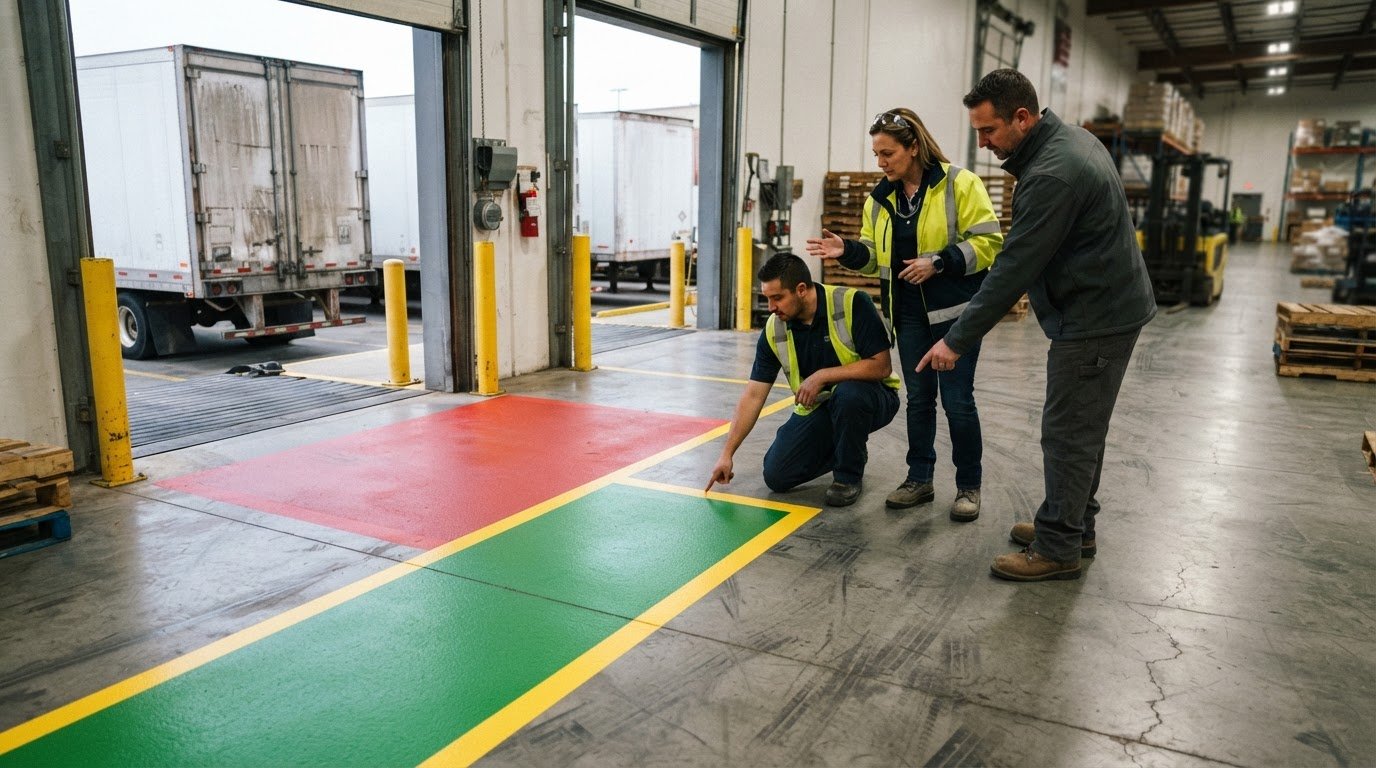
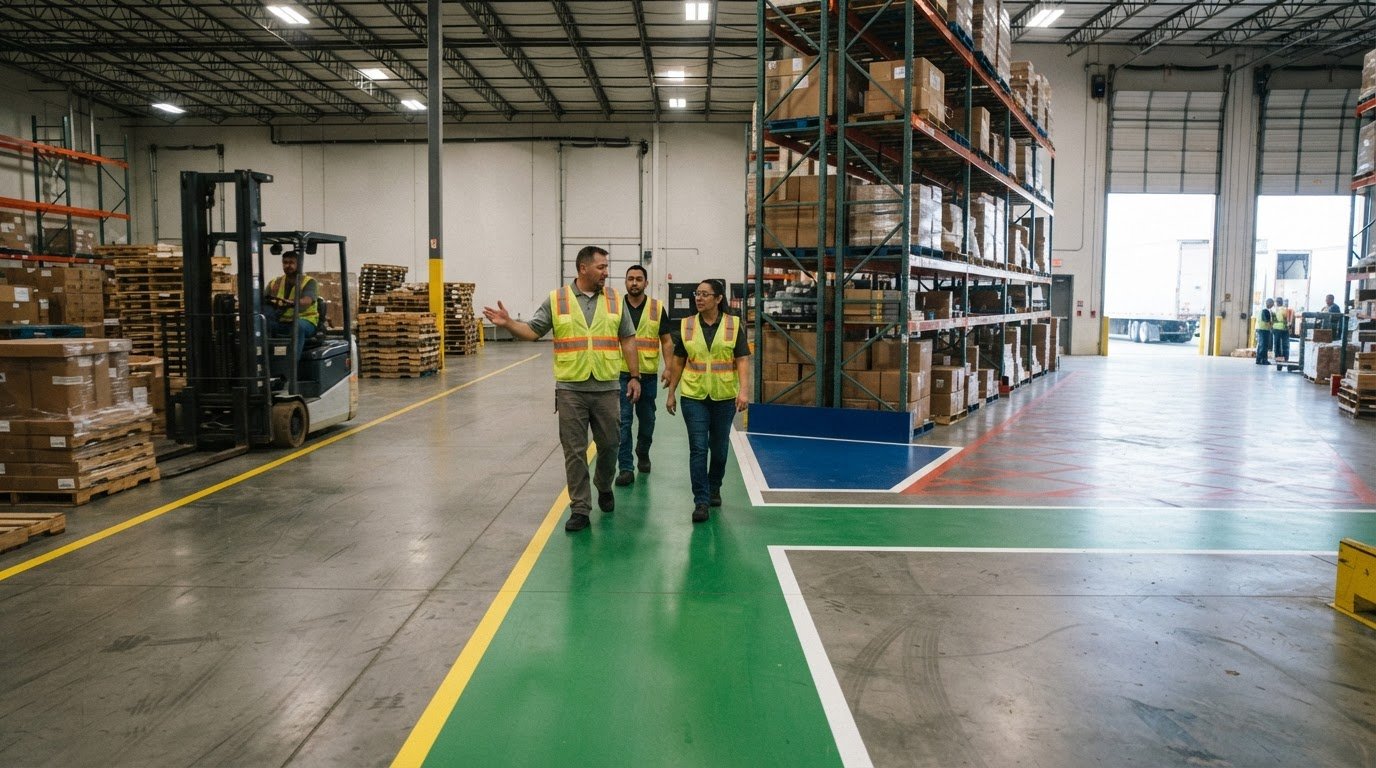
The distinction between commercial and industrial standards involves linear footage and technical layout complexity. High-traffic industrial environments, such as distribution centers or manufacturing plants, require more than basic high-build traffic paint. In these high-stakes settings, epoxy coatings or thermoplastic applications are often necessary to withstand the constant friction of heavy machinery and freight vehicles. Industrial striping is a precision-engineered safety system. Professional parking lot line striping provides the durability required to maintain compliance without the disruption of constant maintenance. Backed by 29+ years of experience, we focus on delivering results that prioritize functional outcomes over aesthetic flair.
Navigating Georgia Compliance: ADA, Fire Lanes, and Safety Standards
Compliance isn’t a suggestion for Georgia facility managers; it’s a legal mandate enforced by the State Fire Marshal and local code authorities. Failure to adhere to these standards exposes property owners to significant liability risks, including ADA lawsuits and heavy fines for fire code violations. Professional parking lot striping Georgia requires a deep understanding of the intersection between federal mandates and specific state ordinances to protect your operational budget and public safety. Non-compliant layouts don’t just look unprofessional; they invite legal scrutiny that can halt your daily operations without warning.
ADA Accessibility Requirements in Georgia
Georgia aligns with federal requirements, meaning one out of every eight accessible spaces must be van-accessible. These specific stalls require an access aisle at least 96 inches wide to accommodate lift equipment. Standard accessible stalls must also be at least 96 inches wide with an adjacent 60-inch access aisle (the designated space for passenger loading). Proper signage is equally critical. ADA-compliant signs must be mounted at least 60 inches above the ground to ensure visibility over parked vehicles. Adhering to the ADA Standards for Accessible Design helps prevent traffic chaos and ensures your facility remains accessible to all visitors.
Fire Lane and Emergency Zone Markings
Georgia fire code dictates precise standards for emergency access zones. Curbs designated as fire lanes must be painted red and feature “NO PARKING FIRE LANE” stenciling in white. These letters must be at least 24 inches high with a 4-inch stroke width to ensure they’re legible from a distance for emergency responders. Additionally, fire lane signage should be placed every 100 feet and mounted at least 7 feet above the ground. You must also maintain a 15-foot clearance around all fire hydrants to ensure unobstructed access during an emergency. Beyond the parking perimeter, integrating pedestrian walkways and safety aisles within your layout further minimizes the risk of on-site accidents. If you’re unsure about your current compliance status, you can consult with an industrial veteran to verify your facility meets all current Georgia standards.
The Industrial Approach to Pavement Marking: Prep and Materials
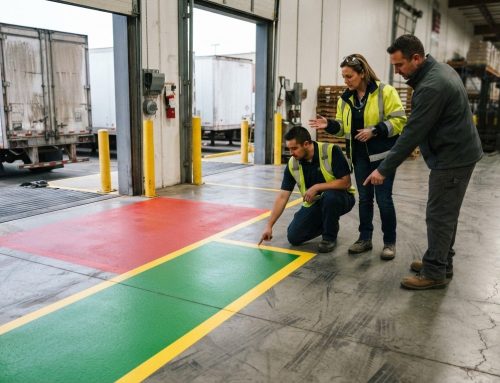
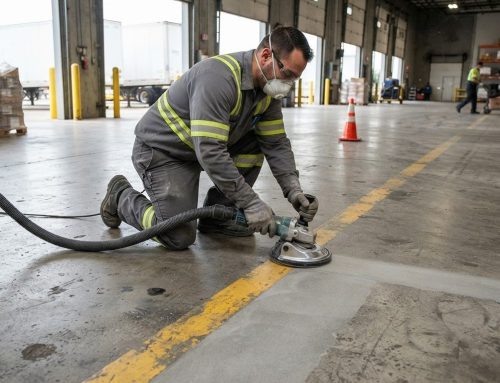
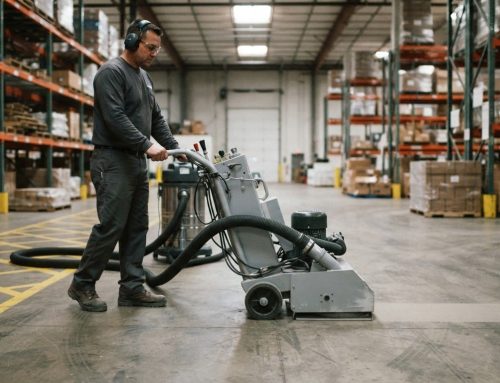
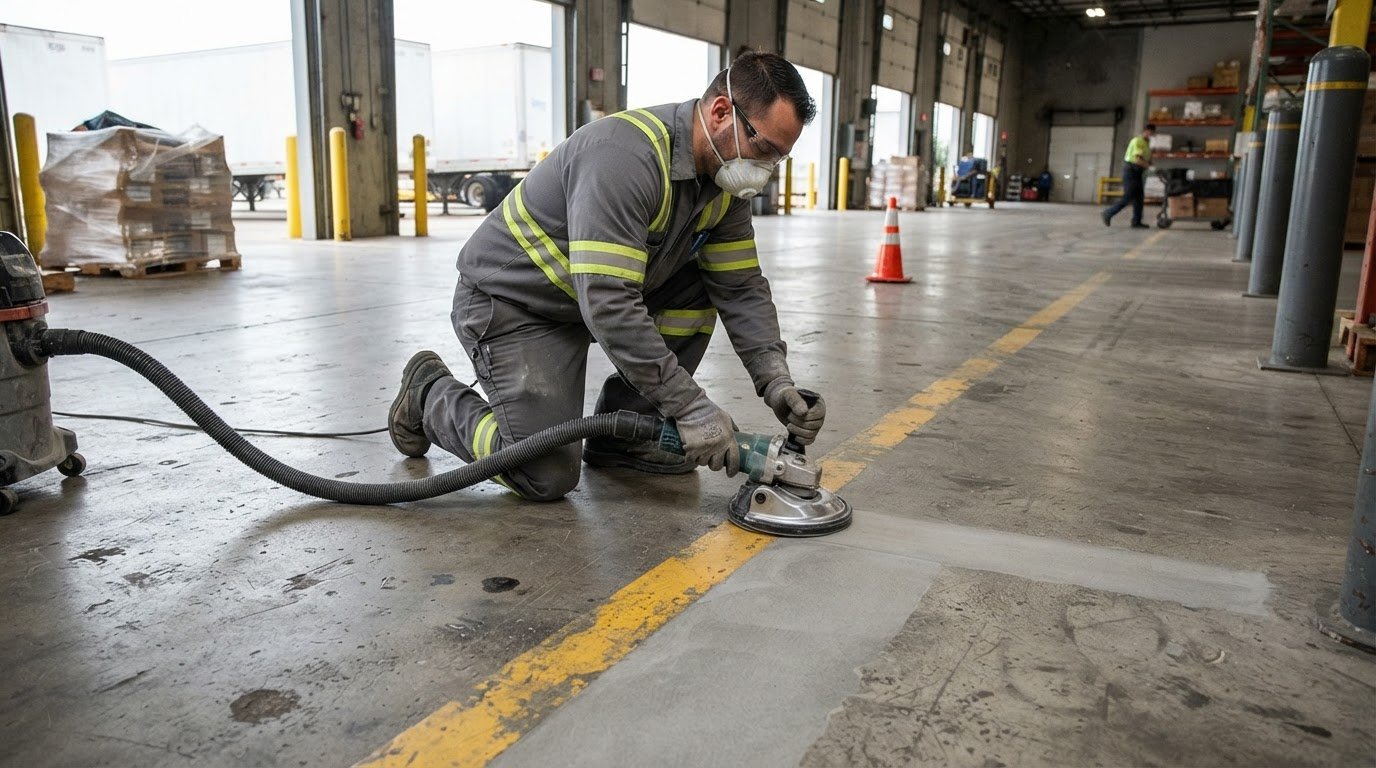
Superior adhesion on both asphalt and concrete requires a clean, dry, and profiled surface. While the Manual on Uniform Traffic Control Devices provides the legal framework for marking visibility, the physical longevity of those markings is determined by the preparation phase. Mechanical removal through grinding or shot blasting is the only way to guarantee that new coatings won’t fail prematurely due to underlying debris. This rigorous approach to warehouse line removal and surface prep is what separates a seasonal touch-up from a long-term infrastructure solution. We prioritize these heavy-duty methods because they reduce the total cost of ownership over the life of your facility.
Material Selection for Georgia High-Traffic Lots
Choosing the right material involves balancing traffic volume with environmental exposure. For heavy truck courts and distribution centers, thermoplastic markings offer the best durability. This material is melted and fused to the pavement, creating a thick, reflective layer that survives years of abrasive tire wear. In contrast, covered environments or multi-level structures benefit from parking garage striping and floor marking using high-solids epoxy. Epoxy provides excellent chemical resistance against automotive fluids and maintains its color integrity in low-light conditions.
Operational downtime is a significant concern for any active facility. We manage this by selecting materials with specific curing times (the period required for the marking to reach full hardness) that align with your traffic windows. Whether you require fast-dry acrylics for a quick restripe or high-performance coatings for a new layout, we coordinate the application to minimize business disruption. If you are ready to upgrade your facility with industrial-grade precision, contact our team for a technical site assessment.
Partnering with a Veteran Striping Contractor for Georgia Facilities
Selecting a contractor for large-scale infrastructure requires more than just finding a local crew with a paint machine. For high-profile assets, you need a partner who views pavement markings as a safety-engineered system rather than a cosmetic chore. Securing professional parking lot striping Georgia through an industrial specialist ensures your facility adheres to the strict operational standards required for high-volume traffic environments. A seasoned partner understands that your goal is to maintain compliance while protecting your operational budget from the costs of frequent restriping or legal penalties.
The StripeGuys Difference: 29 Years of Industrial Authority
Since 1995, our team has operated as a dependable industrial veteran with a multi-decade history in the field. We prioritize functional outcomes and organizational efficiency over simple aesthetics. This experience allows us to manage the intricate demands of complex environments, such as international airports and massive regional distribution centers, where precision is mandatory. We don’t just provide commercial parking lot line striping; we act as safety-conscious consultants invested in the long-term organization of your facility. When evaluating potential partners, use this checklist to ensure they meet industrial-grade standards:
- Does the quote specify mechanical surface preparation (shot blasting or grinding) to ensure material adhesion?
- Can the contractor demonstrate a history of managing projects exceeding 50,000 linear feet?
- Is the team capable of around-the-clock coordination to prevent operational downtime?
- Does the contractor provide technical clarifications for material selection (matching specific paints to your traffic volume)?
Planning Your Georgia Striping Project
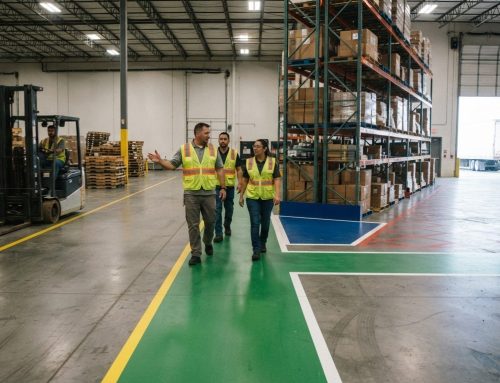
Successful execution begins with detailed site maps and layout planning (the process of blueprinting traffic flow before the first drop of paint hits the ground). We work closely with general managers to schedule work during low-traffic windows, ensuring your logistics remain uninterrupted. By utilizing precise stenciling and high-performance materials, we create clear boundaries that improve on-site safety and driver navigation. Our approach focuses on transparency and accessibility, providing you with the technical data needed to make informed decisions about your pavement assets. The next step for any facility manager is securing an industrial-grade quote that accounts for both current compliance needs and future durability requirements.
Securing Your Facility’s Future with Industrial Precision
Maintaining a high-traffic facility requires constant vigilance regarding safety and legal standards. We’ve established that parking lot striping Georgia is a critical infrastructure investment that directly impacts your liability profile (the legal risk associated with property accidents) and operational flow. By prioritizing mechanical surface preparation and selecting high-performance materials like thermoplastic, you ensure your markings survive the regional climate. This proactive approach reduces long-term costs by extending the functional lifecycle of your pavement assets.
With over 29 years of industrial striping experience since 1995, StripeGuys provides the seasoned expertise needed to manage high-profile commercial projects. We specialize in OSHA and ADA compliance, offering nationwide coverage that brings industrial authority to every layout we design. Don’t let fading lines or non-compliant stalls disrupt your business operations. Request an Industrial-Grade Quote for Your Georgia Facility to start optimizing your site today. We’re ready to help you build a safer, more efficient environment for your organization.
Frequently Asked Questions
How often should a parking lot be restriped in Georgia?
High-traffic facilities should restripe every 18 to 24 months to maintain visibility and legal compliance. Georgia’s intense UV exposure and heavy seasonal rainfall cause standard traffic paints to fade faster than in milder climates. Regular maintenance prevents the traffic chaos associated with unclear boundaries. For industrial sites with heavy freight volume, you might require more frequent touch-ups to ensure your parking lot striping Georgia remains functional and safe for 24/7 operations.
What are the specific ADA parking requirements for Georgia businesses?
Georgia requires one out of every eight accessible spaces to be van-accessible. These stalls must be at least 96 inches wide with a 96-inch access aisle. Standard accessible stalls also require a 96-inch width but can use a 60-inch access aisle. Additionally, ADA-compliant signs must be mounted at least 60 inches above the ground. Following these specific dimensions is mandatory to avoid lawsuits and ensure your facility is accessible to all visitors.
Is shot blasting necessary for every parking lot striping project?
Shot blasting isn’t mandatory for every restripe, but it’s the preferred method for new layouts on concrete or when existing lines are peeling. This mechanical process removes surface contaminants and laitance (a weak top layer of concrete) to create a superior bond. While simple power washing removes loose dirt, it doesn’t provide the textured profile needed for long-term material adhesion. We recommend this for high-friction areas where durability is the primary operational goal.
What is the difference between thermoplastic and standard traffic paint?
Thermoplastic is a thick, durable material that is melted and fused to the pavement surface, whereas standard traffic paint is a thinner, cold-applied coating. Thermoplastic offers superior longevity and reflectivity, making it ideal for high-volume truck courts and heavy-duty industrial environments. Standard paint is more cost-effective for low-traffic areas but requires more frequent restriping. Choosing thermoplastic for your parking lot striping Georgia reduces long-term maintenance costs by extending the time between service cycles.
How long does it take for parking lot lines to dry in Georgia humidity?
Standard water-based traffic paints typically dry to the touch within 30 to 60 minutes, though Georgia’s high humidity can extend this window. High performance coatings like epoxy or thermoplastic have different curing profiles (the time required to reach full hardness). We monitor local atmospheric conditions to ensure the material sets correctly before reopening the lot to traffic. Proper scheduling during low-humidity windows or overnight shifts helps minimize operational downtime and prevents tracking of wet material.
Can you stripe over existing faded lines or do they need to be removed?
You can stripe over existing lines if the old paint is still well-bonded to the pavement and the layout remains identical. However, if the old markings are flaking, peeling, or layered too thick, they must be removed to prevent the new coating from failing. Mechanical removal is also required whenever you are redesigning the traffic flow or correcting non-compliant stalls. Removing failing material ensures the new safety system remains visible and durable for several years.