Workplace injuries cost U.S. employers over $167 billion annually according to the National Safety Council. Most facility managers view floor striping as a recurring maintenance headache that interrupts production, but that perspective ignores the massive financial risk of a single forklift accident or a failed OSHA inspection. When you are justifying the cost of professional floor marking to your leadership team, you aren’t just asking for paint on concrete. You’re proposing a safety system that protects your bottom line. We understand that frequent re-striping causes operational downtime you can’t afford; it’s a logistical stressor that needs a permanent solution.
This guide shows you how high-performance materials like epoxy line painting transform a line item expense into a high-yield investment. You’ll learn how a strategic layout can drive productivity gains of up to 20 percent by optimizing traffic flow and reducing search time. We will break down the February 2026 OSHA 29 CFR 1910.22 requirements and explain why professional surface preparation, such as shot blasting line removal, is the only way to ensure your markings survive heavy forklift traffic. By the end, you’ll have a defensible business case for a floor marking system that eliminates fines and keeps your facility running at peak efficiency.
Key Takeaways
- Identify the hidden financial impact of OSHA violations and forklift accidents caused by substandard or faded safety lines.
- Discover why professional surface preparation, specifically shot blasting line removal, is the primary driver of long-term marking durability.
- Learn a proven framework for justifying the cost of professional floor marking by quantifying the “Cost of Inaction” for safety committees and CFOs.
- Compare the total cost of ownership between epoxy line painting and standard warehouse floor striping to find the best 5-year ROI.
- Explore how precise floor layouts support modern automation like AMRs while delivering immediate productivity gains of up to 20 percent.
The Hidden Costs of Substandard Floor Marking
Many facilities fall into the trap of treating floor striping as a minor maintenance task rather than a strategic safety barrier. This mistake leads to the “re-striping cycle,” where low-grade materials fail under the constant friction of daily forklift traffic. When you use hardware-store paint or low-durability floor marking tapes, the lines often fade or peel within months. You’re then forced to pay for labor and accept operational downtime all over again. Justifying the cost of professional floor marking becomes simple when you contrast a one-time high-performance installation against the compounding costs of repetitive, failed DIY attempts.
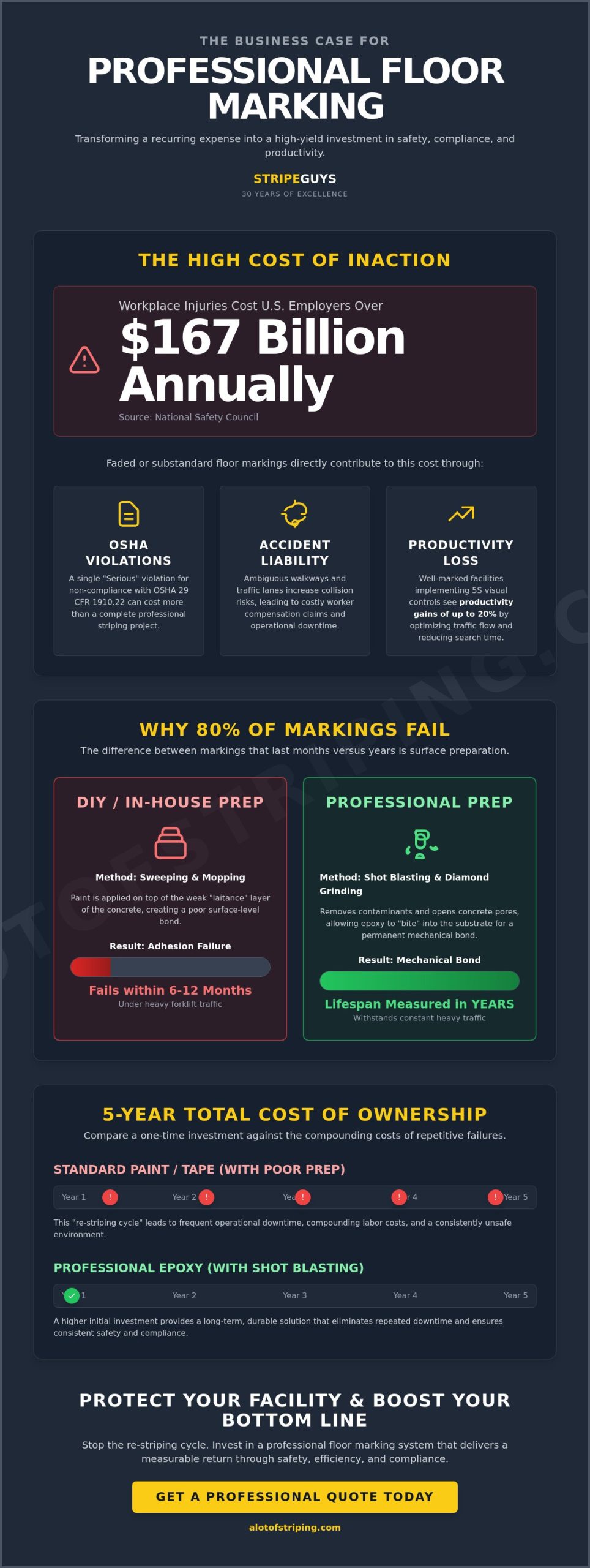
Professional marking acts as a primary tool for liability mitigation. Faded lines are not just an eyesore; they are a breakdown in communication. When a forklift operator cannot distinguish a pedestrian walkway from a travel lane, the risk of a collision spikes. These accidents contribute to the $167 billion annual cost of workplace injuries in the U.S. By investing in durable, high-visibility markings, you create a defensible safety record that protects both your employees and your organization’s financial stability.
Regulatory Compliance and Fine Avoidance
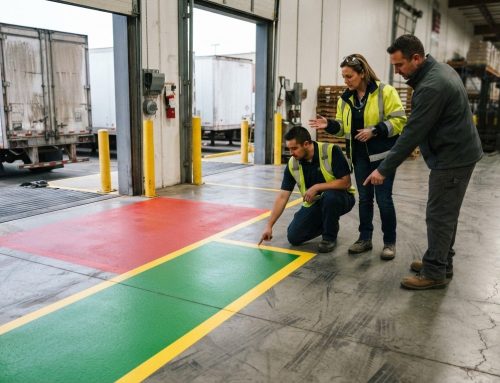
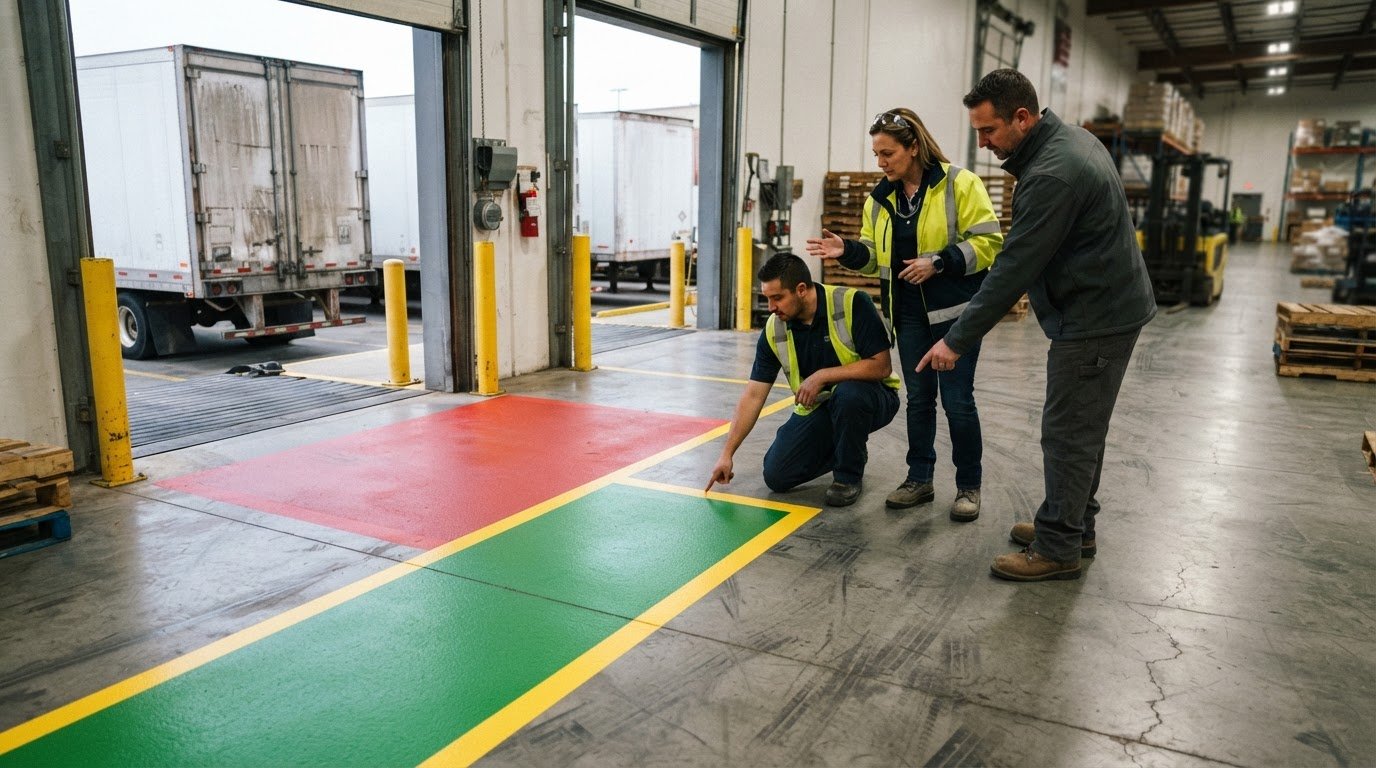
The February 2026 update to OSHA 29 CFR 1910.22 emphasizes that employers must provide a safe means of access and egress. While the specific language has shifted, the requirement for clear, visible boundaries remains a cornerstone of inspection readiness. A single “Serious” violation can carry a penalty that far exceeds the price of a professional warehouse floor striping project. Beyond the interior, compliant parking lot painting is essential for meeting ADA standards. Proper markings ensure you avoid the legal fees and settlement costs associated with accessibility lawsuits.
Impact on Operational Throughput
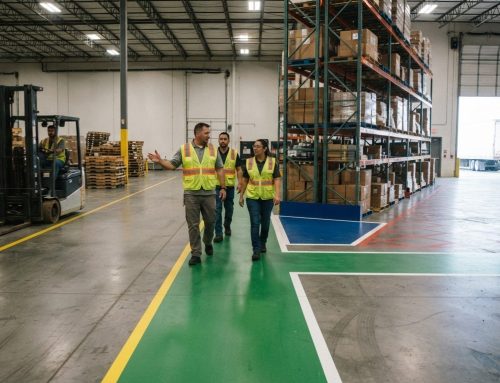
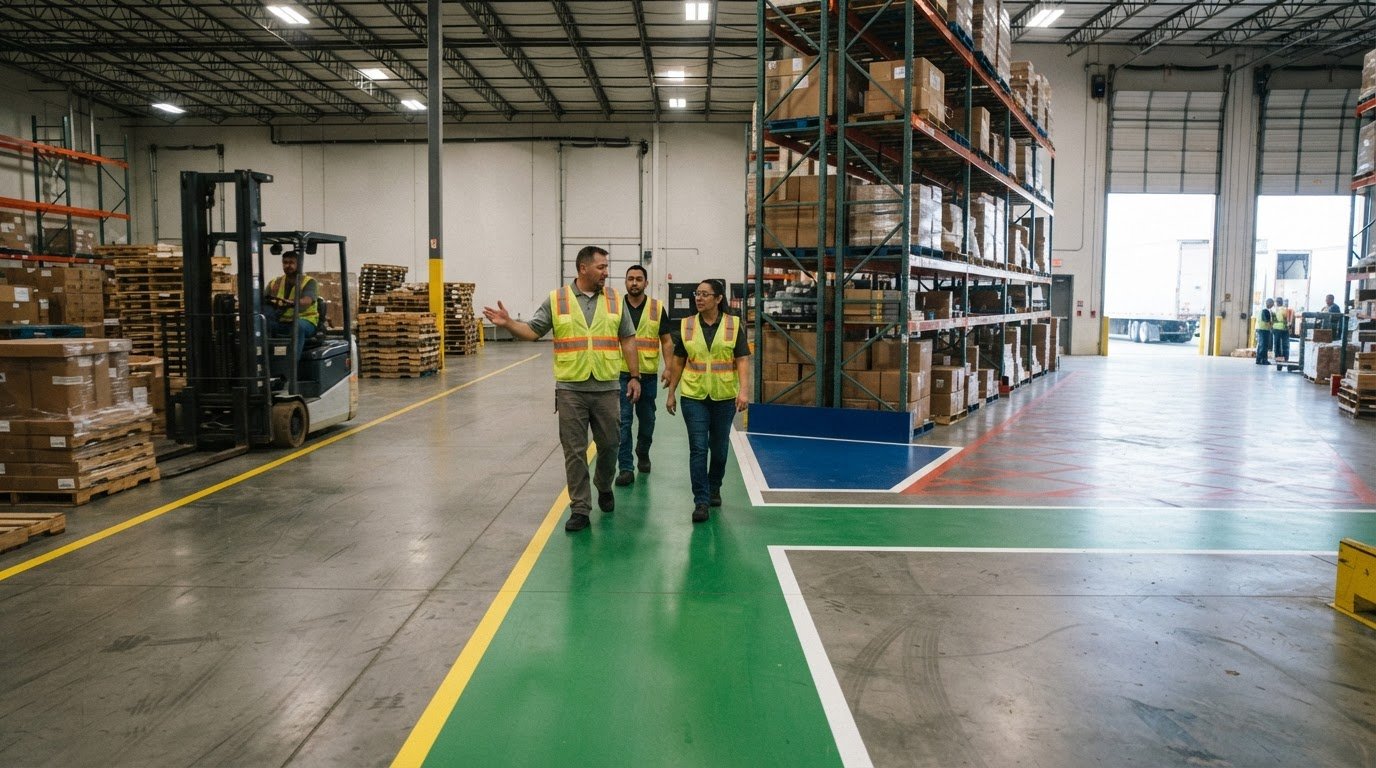
Organization directly impacts your bottom line. Facilities that implement 5S visual controls, including professional floor marking, can see productivity gains between 8 and 20 percent. Clear staging areas and traffic lanes reduce the time workers spend searching for pallets or navigating bottlenecks. This optimization increases labor efficiency and reduces equipment damage caused by chaotic traffic patterns. Furthermore, a well-marked facility improves employee morale by reducing “near-miss” incidents. Workers perform better when they feel their environment is structured, predictable, and safe.
Professional Prep vs. DIY: Why Surface Adhesion Dictates ROI
Surface preparation is the invisible foundation of a durable industrial facility. Most in-house maintenance teams believe that a quick sweep and a mop are sufficient before applying paint. This assumption is the primary reason why 80 percent of floor marking failures occur within the first six months. Without mechanical preparation, the material merely rests on top of the concrete’s “laitance” layer (a weak, milky film of cement and sand). When heavy forklifts turn their wheels on these lines, the paint shears off immediately. Justifying the cost of professional floor marking starts with acknowledging that industrial-grade adhesion requires more than just a clean floor; it requires a mechanical bond.
Professionally prepared surfaces allow coatings to “bite” into the concrete substrate. This process ensures that the markings can withstand the high-friction environment of a 24/7 distribution center. When you compare the lifespan of paint applied to raw, unprepared concrete versus a profiled surface, the difference is measured in years, not months. Justifying the cost of professional floor marking becomes much easier when you factor in the labor savings from not having to repeat the work every six months. Investing in the right prep today prevents the logistical headache of shutting down your aisles for re-striping next quarter.
Mechanical Removal and Surface Profiling
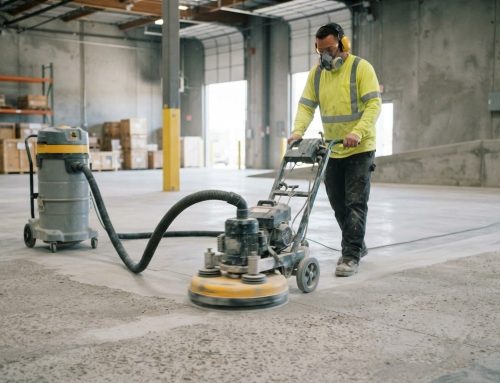
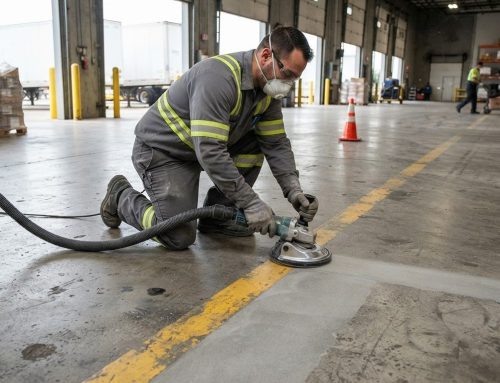
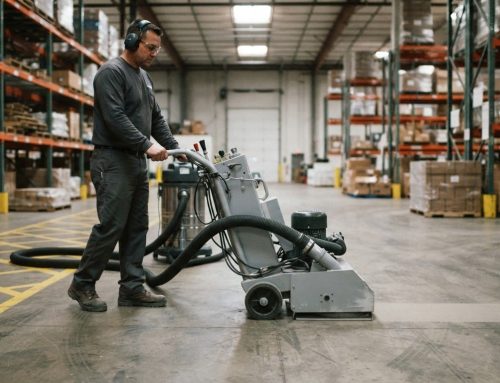
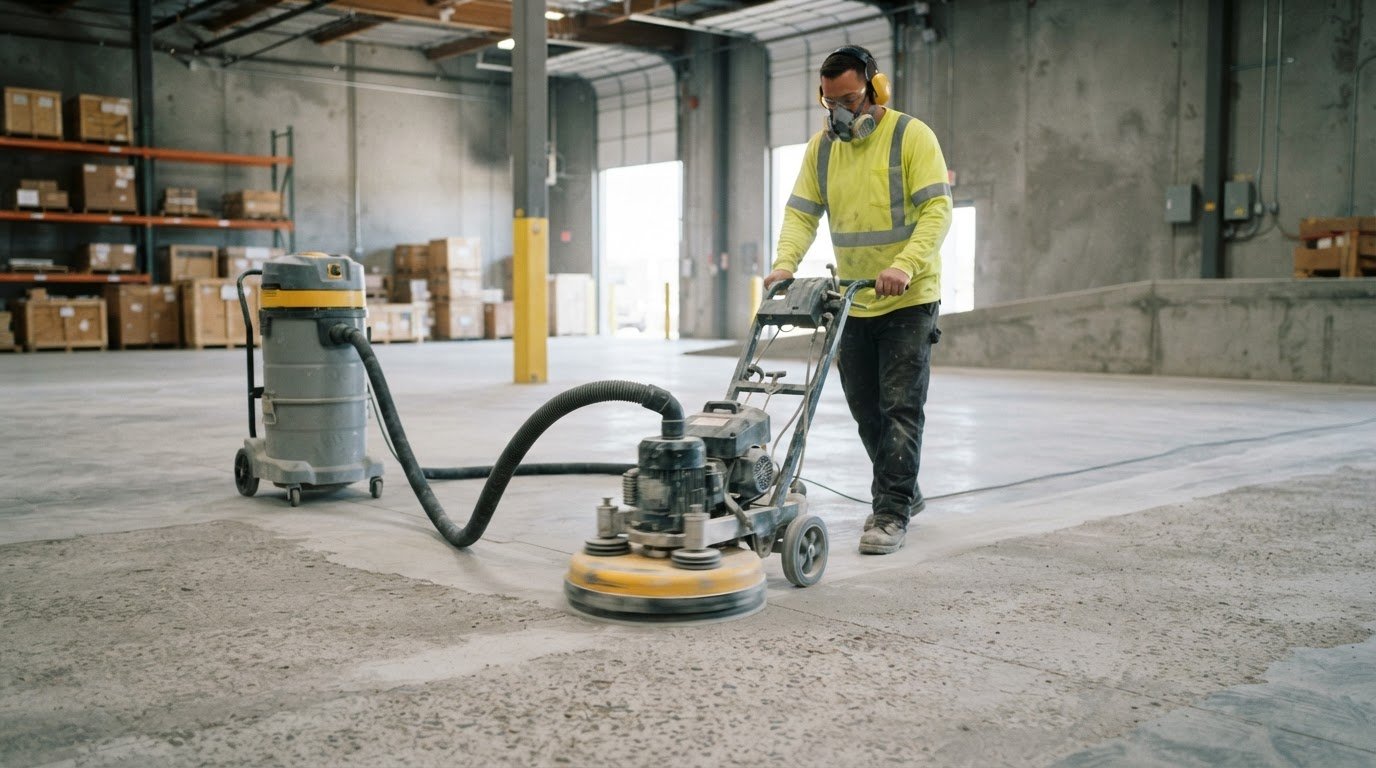
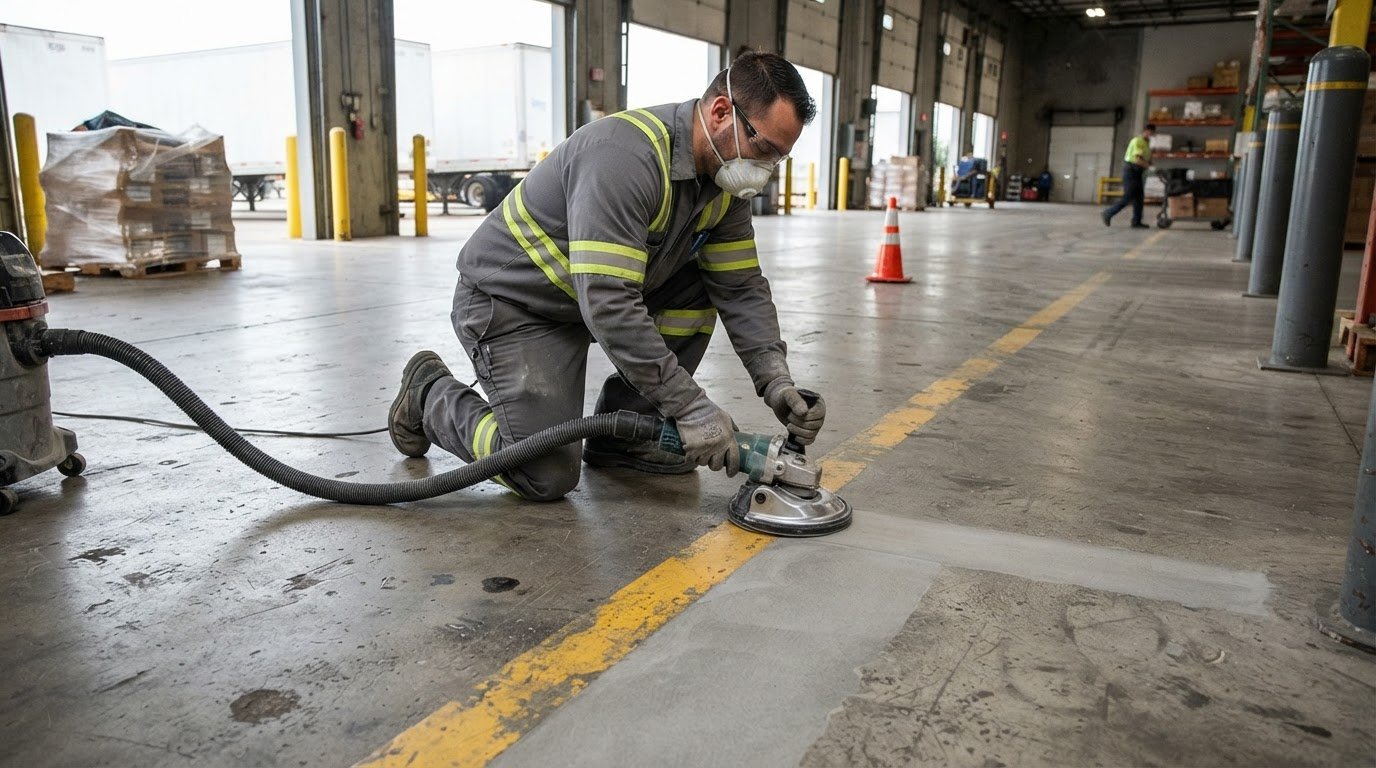
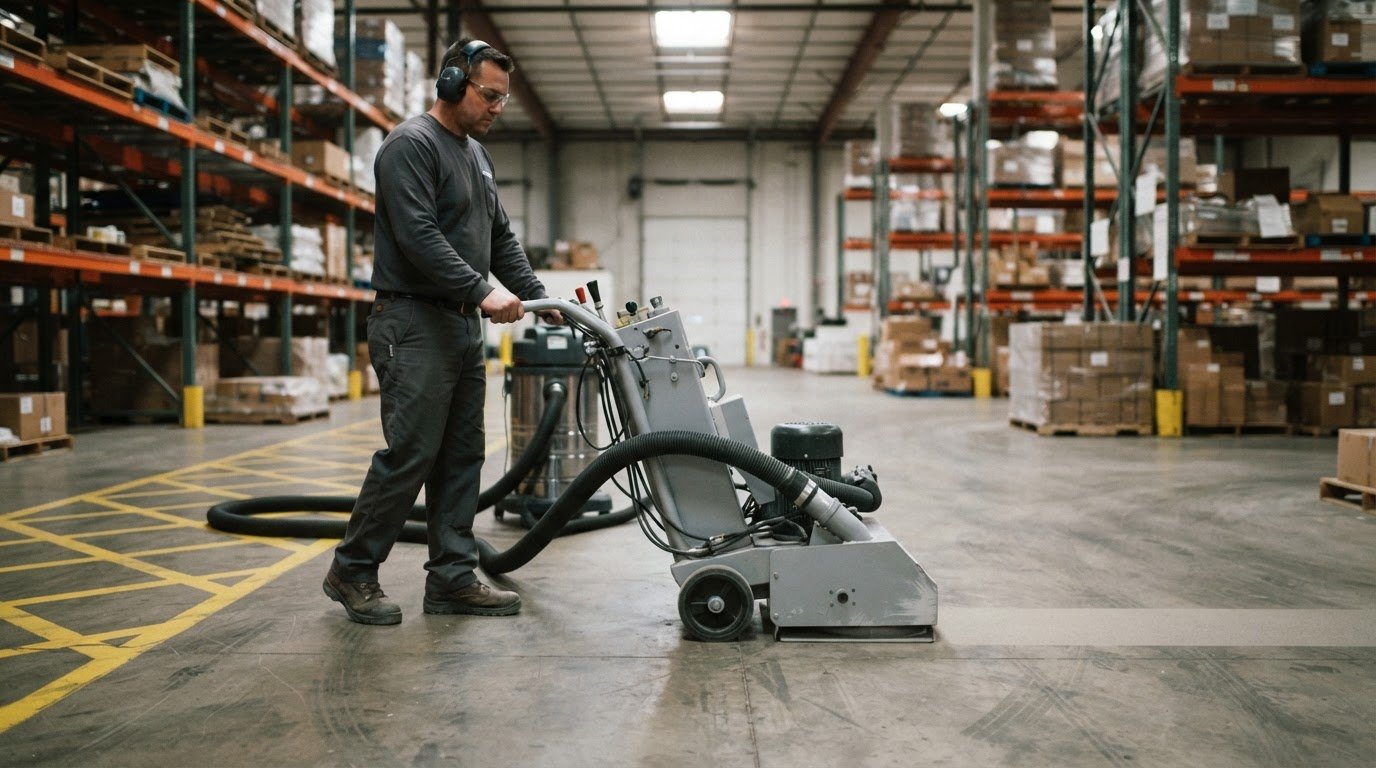
Professional contractors use specialized equipment like shot blasting to “open” the concrete pores. Shot blasting involves propelling steel shot at the floor to remove old coatings and contaminants, creating a textured profile that is ideal for bonding. For specific industrial finishes, diamond grinding might be used to smooth the surface while still ensuring adhesion. These methods are far superior to chemical cleaning, which often leaves behind residues that interfere with epoxy line painting. If you’re dealing with failed existing lines, shot blasting line removal is the most effective way to reset your floor for a permanent solution.
The Professional Application Process
Proper preparation extends beyond the physical floor surface to the layout itself. Professionals use precision stenciling and laser-guided tools to ensure complex designs comply with OSHA standard 1910.22 regarding safe access and egress. This level of accuracy is difficult to achieve with hand-rolled DIY methods. In sensitive or food-grade environments, contractors also manage dust and debris using HEPA-filtered vacuum systems. This ensures your facility remains operational and compliant throughout the installation. Professional contractors utilize heavy-duty equipment to ensure your investment lasts for years. If you’re tired of lines that peel after three months, consider the long-term benefits of professional warehouse floor striping.
Analyzing the Total Cost of Ownership: Epoxy vs. Tape vs. Paint
Calculating the true expense of facility maintenance requires shifting focus from the upfront invoice to the five-year total cost of ownership. Justifying the cost of professional floor marking involves comparing how different materials perform under the stress of 10,000-pound forklifts and industrial scrubbers. Standard warehouse floor striping using water-based or solvent-based paint often requires semi-annual re-application in high-traffic zones. Over five years, the cumulative labor costs and operational disruptions of ten paint jobs far exceed the price of a single, high-performance installation. Choosing the wrong material doesn’t just waste money; it creates a cycle of non-compliance and logistical stress.
Visibility retention is a critical factor in this calculation. Low-grade materials quickly succumb to “ghosting” (a condition where tire friction burns through the pigment and leaves a dark, illegible smear). High-performance materials resist tire marks and maintain the high-contrast finish required for safety. When lines become obscured by rubber burns, they no longer satisfy OSHA’s general requirements for walking-working surfaces. Professional installation ensures that the material thickness and chemical composition are optimized for your specific traffic volume, ensuring your investment remains visible for the long haul.
The Business Case for Industrial Epoxy
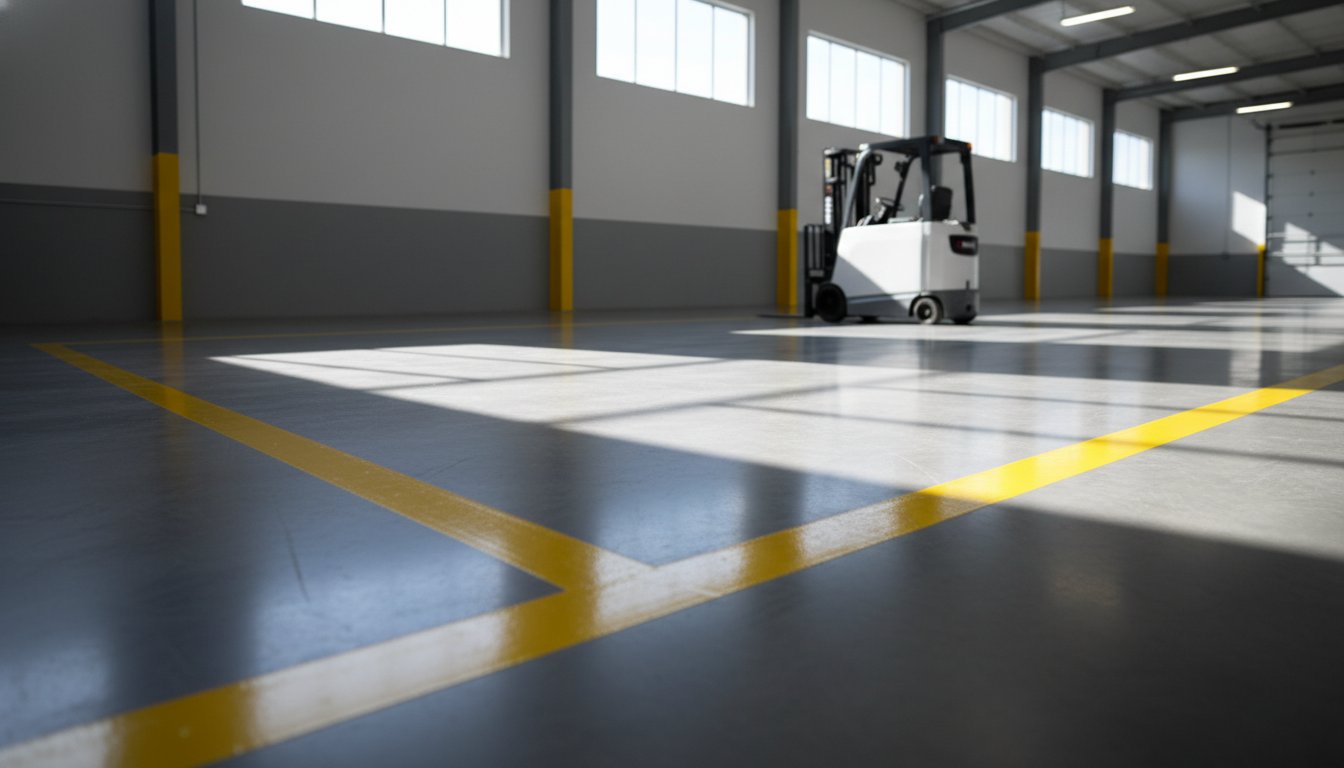
Epoxy line painting is the gold standard for high-volume distribution centers where durability is non-negotiable. This material creates a high-build, chemical-resistant barrier that bonds permanently to the concrete profile created during mechanical preparation. Unlike standard paint, epoxy resists the caustic chemicals found in many industrial floor cleaners and prevents fluids from migrating into the concrete. While epoxy requires a longer curing period (the time needed for the chemical reaction to harden the material), the long-term savings are substantial. You trade a few hours of initial downtime for years of maintenance-free performance.
When to Utilize Heavy-Duty Floor Tape
Heavy-duty floor tape offers a modular solution for facilities that require flexibility in their layouts. It provides excellent visibility and requires zero curing time, which means your facility can return to full operation immediately after the application. However, facility managers must be aware of “pivot points” where forklifts perform tight, repetitive turns. In these specific areas, the lateral shear strength of tape is lower than the mechanical bond of epoxy. Justifying the cost of professional floor marking means selecting the material that matches the physical reality of your workspace. We often find that a hybrid approach—using epoxy for permanent thoroughfares and tape for flexible staging areas—provides the best overall ROI.
A Framework for Justifying the Budget to Stakeholders
Securing the budget for facility upgrades requires shifting the conversation from a simple maintenance cost to a strategic capital investment. When you’re justifying the cost of professional floor marking to your CFO or safety committee, you must focus on the “Cost of Inaction” (COI). This metric quantifies the financial risks of maintaining the status quo, such as the high probability of a forklift collision or the inevitable fines from an OSHA audit. Presenting a data-driven business case ensures that stakeholders understand how a one-time investment in high-performance markings prevents the recurring drain of failed DIY projects.
A defensible 5-year ROI model is your most powerful tool. While hardware-store paint might appear cheaper on an initial invoice, its lack of durability creates a cycle of constant repair. Professional installation with industrial-grade materials eliminates the need for semi-annual re-striping, allowing your maintenance team to focus on critical infrastructure rather than painting lines. Justifying the cost of professional floor marking becomes an exercise in long-term fiscal responsibility; you’re choosing to pay for a permanent solution rather than a temporary fix that will inevitably fail.
Projecting Long-Term Maintenance Savings
Professional markings significantly reduce the frequency of facility shutdowns. Every time you re-stripe an aisle with low-grade paint, you lose hours of production time and disrupt your logistics flow. When you factor in the cost of internal labor and the loss of operational throughput, the “savings” of DIY work disappear. A professional contractor brings seasoned expertise and specialized equipment that ensures the job is done correctly the first time. This “Professional Guarantee” provides peace of mind that your markings will remain compliant and visible for years, backed by the reliability of a partner with a multi-decade history in the field.
Safety as a Profit Driver
Safety is not just a compliance requirement; it’s a profit driver. Facilities that implement 5S visual controls often see productivity gains between 8 and 20 percent by reducing search time and optimizing traffic patterns. Beyond efficiency, clearly defined pedestrian and vehicle lanes can lead to lower insurance premiums and fewer workers’ compensation claims. A clean, organized facility also serves as a powerful marketing tool during client tours, signaling operational excellence and a commitment to quality. You can transform your warehouse from a liability into a high-performance asset by investing in professional warehouse floor striping that protects your people and your bottom line.
The StripeGuys Advantage: 29+ Years of Industrial Authority
Choosing a contractor with nearly three decades of field experience transforms your facility maintenance from a gamble into a predictable outcome. Justifying the cost of professional floor marking is simple when you partner with a team that prioritizes functional longevity over quick fixes. We aren’t just painters; we’re safety-conscious consultants who understand the high stakes of industrial environments. Our multi-decade history in the market serves as a shorthand for reliability, ensuring that every line we stripe meets the rigorous demands of 24/7 operations. We focus on the physical realities of your workspace to deliver markings that survive where others fail.
We provide around-the-clock availability to minimize your operational impact. We understand that shutting down a high-volume distribution center for maintenance is a logistical nightmare. That’s why we coordinate our work around your schedule, ensuring your production remains steady while we improve your safety standards. This commitment to accessibility and transparency is why facility managers trust us with their most critical infrastructure projects. We provide the seasoned expertise needed to move your project from a budget request to a finished, compliant floor.
National Scale with Local Reliability
We offer nationwide coverage for high-profile logistics and distribution projects, managing consistent standards across multiple regional branches. This national reach makes us the ideal single-source contractor for facility networks that require uniform safety protocols at every location. Our proven track record includes complex projects for airports, manufacturing plants, and massive logistics hubs. By maintaining a steady beat of operational excellence, we ensure that a facility manager in one region receives the same industrial authority and quality as their counterparts across the country. We handle the heavy lifting of coordination so you can focus on your core operations.
Advanced Technical Execution
Our team utilizes industrial-grade epoxy and high-performance materials because they provide the durability required for heavy-duty traffic areas. We don’t skip steps; our process includes precision shot blasting line removal to ensure a clean concrete profile for maximum adhesion. This technical preparation is the foundation of our work, preventing the peeling and fading common with substandard applications. We maintain a no-nonsense attitude toward technical execution, providing clear, declarative communication regarding material selection and curing times. We’re dedicated to transparency in our pricing and our methods, which is why we invite you to Get a professional assessment for your facility from StripeGuys. Let us help you build a clear, defensible business case for a floor marking system that lasts.
Secure Your Facility’s Future with Industrial Precision
Transitioning from a reactive maintenance cycle to a proactive safety strategy requires a shift in perspective. You’ve seen how mechanical surface preparation dictates the lifespan of your markings and why industrial epoxy outperforms standard paint over a five-year horizon. By focusing on the “Cost of Inaction,” you can build a defensible business case for leadership. Justifying the cost of professional floor marking isn’t just about compliance; it’s about protecting your throughput and your people.
StripeGuys brings over 29 years of industrial marking expertise to your facility. We specialize in high-durability epoxy and rigorous surface prep to ensure your lines survive heavy forklift traffic. With our nationwide service coverage, we provide consistent standards across your entire logistics network. Don’t let faded lines become a liability. Request an instant quote for your national facility project and take the first step toward a more organized, efficient workspace. Your facility deserves a solution that lasts as long as your business does.
Frequently Asked Questions
How much does professional warehouse floor striping typically cost?
The total investment for professional warehouse floor striping is determined by several variables including linear footage, the specific material selected, and the level of surface preparation required. High-performance materials and mechanical preparation involve a higher initial outlay but reduce the five-year total cost of ownership by eliminating frequent re-striping. You should obtain a site-specific quote to account for your facility’s unique traffic patterns and concrete condition.
What is the expected lifespan of professional epoxy line painting?
Professional epoxy line painting generally provides a service life of three to five years in standard industrial environments. This longevity is the result of mechanical surface profiling which creates a permanent bond between the coating and the concrete substrate. While heavy forklift traffic and aggressive cleaning schedules may impact this timeline, epoxy remains the most durable option for high-volume distribution centers.
Does floor marking really help with OSHA compliance?
Yes, floor marking is a fundamental component of meeting OSHA 29 CFR 1910.22 standards for safe access and egress. Clear visual boundaries between pedestrian walkways and vehicle lanes are the primary way to demonstrate a safe working environment during an inspection. Justifying the cost of professional floor marking is straightforward when you consider that a single regulatory fine often exceeds the cost of a professional installation.
How long does a facility need to be shut down for professional striping?
Operational downtime depends on the square footage of the project and the curing requirements of the materials used. Standard paint allows for traffic within a few hours; however, industrial epoxy requires a longer period to reach full chemical and mechanical hardness. We coordinate with your team to perform work in phases or during low-activity windows to ensure your facility remains productive throughout the process.
Can professional floor markings be applied over existing paint?
Applying new markings over old, failing paint is not a recommended practice because the new layer will only be as strong as the bond of the old paint. Professional contractors perform warehouse line removal to reach the bare concrete substrate before application. This ensures the new markings bond directly to the floor, preventing the peeling and flaking that occurs with layered DIY attempts.
What is the difference between shot blasting and diamond grinding for line removal?
Shot blasting uses steel shot to aggressively remove old coatings and open the concrete pores for maximum adhesion. Diamond grinding uses abrasive discs to smooth the floor or remove thin layers of pigment. Shot blasting is generally preferred for epoxy line painting because it creates a deeper profile for mechanical bonding. Grinding is often selected for thinner coatings or when a smoother surface finish is required.
Are professional floor markings worth it for smaller facilities?
Professional markings provide a high ROI for smaller facilities by maximizing the efficiency of limited floor space. Clear organization reduces pallet search time and prevents accidents in tight quarters where pedestrians and equipment share the same lanes. Justifying the cost of professional floor marking in a small facility is based on the long-term durability of the lines, which prevents the need for recurring maintenance shutdowns.
How do professional markings handle heavy forklift traffic compared to DIY?
Professional markings are specifically engineered to withstand the lateral shear forces of heavy forklift tires. DIY paint often shears off the surface during tight turns because it lacks a mechanical bond with the concrete. Professional applications use industrial-grade resins and mechanical preparation to ensure the marking remains intact under the constant friction of 24/7 warehouse operations.