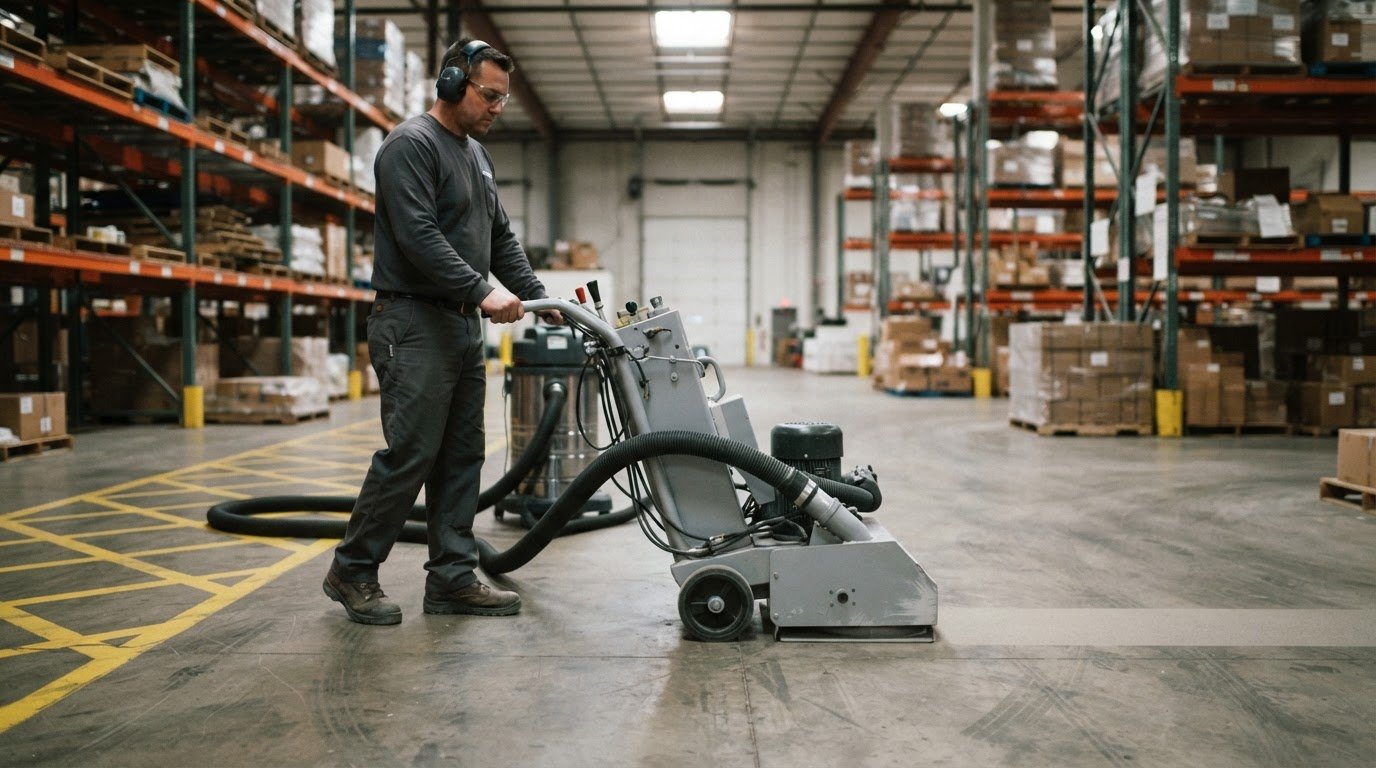
Most facility managers prioritize paint selection, but the true success of an industrial floor project is determined long before the first gallon of epoxy is opened. If your request for proposal lacks specific technical requirements for mechanical surface preparation, you’re essentially inviting your lines to peel within the year. Learning how to write an RFP for warehouse striping that demands shot blasting (a process that removes surface contaminants to create a mechanical bond) is the difference between a three-month fix and a multi-year solution.
It’s common to feel anxiety over facility downtime or uncertainty about complex OSHA color-coding requirements. You need a document that holds contractors accountable for both safety and durability without disrupting your operational flow. This 2026 guide helps you master the technical specifications and logistical frameworks required to draft a professional warehouse striping RFP. We’ll examine how to define material science requirements, schedule around your peak hours, and ensure your facility remains organized for the long haul.
Key Takeaways
- Mandate mechanical surface preparation like shot blasting in your specs to prevent premature line peeling and ensure a permanent bond with the concrete.
- Master how to write an RFP for warehouse striping that effectively balances material science with operational safety requirements to maximize facility efficiency.
- Incorporate specific OSHA 1910.22 compliance standards and standardized color-coding to maintain a safe, regulatory-compliant workspace for your team.
- Require a detailed phased execution plan from bidders to minimize facility downtime and maintain throughput during the application process.
- Score potential partners based on their industrial-specific experience and the availability of professional-grade equipment like airless sprayers and shot blasters.
Why Your Warehouse Striping RFP Needs Specialized Technical Detail
A warehouse striping RFP isn’t just a request for pricing; it’s a technical blueprint for facility safety and organizational flow. Many procurement teams make the mistake of treating floor markings like a janitorial or general maintenance line item. This oversight leads to rapid degradation and wasted budget. In a high-volume distribution center, your floor markings are critical safety infrastructure. They define pedestrian paths, forklift lanes, and hazardous zones that keep your operation running without incident. If you want to know how to write an RFP for warehouse striping that actually delivers results, you must prioritize functional outcomes over simple aesthetics.
Moving Beyond General Facility Maintenance
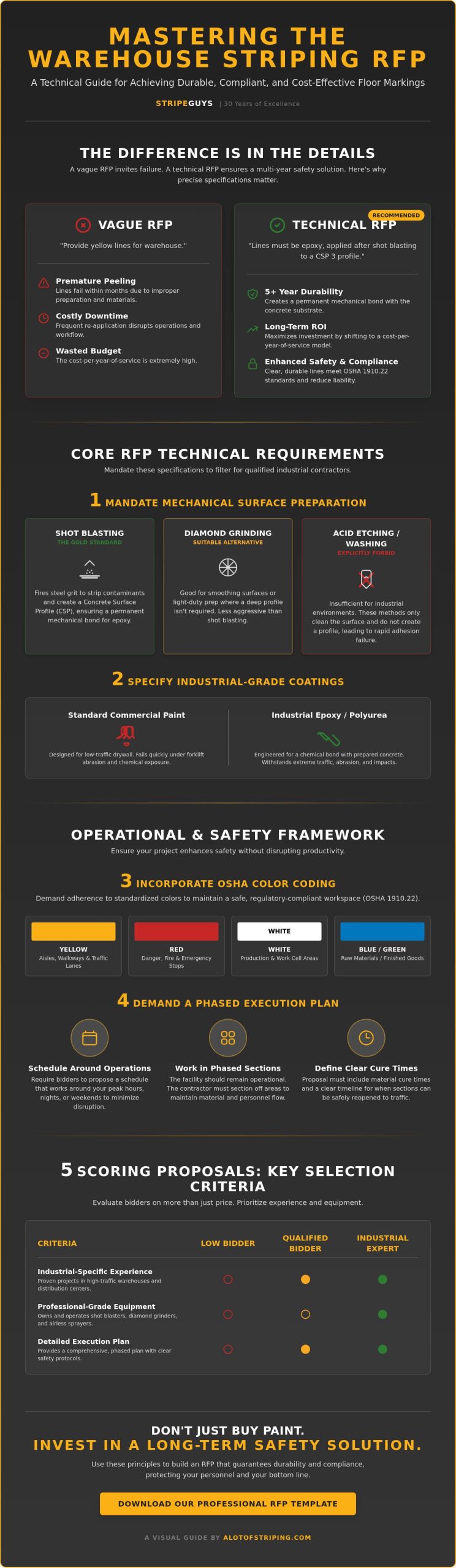
Standard commercial paint is designed for drywall or low-traffic retail floors, not the abrasive environment of a 24/7 warehouse. When an RFP is vague, contractors often bid the cheapest material possible to win the job. These materials lack the chemical bond required to withstand 10,000-pound forklifts making tight turns. Industrial standards for warehouse floor markings emphasize the need for durability in high-traffic zones, yet many RFPs fail to specify the preparation required to achieve it. You need specifications for mechanical surface preparation (the process of shot blasting or grinding to create a profile in the concrete) to ensure the coating becomes part of the substrate. Vague scopes result in uneven lines, poor adhesion, and dangerous safety gaps that expose your company to liability and OSHA scrutiny.
The Long-Term ROI of Precise Specifications
Precision in your RFP reduces the likelihood of costly change orders and project delays. When you define exactly what you need, you eliminate the guesswork that contractors use to pad their margins. Shift your mindset from a cost-per-project view to a cost-per-year-of-service calculation. A cheap application that lasts six months is infinitely more expensive than a high-performance system that lasts five years or more. Understanding how to write an RFP for warehouse striping allows you to set the foundation for a 10-year floor life. This document is your primary tool for holding contractors accountable to industrial-grade standards. It ensures that you aren’t just buying paint, but rather investing in a long-term safety solution that protects your personnel and your bottom line.
By demanding technical depth in your proposal, you filter out contractors who lack the specialized equipment or experience to handle industrial environments. A high-quality RFP acts as the first line of defense against facility downtime and premature material failure. It ensures that every bidder understands the high stakes of your operational needs and the technical rigor required to meet them.
Defining Technical Specifications: Materials and Surface Preparation
A successful RFP must explicitly define the physical bond between the coating and the concrete substrate. If your document simply asks for “yellow lines,” you’re leaving the door open for low-quality applications that will flake under the stress of daily operations. When determining how to write an RFP for warehouse striping, you must mandate mechanical surface preparation as a non-negotiable requirement. This process ensures the material penetrates the concrete rather than sitting on top of surface contaminants.
Mandatory Surface Prep: Shot Blasting vs. Grinding
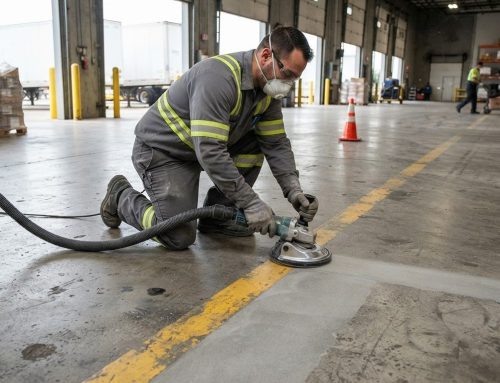
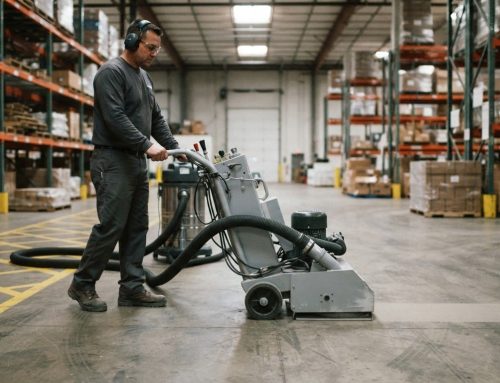
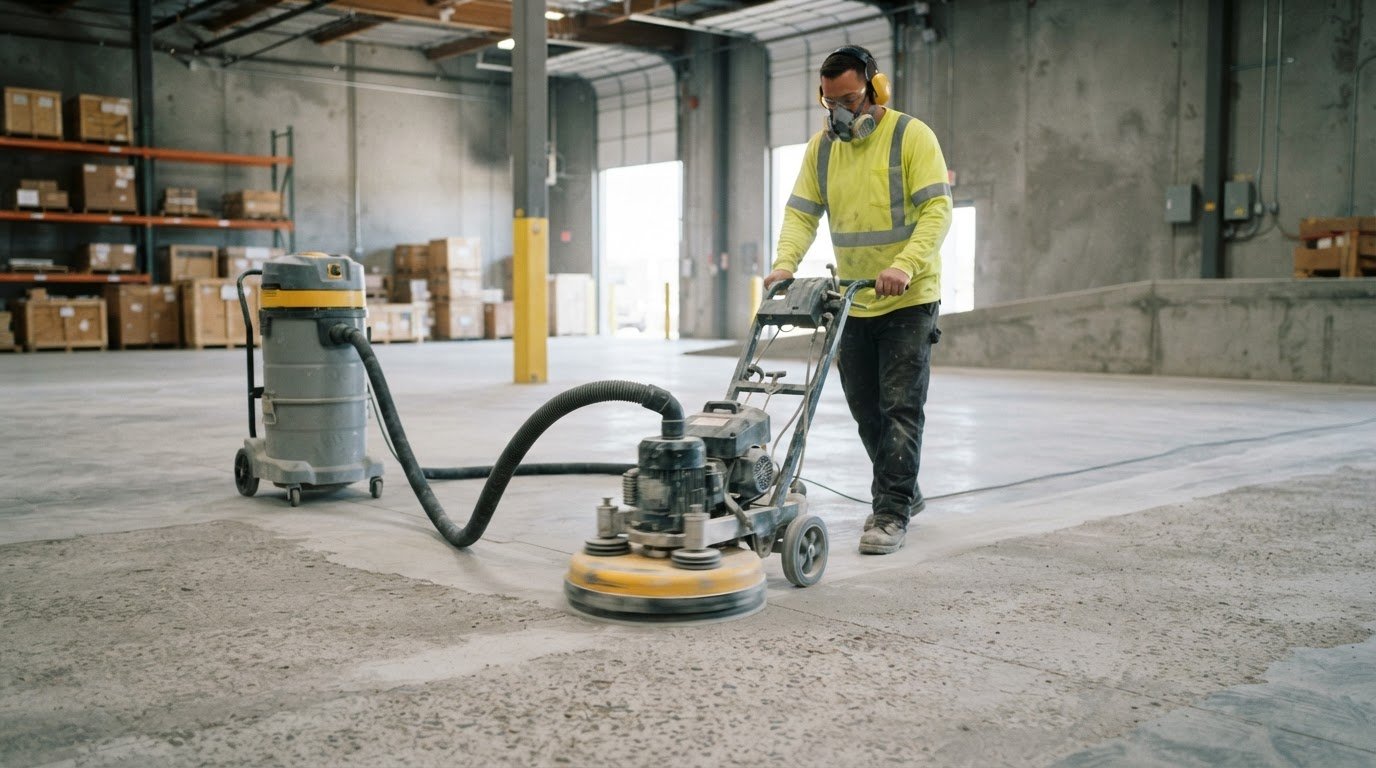
Your RFP should require shot blasting (a process that fires steel grit at the floor to strip away the top layer of concrete) for all new epoxy applications. This creates a specific Concrete Surface Profile (CSP) that acts as a mechanical anchor for the resin. For existing surfaces that only need light-duty markings or smoothing, diamond grinding is a suitable alternative. You should explicitly forbid “acid etching” or simple pressure washing in your technical specs. These methods are insufficient for industrial environments and often lead to premature adhesion failure. Precise preparation is the only way to meet the durability requirements implied by OSHA standard 1910.22, which mandates that walking-working surfaces remain in a safe, maintained condition.
Selecting the Right Coating for Your Environment
Material selection should be dictated by the specific traffic patterns in your facility. Specify 100% solids epoxy for high-traffic thoroughfares and forklift intersections where durability is paramount. In contrast, fast-dry traffic paint might be acceptable for low-impact racking aisles where heavy machinery rarely pivots. If your facility includes battery charging stations or chemical storage, your RFP must demand chemical-resistant coatings to prevent floor degradation. For a deeper look at these differences, review our Epoxy vs Paint comparison guide to see which chemistry fits your budget and durability needs.
Beyond materials, your RFP must include exact linear footage measurements and line widths. The industry standard is a 4-inch line, but you may require wider markings for high-visibility pedestrian crossings. Don’t forget to include specifications for staging area markings (often used for inbound/outbound freight) and custom stenciling for “No Parking” or “Fire Lane” zones. Clearly defining these details ensures you receive accurate bids from professional Warehouse Floor Striping contractors who understand the technical rigor of your project. This level of detail eliminates the ambiguity that leads to project delays and ensures a high-performance finish that withstands the physical realities of your workspace.
Incorporating Safety Standards and Regulatory Compliance
Safety isn’t an accessory; it’s a legal and operational necessity. When you’re determining how to write an RFP for warehouse striping, you must treat regulatory compliance as a core technical requirement. Your RFP should explicitly mandate adherence to OSHA’s General Requirements for Walking-Working Surfaces. This ensures that your facility maintains clear, unobstructed pathways that prevent slip-and-fall incidents and forklift collisions. By defining these standards in the bidding phase, you ensure that every contractor is quoting a solution that meets federal safety mandates.
Standardizing OSHA Color Codes
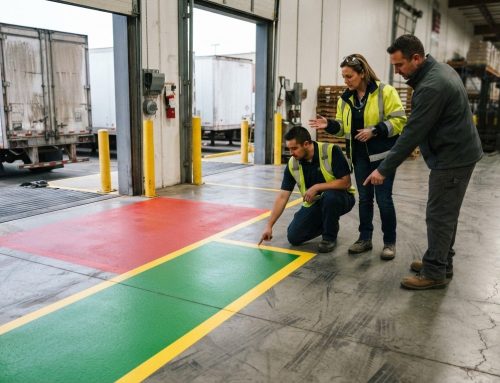
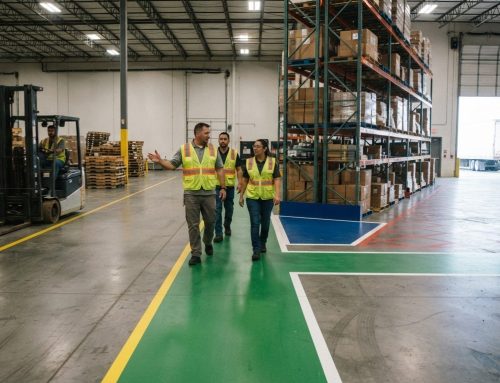
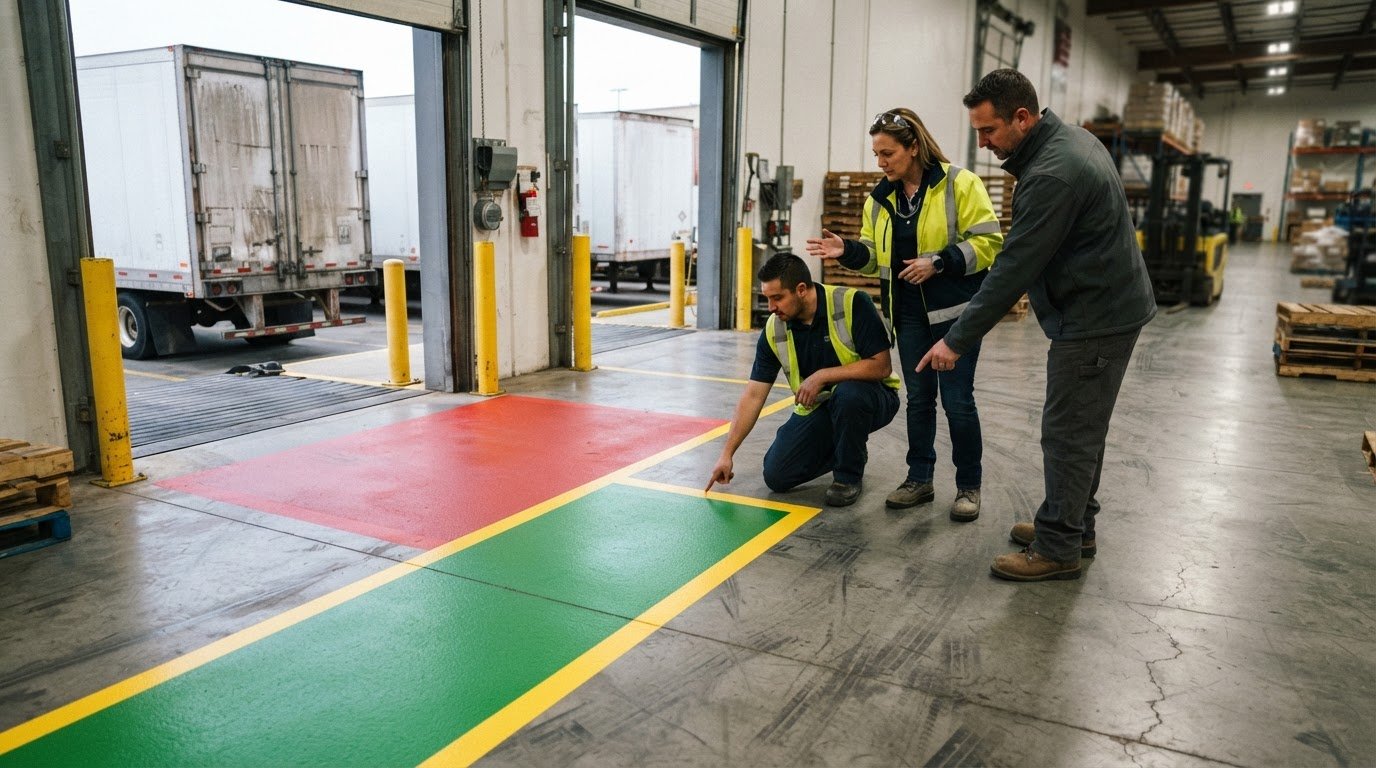
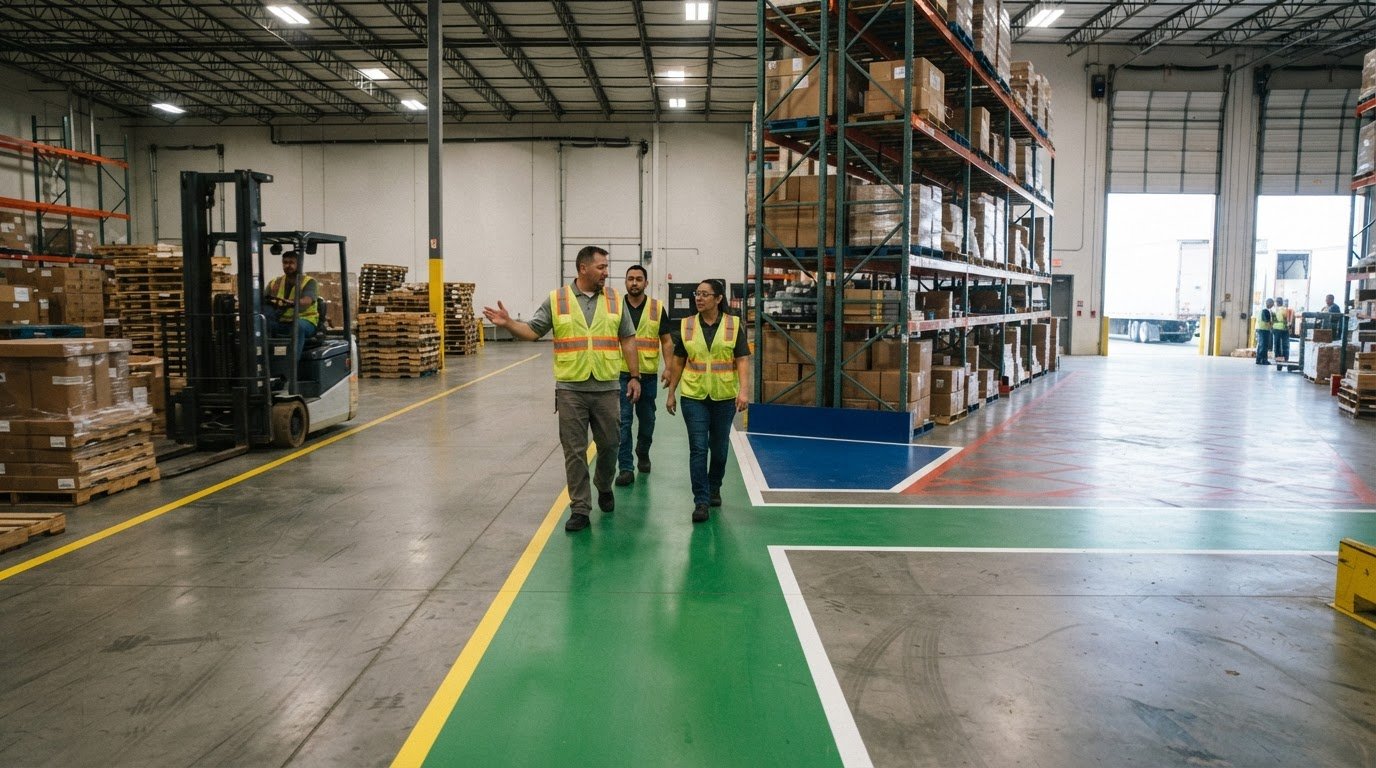
A professional RFP should remove all ambiguity regarding color usage. Specify that yellow must be used for traffic lanes and aisles, while red identifies fire-related hazards like extinguishers and hydrants. You should also define walkway widths (typically a minimum of 36 inches for pedestrian traffic) and forklift exclusion zones to prevent dangerous intersections. For a complete breakdown of these requirements, consult our OSHA compliant floor markings checklist. This level of detail prevents contractors from using non-standard colors that could confuse employees or lead to safety citations during an inspection.
Emergency Egress and Fire Lane Requirements
High-risk zones require specialized treatment that goes beyond standard paint. Mandate the use of non-slip additives (fine aggregates mixed into the coating to increase traction) for all emergency exit paths and pedestrian walkways. Your RFP must also require clear, high-visibility markings for fire extinguishers, electrical panels, and first aid stations to ensure they remain accessible at all times. In facilities with public-facing areas or office-adjacent storage, include requirements for ADA-compliant markings to ensure accessibility for all personnel. If your facility operates in low-light conditions, consider specifying photoluminescent (glow-in-the-dark) markings to guide workers toward exits during power failures.
Finally, your RFP must demand proof of the contractor’s own safety protocols. Require documentation of their Personal Protective Equipment (PPE) standards, ventilation plans for high-VOC (volatile organic compound) coatings, and fall protection measures if working near loading docks. A contractor who cannot demonstrate rigorous internal safety standards is a liability to your facility. By making these requirements explicit, you ensure that the project itself doesn’t become a safety hazard for your staff or the installation crew. This comprehensive approach to how to write an RFP for warehouse striping protects your team, your equipment, and your regulatory standing.
Outlining Operational Logistics and Project Timelines
A warehouse that stops moving loses money. When you are mastering how to write an RFP for warehouse striping, you must account for the physical reality of your 24/7 operations. An effective proposal demands a phased execution plan (a schedule that tackles the floor in sections) to ensure your facility remains functional throughout the project. You should specify exact working hours, whether that means night shifts, weekend blocks, or holiday shutdowns, to align the contractor’s team with your lowest traffic periods. This prevents the project from creating a bottleneck in your shipping and receiving lanes and ensures that your throughput remains steady while the work is performed.
Managing Facility Downtime and Curing
Return-to-service times are the most critical logistical metric in your RFP. You must require bidders to provide separate timelines for foot traffic and heavy forklift traffic. While a coating might be dry to the touch in four hours, it may require 24 to 72 hours for a full chemical cure (the stage where the material reaches its maximum hardness) to withstand the weight of loaded machinery. If you allow heavy equipment on the floor too early, you risk crushing the new lines and ruining the bond. Additionally, mandate a detailed ventilation plan for any low-VOC or solvent-based materials to protect your staff from odors or fumes during the application process. Your RFP should outline a step-by-step timeline that begins with mechanical surface preparation and ends with a final walkthrough inspection to ensure every specification was met.
Site Access and Safety Protocol Requirements
Logistics also extend to site readiness and physical access. Your RFP should define site readiness responsibilities explicitly to avoid day-one delays. This includes who is responsible for moving pallets, removing debris, or performing the final industrial cleaning before the contractor arrives. Specify the exact access points and equipment staging areas to prevent contractor vehicles from blocking your loading docks or interfering with employee parking. To maintain a safe environment, require the contractor to provide temporary barricades or high-visibility safety cones to isolate active work zones from your staff. Finally, demand a single point of contact, such as a dedicated Project Manager, who is responsible for daily progress reports and immediate communication regarding any scheduling shifts. If you need a partner who respects these operational boundaries and delivers durable results, contact us for professional Warehouse Floor Striping services today.
By defining these logistical requirements upfront, you eliminate the uncertainty that often leads to project friction. A well-structured RFP ensures that the contractor works around your business, not the other way around. This level of planning is the only way to guarantee a successful installation without sacrificing your facility’s daily productivity or safety standards.
Scoring Your Proposals: Essential Criteria for Contractor Selection
Once you’ve distributed your document, the focus shifts to vetting the responses. Knowing how to write an RFP for warehouse striping is only half the battle; you must also know how to score the bidders to ensure they can execute your technical requirements. A reliable contractor should demonstrate a minimum of 20 years of industrial-specific experience to prove they can handle the unique stresses of a distribution center environment. You aren’t just looking for a painter; you’re looking for a safety-conscious consultant with a proven Experience Modification Rate (EMR) that reflects a commitment to accident-free job sites. High insurance coverage and a clean safety record are non-negotiable when bringing outside crews into a live operational environment.
Verifying Technical Capability and Equipment
Request a comprehensive equipment list as part of the bid package. If a contractor intends to use hand rollers for a large-scale project, it’s a major red flag indicating they lack the professional-grade airless sprayers required for uniform thickness and speed. You should also verify their ability to perform warehouse line removal using internal crews and specialized shot blasters rather than subcontracting the work. Subcontracting often leads to communication breakdowns and scheduling delays that your facility can’t afford. Demand high-resolution photos or case studies of previous projects exceeding 50,000 square feet to confirm their team can manage large-scale logistics without compromising the precision of the lines.
Final Evaluation: Beyond the Lowest Bid
Avoid the temptation to automatically select the lowest bidder. In the industrial sector, the cheapest quote often results from cutting corners on surface preparation or material quality. We recommend a weighted scoring system where the technical proposal (materials, prep methods, and safety record) accounts for 60% of the total score, while price accounts for the remaining 40%. This ensures that long-term ROI and operational safety take precedence over short-term savings. When you evaluate how to write an RFP for warehouse striping, remember that the goal is a partnership with dependable industrial veterans who provide clear documentation and around-the-clock accessibility. This approach guarantees that the final result is a durable, compliant floor that supports your facility’s efficiency for years to come.
Ready to skip the guesswork? Contact StripeGuys for an expert RFP consultation or quote to ensure your next project meets the highest standards of industrial durability.
Securing Long-Term Durability for Your Facility Floor
A professional warehouse striping project is defined by the technical precision of its initial documentation. By mandating mechanical surface preparation and specifying high-performance epoxy resins, you eliminate the risk of premature material failure. Integrating clear OSHA color-coding and phased logistical timelines further protects your personnel and maintains your facility’s daily throughput. Mastering how to write an RFP for warehouse striping allows you to hold contractors to a higher standard of industrial excellence while protecting your long-term maintenance budget.
Selecting a partner with the right specialized equipment and a proven safety record is the final step in ensuring project success. At StripeGuys, we bring 29+ years of industrial experience to every job site. We provide nationwide coverage for large-scale distribution centers and serve as specialists in OSHA-compliant safety marking systems. Our team understands the high stakes of your operational environment and works to minimize downtime while maximizing floor durability.
Get a Professional Quote from the Industrial Striping Experts at StripeGuys. You’ve done the hard work of planning; now let us handle the execution to keep your facility organized and safe for years to come.
Frequently Asked Questions
What are the most common mistakes in a warehouse striping RFP?
The most frequent errors include omitting mechanical surface preparation requirements and failing to specify exact material types. Many documents treat floor marking as a general maintenance task rather than a technical infrastructure project. This oversight often leads to contractors bidding low-grade paints that cannot withstand the abrasive force of heavy forklift traffic, resulting in lines that peel within months.
How long does a typical warehouse striping project take to complete?
Most industrial striping projects require three to five days to complete depending on the facility’s total square footage and the chosen material. While fast-dry traffic paints allow for rapid return-to-service, high-performance epoxy systems require specific curing windows to reach full mechanical hardness. A phased execution plan ensures that parts of your facility remain operational while other sections are being treated and cured.
Should I include line removal in the same RFP as new striping?
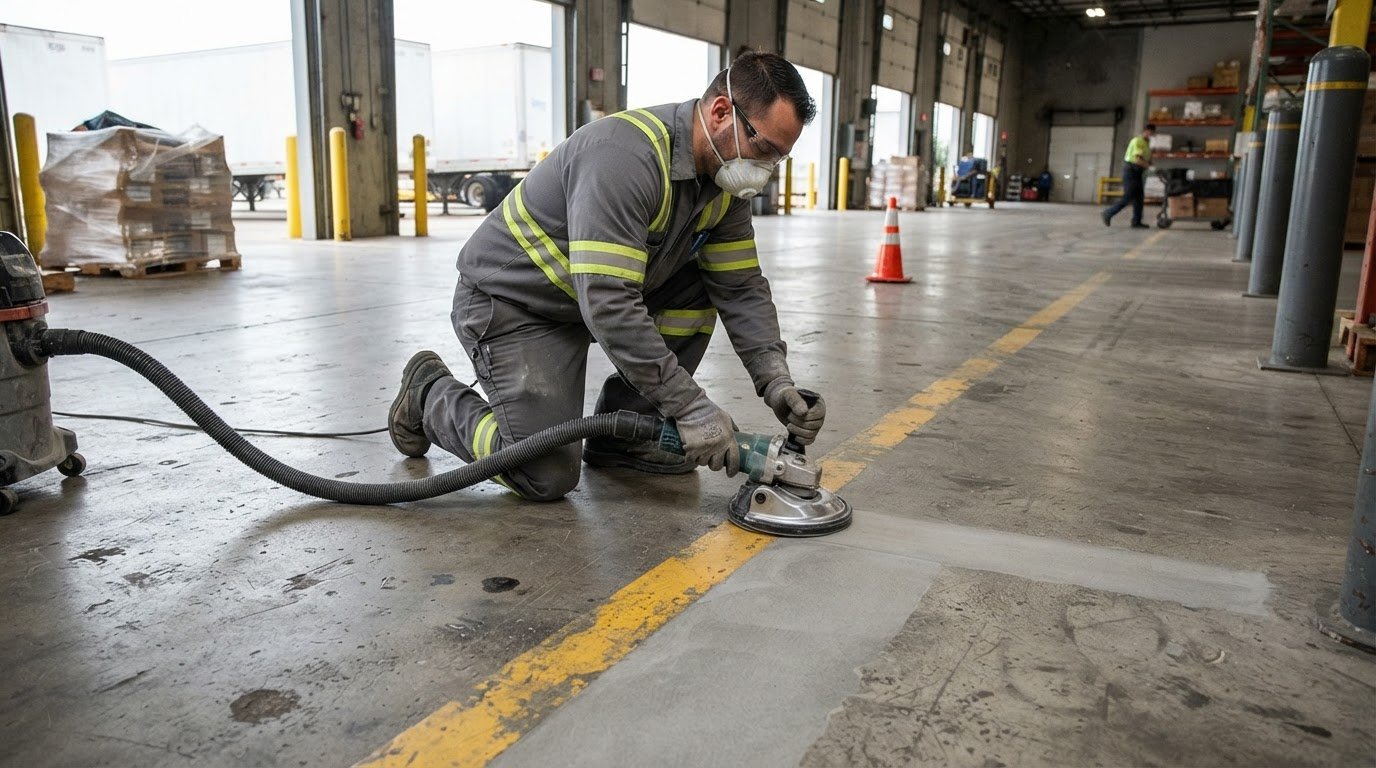
You should always include warehouse line removal in the same RFP to ensure a single point of accountability for the final surface bond. Professional contractors use shot blasting or diamond grinding to remove old markings while simultaneously creating the necessary profile for the new coating. Combining these services prevents adhesion failures caused by applying new materials over incompatible or failing old paint.
What OSHA regulations must be mentioned in my RFP?
Your RFP must explicitly mandate compliance with OSHA standard 1910.22, which governs walking-working surfaces in industrial environments. This regulation requires that all permanent aisles and passageways be clearly marked and kept free of obstructions. Specifying this standard ensures that the bidding contractors provide a safety marking system that meets federal requirements for pedestrian and vehicle separation.
Can I specify floor tape instead of paint in my RFP?
Floor tape is an option for low-traffic zones or temporary staging areas, but it’s rarely suitable for heavy-duty forklift lanes. Industrial tapes can peel or tear when subjected to the pivoting tires of a loaded forklift or the dragging of heavy pallets. For high-volume distribution centers, epoxy or polyurethane coatings offer a more permanent solution that resists the physical stress of 24/7 operations.
What is the best material to specify for high-traffic forklift aisles?
A 100% solids epoxy is the superior choice for high-traffic thoroughfares due to its extreme abrasion resistance and chemical bonding properties. This material creates a thick, durable layer that doesn’t easily chip or wear down under the friction of industrial tires. When paired with mechanical shot blasting, it provides the longest service life and the best return on investment for your facility floor.
How do I verify the industrial experience of a striping contractor?
Verify a contractor’s experience by requesting a list of completed projects exceeding 50,000 square feet and checking their Experience Modification Rate (EMR) for safety. A dependable veteran in the field should have a multi-decade history and be able to provide references from national distribution centers. This documentation proves they have the specialized equipment and safety protocols required to work in a live warehouse environment.
Is a site walkthrough necessary before contractors submit their bids?
A site walkthrough is essential because it allows contractors to assess the concrete’s condition and identify potential logistical bottlenecks that could delay the project. Understanding how to write an RFP for warehouse striping involves scheduling these visits so bidders can take accurate measurements and evaluate existing surface prep needs. This step eliminates the guesswork that leads to unexpected change orders once the project begins.