A single oversight in your facility’s layout can trigger Department of Justice fines of up to $75,000 for a first offense. It’s a high price to pay for a few inches of misplaced paint. When managing ADA parking lot striping Greenville SC, facility directors often feel overwhelmed by the technical overlap of federal mandates and local safety needs. You need more than just a fresh coat of blue paint; you need a layout that stands up to federal scrutiny and high-volume industrial traffic.
We understand that deciphering stall widths and access aisle requirements feels like a liability minefield. This guide simplifies those complexities to ensure your commercial facility remains compliant, accessible, and safe for every visitor. We’ll examine the specific federal standards for standard and van-accessible stalls, the importance of mechanical surface preparation for long-term durability, and how to identify a contractor with the industrial tenure to execute these technical specifications correctly. Mastering these requirements protects your budget and ensures your infrastructure serves all users with professional reliability.
Key Takeaways
- Understand why federal ADA standards are mandatory for commercial facilities and how Department of Justice oversight helps prevent significant legal liabilities.
- Master the precise geometry required for ADA parking lot striping Greenville SC to ensure every stall and access aisle meets federal width and slope requirements.
- Identify the visual standards for blue and white contrast zones that maximize visibility and maintain safety for all facility visitors.
- Recognize the specific signs of material degradation, such as fading and peeling, that signal your parking lot requires immediate industrial-grade re-striping.
- Learn how coordinating outdoor parking compliance with indoor safety markings creates a unified and efficient environment for large-scale commercial operations.
Understanding Federal ADA Standards for Commercial Parking Lots
The Americans with Disabilities Act of 1990 serves as the federal civil rights foundation for all commercial infrastructure. It mandates that public accommodations remain accessible to individuals with disabilities, placing a heavy emphasis on the design and maintenance of parking facilities. The Department of Justice (DOJ) enforces these standards through strict audits and legal action, ensuring that accessibility isn’t treated as an optional upgrade. Every compliant stall must be clearly marked with the International Symbol of Access (ISA), which is the universal blue and white wheelchair icon that signals a reserved zone.
A common misconception among facility managers is the idea of “grandfathered” status. In reality, the DOJ requires property owners to remove architectural barriers in existing lots whenever such changes are readily achievable. If you’re planning any layout modifications or fresh parking lot line striping, your facility must align with current federal mandates. StripeGuys acts as a safety-conscious consultant during these projects, ensuring your layout reflects current law rather than outdated local habits.
The 2010 ADA Standards for Accessible Design
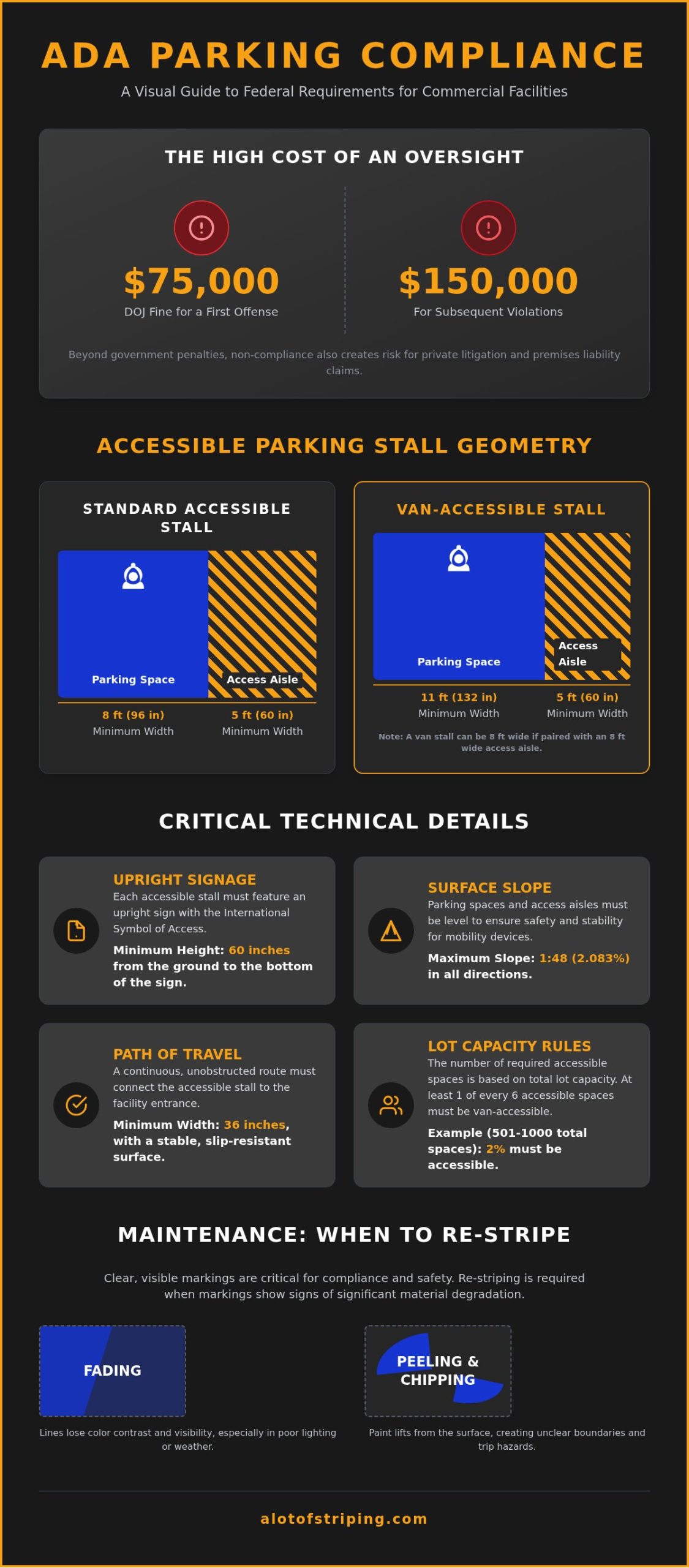
The 2010 update refined the requirements for how accessible spaces function within a larger site. For new construction, compliance is mandatory from day one, while existing facilities must prioritize barrier removal that is easily accomplishable. A critical technical requirement is the “path of travel,” which is the continuous, unobstructed route connecting the accessible stall to the building entrance. This path must be at least 36 inches wide and maintain a stable, slip-resistant surface. The safe harbor provision generally allows businesses to maintain 1991 standard compliance for elements that haven’t been altered since the 2010 standards took effect.
Consequences of Non-Compliance and Liability
Ignoring the specifics of ADA parking lot striping Greenville SC exposes your organization to extreme financial risk. Initial DOJ fines can reach $75,000, with subsequent violations climbing to $150,000. Beyond government penalties, private litigation from “drive-by” plaintiffs has become a frequent and expensive reality for commercial owners. Precise striping does more than just avoid fines; it significantly reduces premises liability by providing a clear, safe environment for all visitors. Documenting these compliance efforts is essential for insurance purposes, proving that the facility owner has prioritized safety and adherence to federal law.
Technical Specifications for Accessible Parking Space Geometry
Precision in stall geometry is the difference between a compliant facility and a legal liability. When planning ADA parking lot striping Greenville SC, facility managers must adhere to strict capacity ratios defined by federal law. For example, a lot with 501 to 1,000 spaces requires at least 2% of the total capacity to be accessible. Every six accessible spaces must include at least one van-accessible stall. These zones require high-contrast markings, typically using blue and white paint, to clearly define the International Symbol of Access (ISA). Every accessible stall must also feature an upright sign mounted at a minimum height of 60 inches to ensure visibility even when a vehicle is parked in the space.
For property owners performing maintenance, following official ADA guidance on restriping ensures that new markings don’t accidentally reduce the number of compliant spaces. If you’re unsure about your current layout, you can consult with our team to verify your facility’s adherence to these federal standards.
Standard vs. Van-Accessible Stall Dimensions
Federal standards distinguish between standard and van-accessible spaces based on the width of the stall and its adjacent aisle. A standard accessible stall must be at least 8 feet (96 inches) wide. Van-accessible stalls require more clearance, needing an 11-foot (132-inch) width. A van space can also be 8 feet wide if it’s paired with an 8-foot wide access aisle. These dimensions allow for the safe deployment of wheelchair lifts and ramps. Standard car-accessible spaces typically utilize a 5-foot (60-inch) access aisle, providing sufficient room for side-entry mobility aids.
Access Aisles and Loading Zones
The access aisle is a critical safety component that must remain level with the parking space. Federal law mandates a maximum slope of 1:48 (approximately 2.08%) in any direction to prevent wheelchairs from rolling or tipping. Two parking spaces can share a single access aisle, which maximizes space efficiency in high-traffic parking lot line striping projects. These aisles must be marked with diagonal hatching, also known as cross-stripping, to discourage illegal parking. To further clarify the zone’s purpose, “No Parking” stenciling should be applied within the aisle boundaries, serving as a clear visual deterrent for unauthorized vehicles.
Maintenance and Re-striping for Long-Term Compliance
High-traffic commercial environments demand high-visibility markings to maintain order and safety. Over time, UV exposure and constant vehicle friction cause standard traffic paints to fade, peel, or turn gray. When ADA markings lose their crisp edges, they effectively become non-compliant because they no longer provide the clear visual cues required by law. When facility managers evaluate the condition of their ADA parking lot striping Greenville SC, they must look for signs of significant degradation that could confuse drivers or pedestrians. Clear lines are essential for organizing traffic flow and protecting individuals with mobility challenges. If a visitor can’t distinguish an access aisle from a parking space, the risk of accidents and litigation increases.
Simply applying new paint over old, degraded lines is a short-term fix that leads to long-term failure. This practice often results in “ghosting,” where the previous layout remains visible or the new layer fails to bond properly and flakes away. StripeGuys prioritizes mechanical surface preparation to avoid these issues and ensure a durable finish. If your current markings are no longer vibrant and distinct, it’s time to schedule a professional assessment of your facility.
Surface Preparation and Line Removal
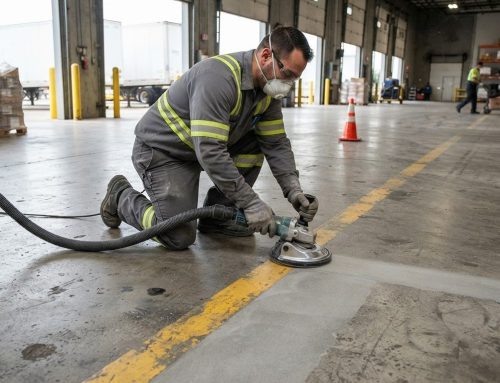
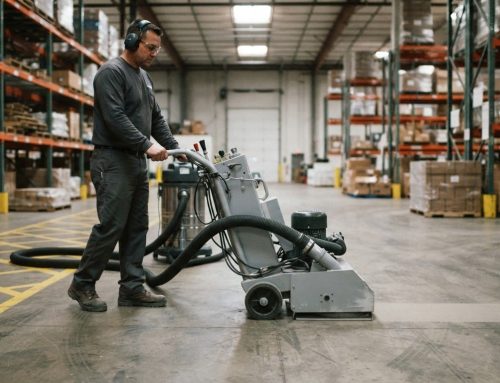
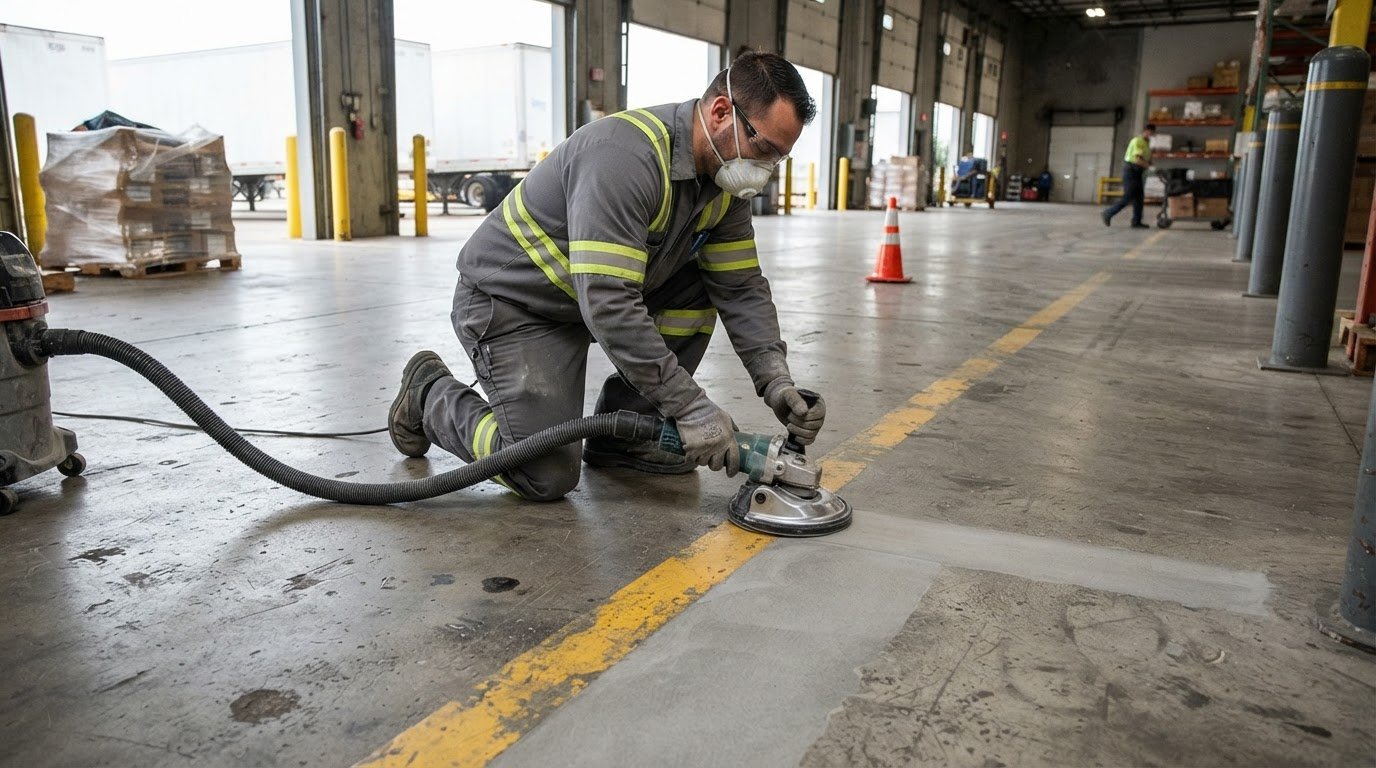
For new markings to last, the substrate must be free of debris and old material. We utilize industrial methods like shot blasting or grinding to achieve a clean surface profile. These techniques are superior to chemical stripping because they provide the mechanical “tooth” needed for superior paint adhesion. This process is similar to our approach for warehouse line removal, where removing old epoxy or thermoplastic is necessary to ensure the longevity of the new safety layout. Proper preparation ensures the new markings won’t peel under the stress of heavy industrial traffic.
Material Selection: Traffic Paint vs. Epoxy
Choosing the right material depends on your facility’s specific volume and environmental exposure. While water-based acrylics are cost-effective for low-traffic areas, high-performance epoxy coatings offer significantly better durability for industrial truck courts and loading zones. For ADA zones, we recommend the use of reflective glass beads to enhance nighttime visibility and safety. Adhering to the technical specifications for parking spaces ensures that your choice of material supports the required contrast and slip resistance. Professional reliability means selecting materials that survive the physical realities of your workspace while maintaining federal compliance.
Professional ADA Striping for Industrial and Commercial Facilities
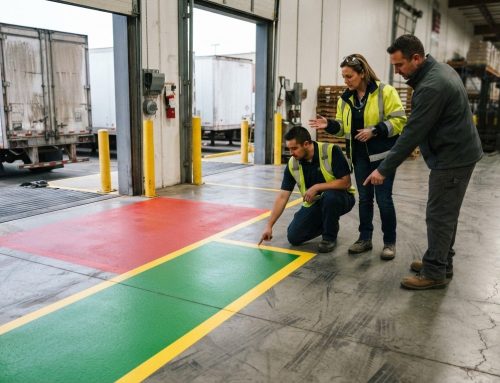
ADA compliance serves as a critical component of overall facility organization rather than a mere legal checkbox. In high-stakes industrial environments, such as large-scale distribution centers and manufacturing plants, the parking lot functions as the initial stage of a complex logistics chain. Clear and compliant ADA parking lot striping Greenville SC ensures that every visitor and staff member can navigate the site without confusion. We approach these projects with a focus on organizational efficiency, ensuring that accessible zones don’t interfere with freight lanes or heavy equipment movement. This strategic placement minimizes operational friction while maintaining a safe environment for everyone on-site.
Logistics operations rely on the seamless flow of personnel between the exterior and the interior of the building. The transition from outdoor accessible stalls to indoor pedestrian walkways must be logical, unobstructed, and clearly defined. StripeGuys utilizes 29+ years of industrial experience to ensure these pathways meet federal standards while supporting high-volume facility operations. We provide safety-conscious consulting to resolve layout conflicts, ensuring that your ADA parking lot striping Greenville SC remains functional under the stress of industrial traffic.
Integrating Parking and Warehouse Safety
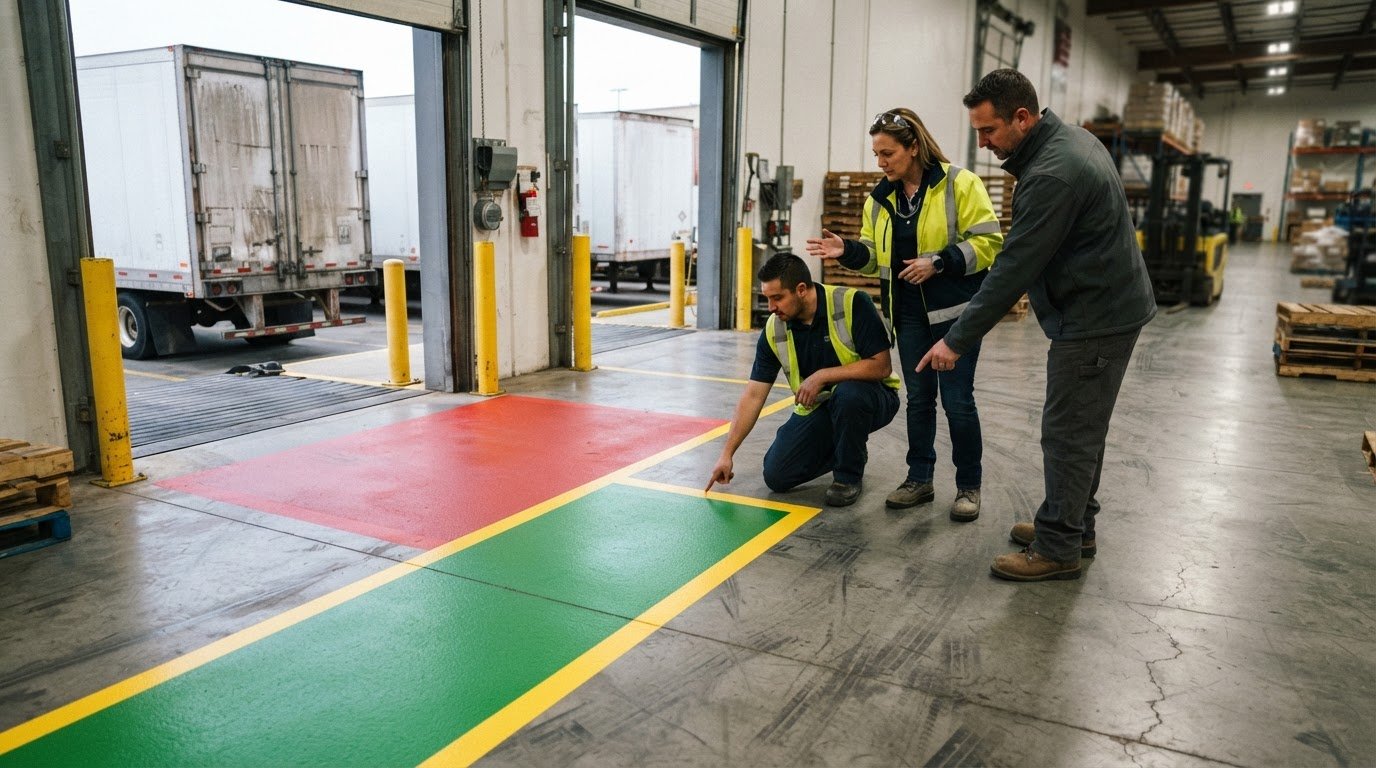
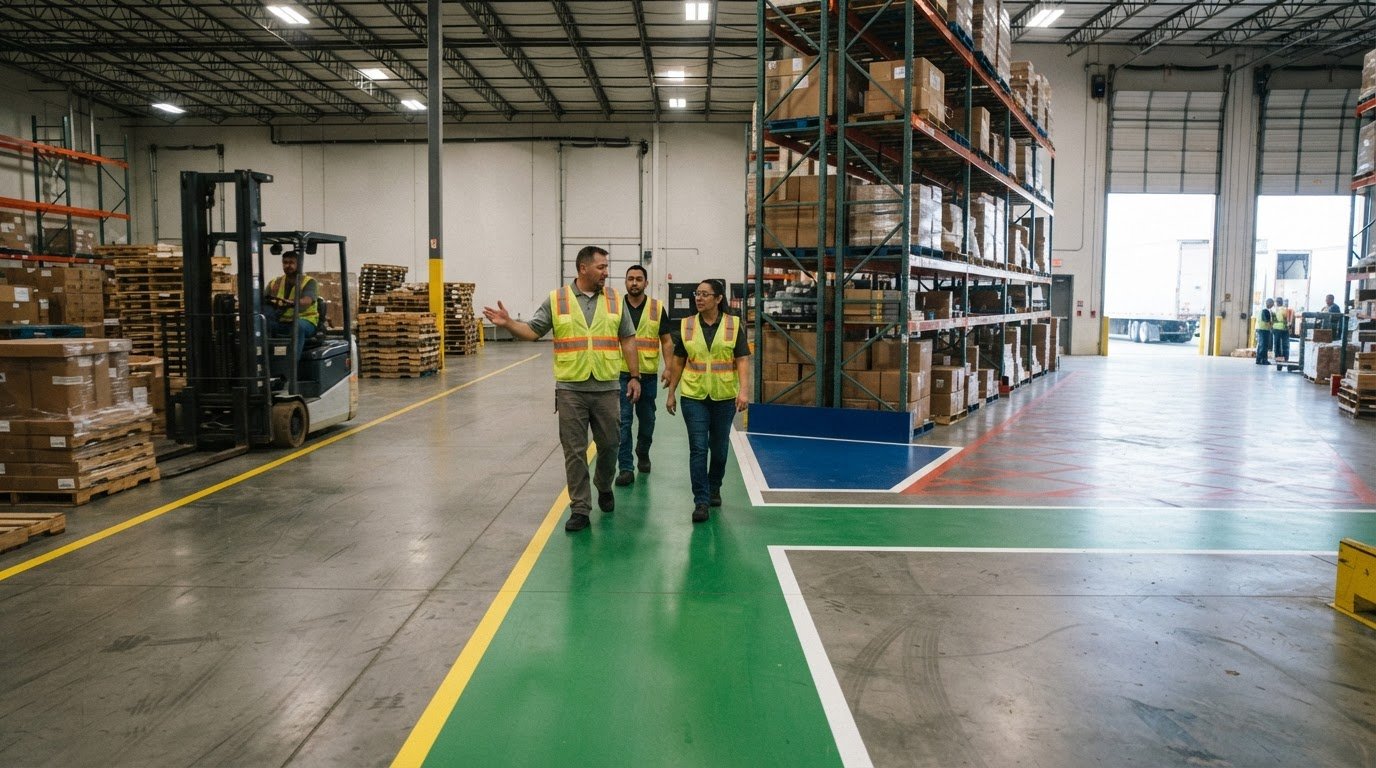
A cohesive safety plan extends from the front curb directly to the shipping dock. When we execute professional parking lot line striping, we analyze how those outdoor markings align with your interior safety aisles. Consistent stenciling and standardized color coding across the entire facility reduce cognitive load for employees, which directly improves workplace safety. This facility-wide approach prevents the safety gaps that general painting contractors often overlook. By maintaining a unified marking system, you ensure that safety protocols remain clear from the moment a vehicle enters the property.
Why Industrial Veterans Outperform General Contractors
General painters often prioritize aesthetic flair, but industrial veterans prioritize functional outcomes and strict regulatory adherence. StripeGuys understands the high stakes of large-scale infrastructure, offering nationwide coverage that supports multi-site logistics operations with professional reliability. Our project-based efficiency ensures that work is completed within tight windows to minimize disruption to your daily schedule. We emphasize mechanical surface preparation to guarantee that your investment survives the physical realities of a hardworking industrial workspace. For a partner who understands the technical demands of your facility, contact StripeGuys for a professional ADA compliance assessment to secure your infrastructure.
Securing Long-Term Compliance and Facility Safety
Maintaining a compliant facility requires a technical commitment to federal standards and precise execution. We’ve established that ADA parking lot striping Greenville SC is more than a visual update; it’s a critical legal and safety requirement that demands industrial-grade materials and mechanical surface preparation. By focusing on exact stall geometry and the synergy between outdoor zones and indoor pedestrian walkways, you protect your organization from liability while improving overall operational flow. These standards ensure that every visitor can navigate your property without risk or confusion.
StripeGuys brings over 29 years of industrial marking expertise to every project, providing nationwide service for large-scale commercial hubs. We specialize in federal ADA and OSHA compliance, ensuring your markings remain durable under the stress of heavy traffic. Secure your facility with professional ADA striping from StripeGuys to ensure your infrastructure meets the highest safety standards. Taking proactive steps now prevents costly legal complications and ensures your facility remains accessible to everyone. Our team is ready to help you maintain a safe and organized environment.
Frequently Asked Questions
How many ADA parking spaces are required for my commercial lot?
Federal law mandates a specific ratio based on your lot’s total capacity. For parking lots with 501 to 1,000 spaces, 2% of the total capacity must be ADA-compliant. Smaller facilities with 1 to 25 total spaces require at least one accessible stall. It’s critical to calculate these numbers correctly to avoid DOJ fines. StripeGuys acts as a safety-conscious consultant to ensure your layout meets these technical requirements without wasting valuable real estate.
What is the difference between a car-accessible and a van-accessible space?
The primary difference lies in the width of the stall and the adjacent access aisle. A standard car-accessible stall requires a minimum width of 96 inches. Van-accessible stalls must be at least 132 inches wide to accommodate side-loading ramps. Alternatively, a van stall can be 96 inches wide if it’s paired with a 96-inch access aisle. At least one out of every six accessible spaces must be van-accessible to maintain federal compliance.
Is it legal to use blue paint only for ADA markings?
While blue is the industry standard for identifying accessible zones, federal regulations prioritize high-contrast visibility. The International Symbol of Access (ISA) typically features a white wheelchair icon on a blue background. Using blue paint alone without the proper stenciling or contrast doesn’t meet federal requirements. StripeGuys uses high-performance epoxy coatings to ensure these colors remain vibrant and distinct. Proper contrast ensures that drivers clearly recognize reserved areas, reducing the risk of unauthorized parking.
How often should I re-stripe my parking lot to maintain compliance?
Most commercial facilities require re-striping every 12 to 24 months to ensure ADA parking lot striping Greenville SC remains fully compliant. High-traffic environments or areas with heavy UV exposure may need more frequent maintenance. If your markings show signs of fading, peeling, or graying, they no longer provide the clear visual cues required by the Department of Justice. Regular maintenance prevents legal liabilities and maintains a professional, organized appearance for your facility.
Do I need to remove old, non-compliant lines before re-striping?
Removing old or non-compliant lines is essential to prevent “ghosting,” where previous markings remain visible under new paint. StripeGuys utilizes mechanical removal methods like shot blasting or grinding to create a clean substrate. This process ensures superior adhesion for new markings and prevents premature peeling. Simply painting over old lines often leads to a confusing layout that can trigger safety violations. Proper surface preparation is the only way to guarantee long-term durability and technical accuracy.
What are the height requirements for ADA parking signs?
Signs identifying accessible parking spaces must be mounted at a minimum height of 60 inches from the ground surface to the bottom of the sign. This ensures the sign remains visible even when a vehicle is parked in the stall. For van-accessible spaces, an additional sign stating “Van Accessible” must be mounted below the symbol of accessibility. Correct sign placement is a mandatory part of federal compliance that works in tandem with your lot’s pavement markings. For owners looking to modernize their signage and reservation systems, you can discover CurbFlip to explore scannable signs that enhance facility oversight.