Most facility managers treat line removal as a simple demolition task, but in 2026, it’s actually a high-stakes engineering requirement that can halt your production if handled poorly. You likely recognize that outdated, peeling lines aren’t just an eyesore; they’re a liability that risks inventory contamination and safety non-compliance. Whether you’re managing the latest OSHA dust containment standards or the mandatory 0.5 coefficient of friction requirements, the process of industrial floor marking removal must be precise to avoid permanent concrete damage.
This guide provides the technical roadmap to master removal strategies that eliminate the threat of airborne silica dust and prevent “ghosting” on your slabs. We’ve spent over 29 years refining these mechanical processes to ensure your facility remains operational during the transition. You’ll learn how to select between shot blasting and diamond grinding to achieve a residue-free surface that’s ready for high-durability epoxy (which can last up to 10 years in heavy environments) without disrupting your vital daily supply chain.
Key Takeaways
- Learn why industrial-grade markings migrate into concrete pores and how to address this deep adhesion without causing structural damage to your slab.
- Evaluate shot blasting versus diamond grinding to select the most efficient method for industrial floor marking removal based on your facility’s specific floor profile.
- Implement professional dust containment and phased scheduling to protect your inventory and maintain production during the removal process.
- Understand the mechanical profiling required to create an “anchor pattern” that ensures your next epoxy application bonds permanently.
- Navigate the latest 2026 OSHA safety and friction standards to ensure your facility remains compliant and safe after the lines are cleared.
The Science of Industrial Floor Marking Adhesion and Removal
Industrial markings are engineered for extreme durability to withstand heavy forklift traffic and harsh chemical exposure. This permanence is achieved through a mechanical and chemical bond with the concrete substrate. When you’re facing an industrial floor marking removal project, you’re fighting the very qualities that made the markings successful in the first place. High-performance materials like epoxy line painting are designed to cross-link with the floor surface, creating a monolithic (single-layer) structure that doesn’t simply sit on top of the slab.
Concrete may look solid, but it’s a porous material filled with microscopic capillaries. During application, liquid resins and paints migrate deep into these pores. If you only use simple scraping or light sanding, you only remove the surface “cap” of the marking. The material embedded in the pores remains visible, a phenomenon known as “ghosting.” These ghost lines are more than an aesthetic issue; they create visual clutter that can lead to navigation errors in high-traffic zones, directly impacting facility safety.
Understanding the Concrete-Marking Bond
The difficulty of removal depends heavily on whether the concrete was sealed prior to the initial striping. Unsealed concrete acts like a sponge, drawing epoxy resins deeper into the substrate. While Floor marking tape provides a surface-level solution for temporary needs, permanent markings require a mechanical profile to stay put. We’ve found that chemical strippers often fail in large-scale environments because they leave behind a slick residue (a thin film of unreacted chemicals) that compromises the adhesion of any future coatings. This makes mechanical methods the only reliable choice for professional results.
The Risks of Improper Removal Techniques
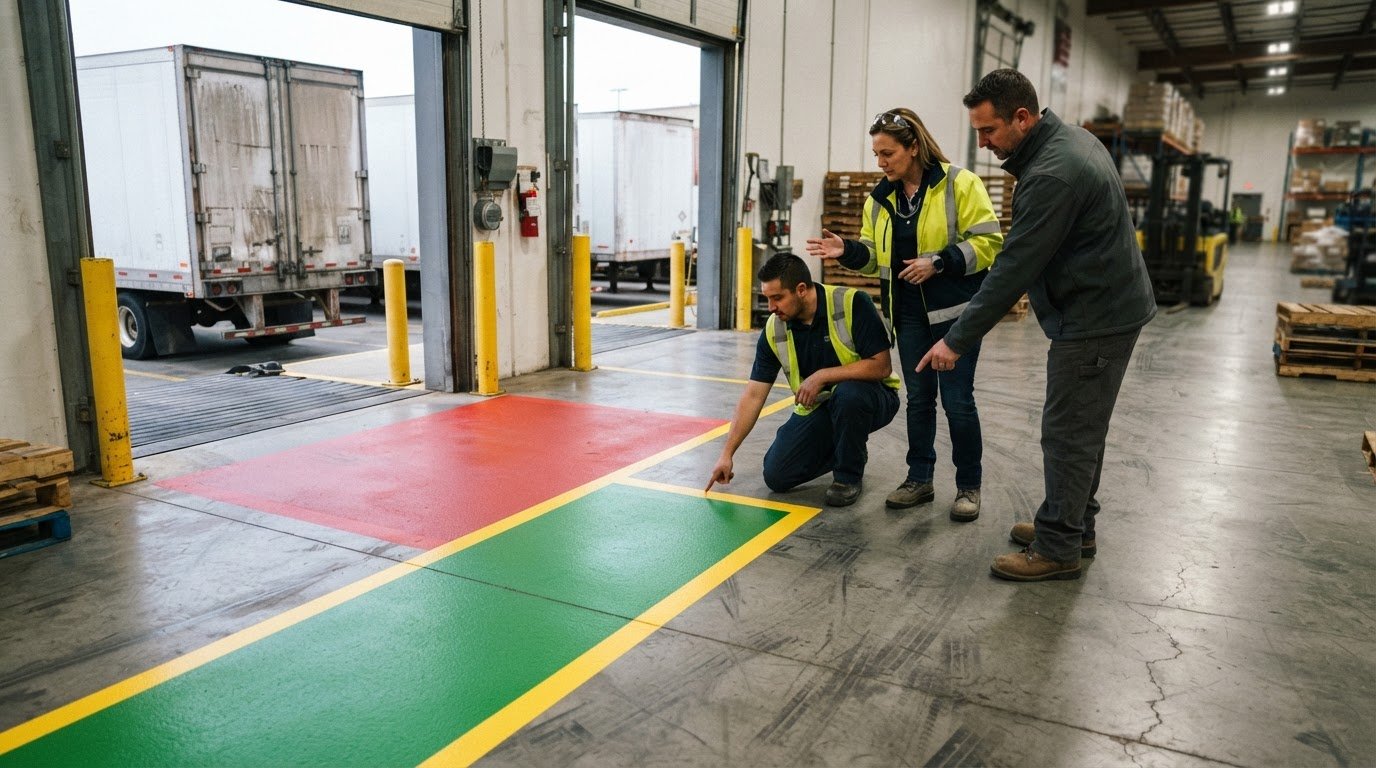
Inexperienced contractors often resort to aggressive grinding that causes concrete pitting (the creation of small craters or uneven dips in the slab). This ruins the floor’s structural integrity and creates trip hazards for pedestrians. Beyond physical damage, improper industrial floor marking removal leaves “ghost lines” that violate OSHA clarity standards. If a forklift operator sees two sets of conflicting aisle markers, the risk of a collision increases significantly. Proper removal must leave a clean, profiled surface that meets the 2026 friction requirements while ensuring new warehouse floor striping can bond correctly to the slab.
Mechanical Removal Methods: Shot Blasting vs. Diamond Grinding
Selecting the right mechanical method is the most critical decision in any industrial floor marking removal project. You can’t use a one-size-fits-all approach because the equipment used to strip the lines determines the floor’s final profile. Most industrial contractors rely on two primary techniques: shot blasting and diamond grinding. While both remove old markings, they serve different operational goals based on the floor’s future application.
For facilities dealing with heavy-duty build-up or thick thermoplastic lines, we sometimes employ scabbling (a process using piston-driven heads to impact the floor). This is a more aggressive technique for extreme cases where paint layers have reached a significant thickness. However, for the majority of warehouse environments, the choice comes down to the desired surface profile and the type of new marking being applied.
Shot Blasting: The Gold Standard for Surface Prep
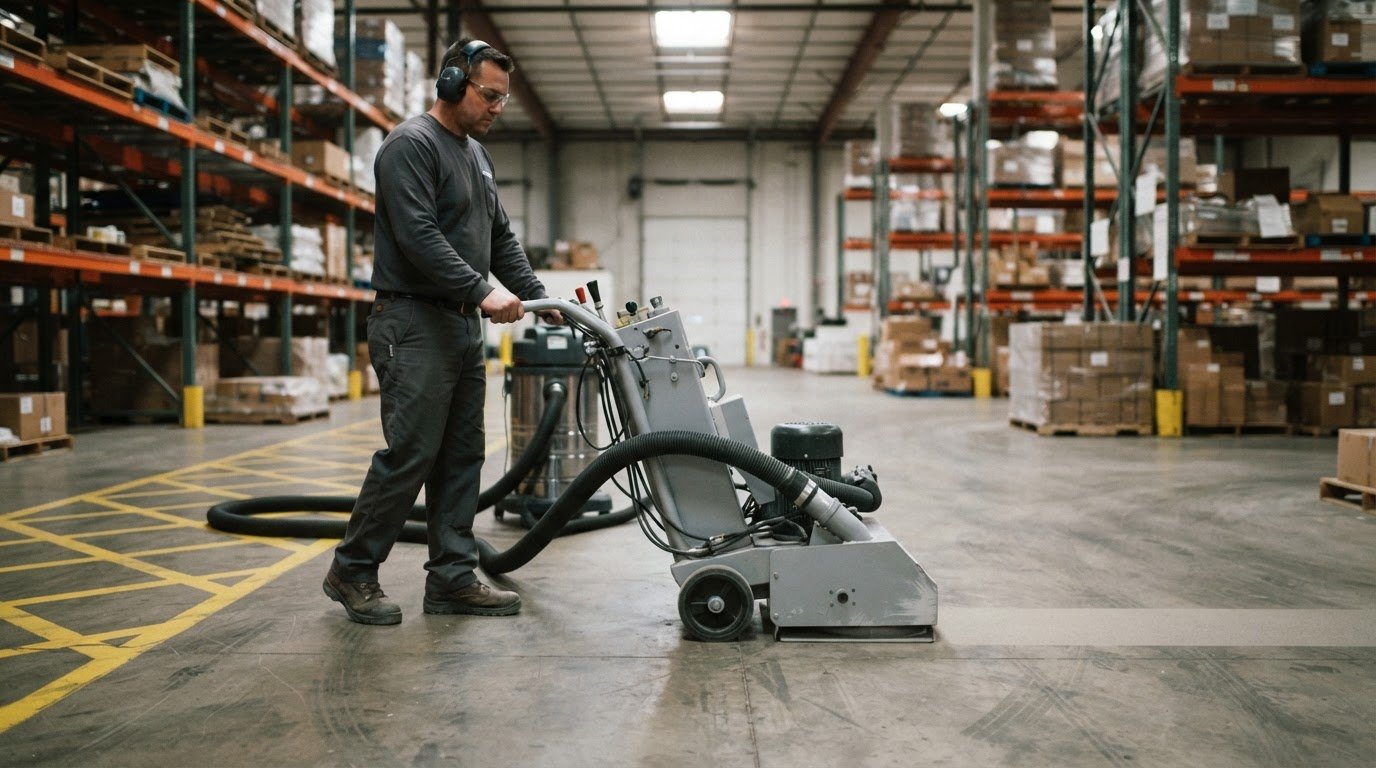
Shot blasting is the preferred method for large-scale distribution centers and manufacturing plants. The machine uses a centrifugal blast wheel to propel steel shot at the concrete at high velocities. This process strips the old paint while simultaneously profiling the concrete to a CSP (Concrete Surface Profile) of 3 to 5. This creates an “anchor pattern” (a rough surface that allows new coatings to grip), which is essential before applying epoxy warehouse striping.
The primary benefit of shot blasting is its efficiency in a closed-loop system. The machine’s internal vacuum recovers the steel shot and the removed debris in one pass. This creates a dust-free environment, making it ideal for facilities with sensitive electronics or food-grade inventory. Because it preps the floor so thoroughly, it’s the only reliable way to ensure new markings won’t peel under heavy forklift traffic. If you need a high-durability finish, you can consult with our removal specialists for a technical assessment.
Diamond Grinding: Precision and Smoothness
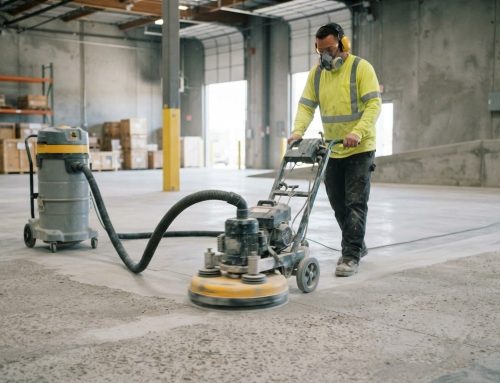
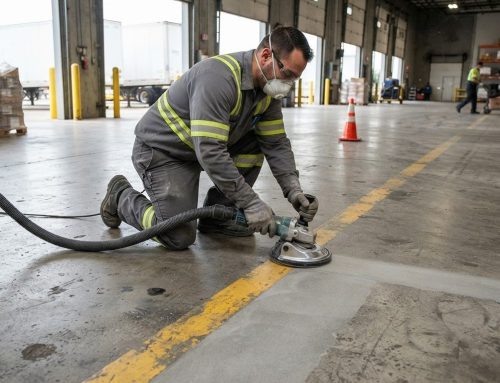
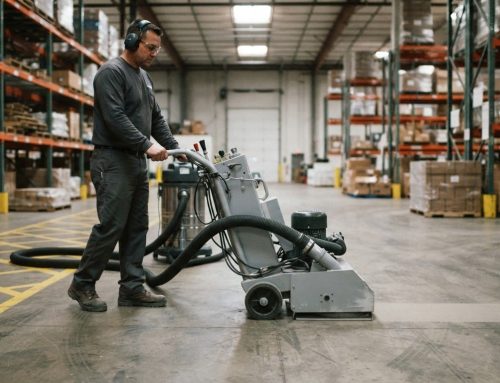
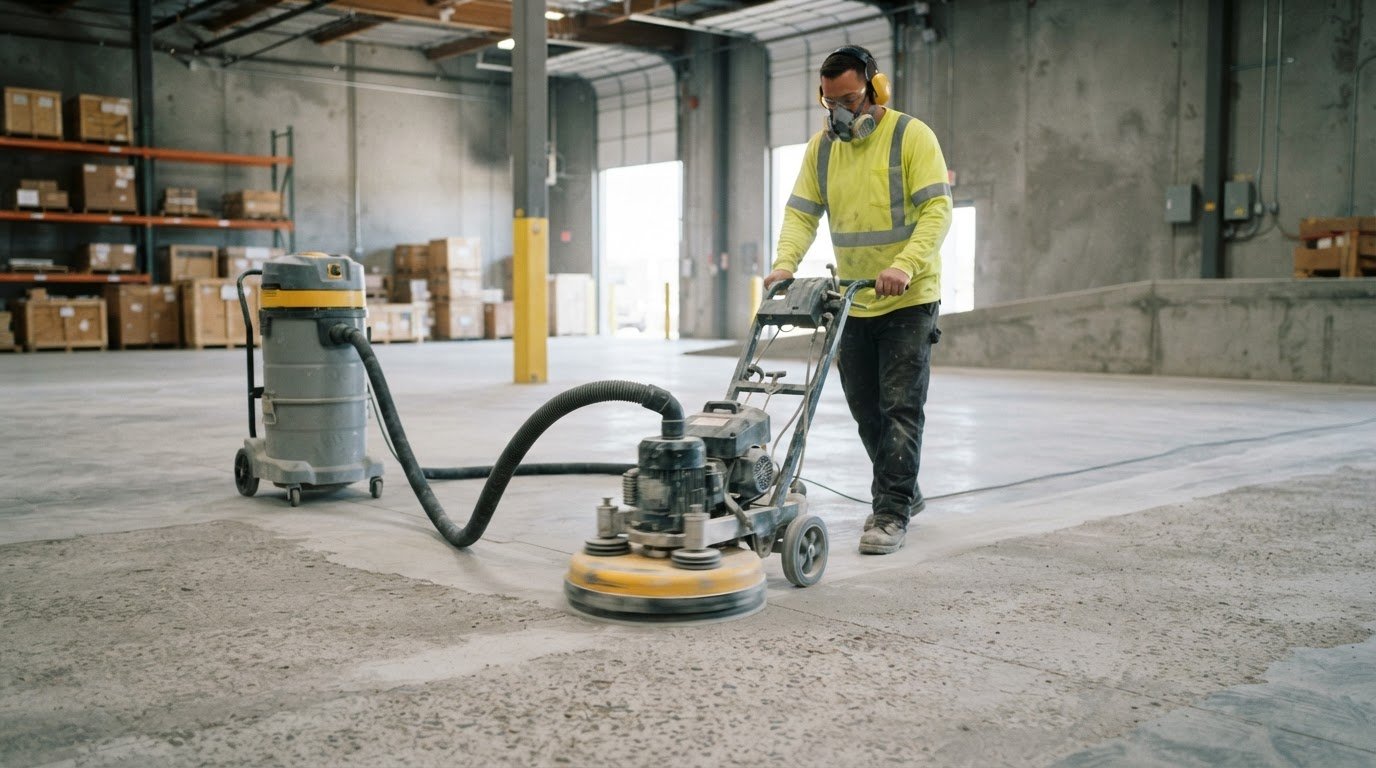
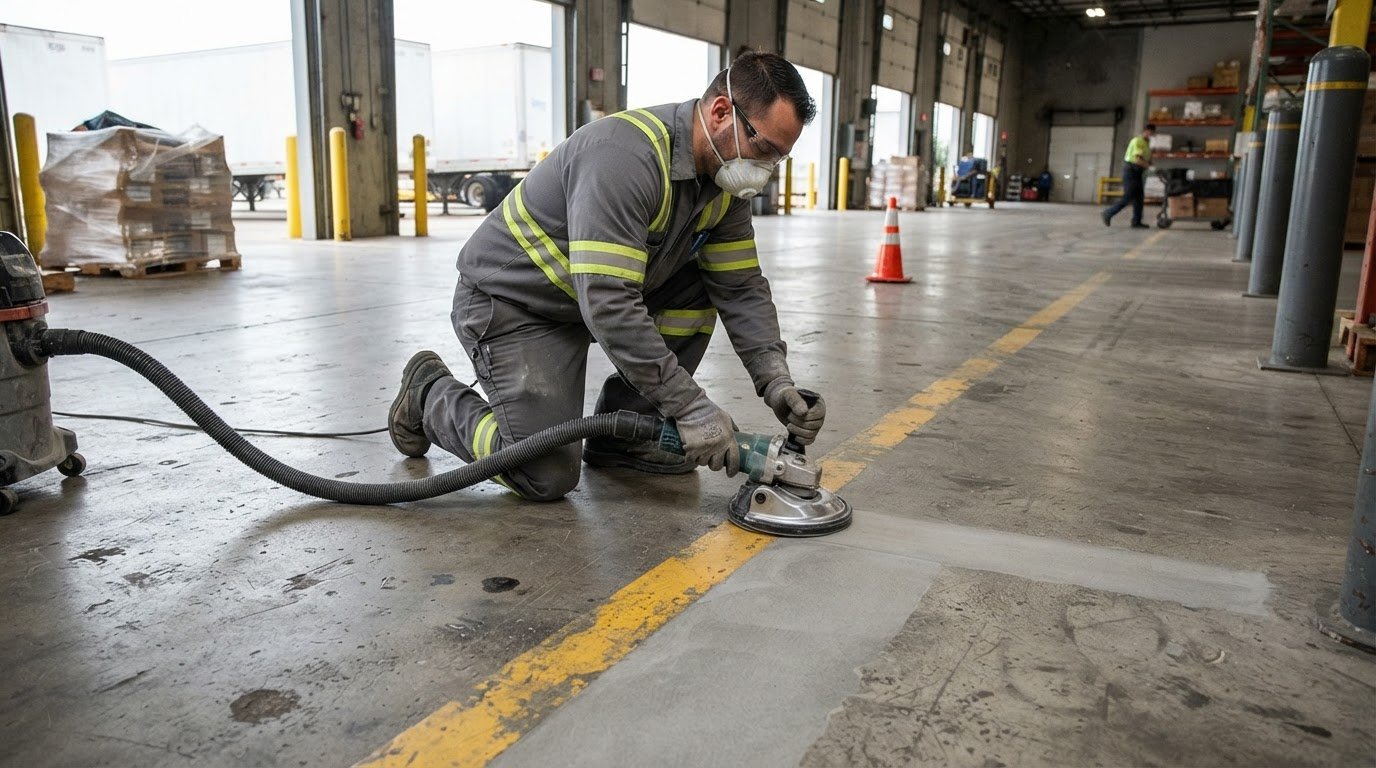
Diamond grinding uses rotating discs embedded with industrial diamonds to shave the surface of the concrete. This method is slower than shot blasting but provides a much smoother finish. It’s the ideal choice for low-clearance areas or floors where aesthetics are a priority. Grinding removes the marking without significantly altering the floor’s structural integrity, which is vital for decorative industrial slabs or when applying thin-film coatings.
Safety is paramount during this process. Because grinding can generate significant concrete dust, we use specialized HEPA-filtered vacuum systems to maintain air quality. Adhering to OSHA guidelines on silica dust control isn’t just about compliance; it’s about protecting your employees from respiratory hazards. Proper industrial floor marking removal requires this level of precision to ensure the slab remains safe for immediate use.

Operational Planning: Managing Dust, Downtime, and Safety
Successful industrial floor marking removal isn’t just about the machinery; it’s about the logistics of working within a live distribution environment. Removing thousands of linear feet while maintaining facility throughput requires a precision-timed operational strategy. We prioritize functional outcomes by scheduling work during low-traffic windows, such as night shifts or weekend blocks, to minimize the impact on your bottom line. This planning ensures that the transition to new pedestrian walkways and safety aisles doesn’t result in costly operational bottlenecks or safety gaps.
Before any equipment arrives, facility managers should use a site-readiness checklist to streamline the process. This includes clearing a five-foot buffer zone around all lines, relocating high-value inventory away from the work area, and ensuring all floor-mounted obstacles are flagged. These steps prevent accidental damage and allow our crews to maintain a high-speed removal rhythm (the physical pace of the machine across the slab). Preparation is the key to finishing on time and within the projected budget.
Phased Removal Strategies for 24/7 Facilities
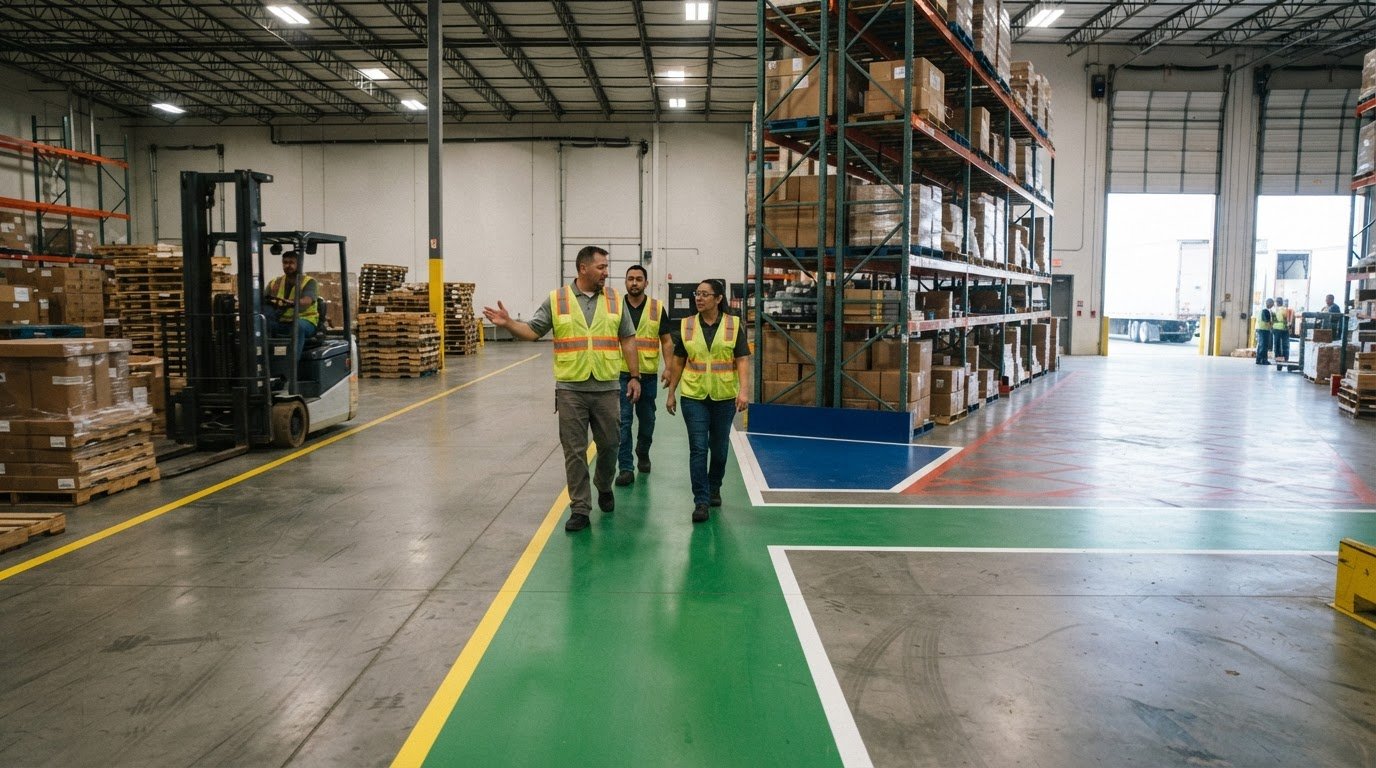
In facilities that never close, we implement a phased zone approach to keep your operations moving. We divide the warehouse into “active” and “work” zones, using temporary physical barriers to isolate the removal site. This allows forklift traffic to continue in one sector while mechanical removal occurs in another. We establish clear communication protocols, using high-visibility signage and direct radio contact with floor supervisors, to ensure every employee knows which transit lines are currently out of service. This prevents the confusion often caused by half-removed markings during the transition period.
Environmental and Safety Compliance
Air quality is a non-negotiable priority in modern industrial settings. Our shot blasting and grinding units utilize integrated HEPA-filtered vacuum systems to capture silica dust at the source. This protects sensitive electronics and prevents inventory contamination that could lead to product loss. We also handle the safe disposal of all removed debris, treating old epoxy and paint as regulated waste (ensuring compliance with local environmental codes). If your facility needs a clean, compliant removal strategy, contact our project managers today to schedule a technical site walkthrough.
Beyond Erasing: Surface Preparation for High-Performance Re-Striping
Removing old lines is only half the battle. The quality of your industrial floor marking removal directly dictates the lifespan of your next striping project. If the surface isn’t mechanically profiled to create an “anchor pattern” (a textured surface that increases the bonding area), new coatings will simply sit on top of the concrete rather than integrating with it. This leads to premature delamination, especially in high-traffic forklift lanes where shear forces are greatest. We treat removal not as a cleaning task, but as the foundational step of surface preparation.
Before any re-application begins, a rigorous final inspection is mandatory to ensure the slab is ready for a permanent bond. We test for moisture vapor emission rates and check the pH level of the concrete to ensure it falls within the acceptable 7.0 to 10.0 range. We also perform a standard “tape test” to verify that no latent dust remains from the industrial floor marking removal phase. These technical checkpoints prevent the common adhesion failures that plague less experienced contractors.
Matching the Profile to the Coating
Selecting the correct Concrete Surface Profile (CSP) is essential for a successful transition to new warehouse line striping. Thin-film paints typically require a smoother CSP 1 or 2, while high-build systems like epoxy need a more aggressive CSP 3 to 5 to achieve a permanent mechanical grip. You must also ensure that “ghost lines” are completely neutralized because any residual pigment can bleed through light-colored markings, creating a confusing and unprofessional finish. For a 100% solids epoxy coating, the ideal surface profile is a CSP 3 achieved through consistent shot blasting.
The StripeGuys Warhouse Line Striping Advantage: 29 Years of Surface Expertise
Our team brings over 29 years of industrial experience to every project site. Because StripeGuys Warhouse Line Striping specializes in both removal and professional re-application, we eliminate the logistical friction that occurs when managing multiple vendors. This dual expertise allows us to guarantee that the removal method used today won’t compromise the safety markings you install tomorrow. For national facility managers, we provide a single-source solution that maintains consistent operational standards across your entire infrastructure. You can contact StripeGuys Warhouse Line Striping for a professional surface evaluation to determine the best removal and re-striping strategy for your facility.
Secure Your Facility’s Operational Excellence
As we move through 2026, the standard for floor maintenance has shifted from simple aesthetics to rigorous technical compliance. Successful industrial floor marking removal requires more than just clearing away old lines; it demands a precise mechanical profile that ensures your next safety investment actually lasts. By choosing specialized shot blasting or grinding over outdated chemical or manual methods, you protect your concrete substrate and maintain the air quality of your active warehouse environment. These mechanical processes are the only way to meet the latest OSHA friction and clarity standards without risking permanent slab damage.
With over 29 years of industrial experience and specialized equipment, StripeGuys provides the nationwide coverage necessary for high-profile distribution centers and airports. We don’t just erase the past; we prepare your floor for a safer, more efficient future. Our team is ready to help you navigate these technical requirements while keeping your production on schedule. Your facility deserves a clean slate that supports long-term durability and organizational clarity.
Maintaining structural integrity often requires a multi-faceted approach; for property managers who handle both industrial sites and historic architecture, Progressive Contracting NY Corp provides specialized masonry and facade restoration services that ensure long-term building health.
Get a Professional Quote for Your Industrial Line Removal Project
Frequently Asked Questions
Will industrial floor marking removal damage my concrete?
Professional removal using calibrated machinery won’t damage your slab when performed by experienced contractors. While aggressive, unmanaged grinding can lead to pitting, controlled shot blasting and diamond grinding actually improve the surface by removing weak laitance (a thin layer of brittle cement) and creating a uniform profile. This technical precision preserves the structural integrity of your floor while preparing it for new safety markings.
If your facility’s floor requires more than just surface preparation—such as structural repairs or new slab sections—you can visit Plano Concrete Service to learn about their professional concrete installation and repair capabilities.
Can we stay operational while the lines are being removed?
You can maintain full production by utilizing phased zone removal and specialized dust containment systems. We employ high-performance HEPA-filtered vacuums that capture particulates at the source, preventing inventory contamination. By scheduling work during off-peak windows or isolating active work zones with physical barriers, we ensure your facility’s throughput remains undisrupted throughout the project.
How long does the removal process typically take for a large warehouse?
Project timelines depend on the specific method used, but shot blasting is exceptionally efficient for large-scale environments. It’s possible to prep up to 30,000 square feet per day using advanced shot blasting equipment. This high-speed process allows for rapid industrial floor marking removal, ensuring that even distribution centers with thousands of linear feet can return to full capacity within a tight operational window.
Why shouldn’t I use chemical strippers for warehouse line removal?
Chemical strippers are generally unsuitable for large facilities because they leave behind a slick residue that compromises the adhesion of future coatings. These chemicals often penetrate the concrete pores and can react negatively with new epoxy resins. Additionally, managing the runoff and hazardous fumes in a 24/7 industrial environment creates significant safety risks and logistical hurdles that mechanical removal completely avoids.
What is ‘ghosting’ and can it be completely fixed?
Ghosting occurs when pigments from old markings migrate deep into the concrete capillaries, leaving a visible shadow after the surface layer is removed. This can be completely resolved through mechanical profiling that reaches into the substrate’s pores. By removing the top 1/16 to 1/8 inch of the concrete surface, we eliminate the embedded resin and provide a clean, neutral slate for your new layout.
How do I know if I need shot blasting or diamond grinding?
Your choice depends on the type of new marking you plan to install and the current condition of your floor. Shot blasting is the standard for high-durability epoxy systems because it creates an aggressive CSP 3 to 5 profile for maximum bonding. Diamond grinding is better suited for thin-film paints or facilities where a smooth, aesthetic finish is the priority. Industrial floor marking removal specialists can evaluate your floor chemistry to recommend the most effective technical approach.