Did you know that OSHA reports approximately 85 fatal forklift accidents and 34,900 serious injuries annually, yet nearly 70% of these incidents are entirely preventable with proper safety protocols? It’s a stressful reality for warehouse managers who watch high-traffic lines peel away under heavy pivoting or struggle to interpret confusing floor layouts that lead to near-misses. You likely already know that keeping your facility organized is a full-time job, and the constant anxiety over potential OSHA fines for non-compliant aisles can be exhausting.
This guide provides the expert-level forklift traffic safety marking guidelines you need to master technical layout strategies and ensure your facility meets 29 CFR 1910.176(a) standards. We’ll examine the specific OSHA requirements for aisle clearance, explore industrial best practices for long-lasting material application (such as professional surface preparation for better adhesion), and show you how to build a visual communication system that survives 24/7 operations while protecting every member of your team. By the end of this article, you’ll have a clear roadmap to achieving a zero-accident safety record through professional surface engineering and precise layout planning.
Key Takeaways
- Learn the critical differences between OSHA 1910.176(a) mandates and ANSI Z535.1 color-coding to ensure your facility meets both legal and industry safety benchmarks.
- Master the forklift traffic safety marking guidelines for 2026 by implementing a standardized color system that clearly differentiates traffic lanes from emergency equipment zones.
- Discover why industrial epoxy line painting is the essential solution for high-traffic pivot points where traditional floor tape fails to provide long-term reliability.
- Identify and eliminate “near-miss” hotspots by conducting a professional traffic flow audit that separates pedestrian walkways from heavy mechanical handling routes.
- Optimize your warehouse organization with durable surface engineering strategies that protect your personnel and help your facility maintain a zero-accident safety record.
Navigating OSHA and ANSI Forklift Traffic Marking Standards
OSHA 1910.176(a) establishes a clear mandate: permanent aisles and passageways must be appropriately marked wherever mechanical handling equipment is used. This regulation is brief but carries heavy weight during inspections because unmarked lanes lead to chaotic traffic flow and increased collision risks. To properly implement forklift traffic safety marking guidelines, facilities must look to ANSI Z535.1 for technical color and visibility standards. This industry standard provides the visual framework for safety communication, ensuring that markings are recognizable even in high-output industrial settings. Under current safety codes, the physical demarcation of forklift lanes is a mandatory legal requirement for any facility utilizing mechanical handling equipment to prevent catastrophic structural and personal accidents.
While the law allows for lines as narrow as 2 inches, this is often insufficient for large-scale warehouses. We find that a 4-inch to 6-inch width is the professional industrial standard because it provides the visual weight necessary for a Forklift operator to identify boundaries while moving at operational speeds. Wider lines also offer better resistance to the abrasive wear caused by heavy tires and frequent pivoting (the sharp turning of equipment that typically grinds away inferior paint).
Aisle Clearance and Load Dimensions
Safe aisle design depends entirely on your specific equipment and inventory. You should calculate the required aisle width by taking the dimension of your widest forklift load and adding 3 feet of total clearance (providing 18 inches of buffer on each side). Our team also designates “No Parking” zones using standardized cross-hatch patterns near fire extinguishers and emergency exits to maintain strict fire code compliance. It’s also vital to identify and mark dead-end aisles; these areas require extra-wide markings to prevent operator entrapment and provide sufficient room for 180-degree turns.
Pedestrian Separation and Right-of-Way
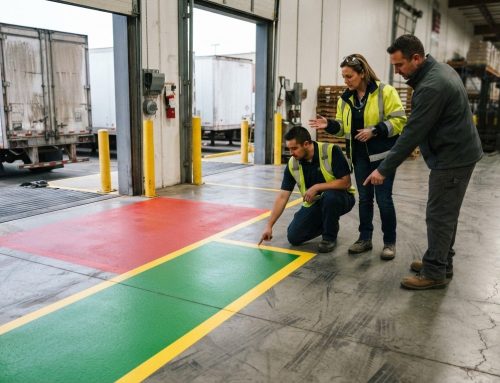
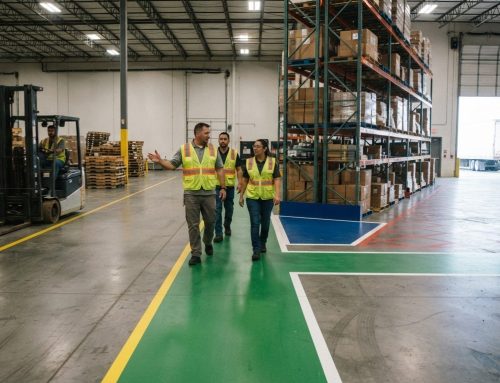
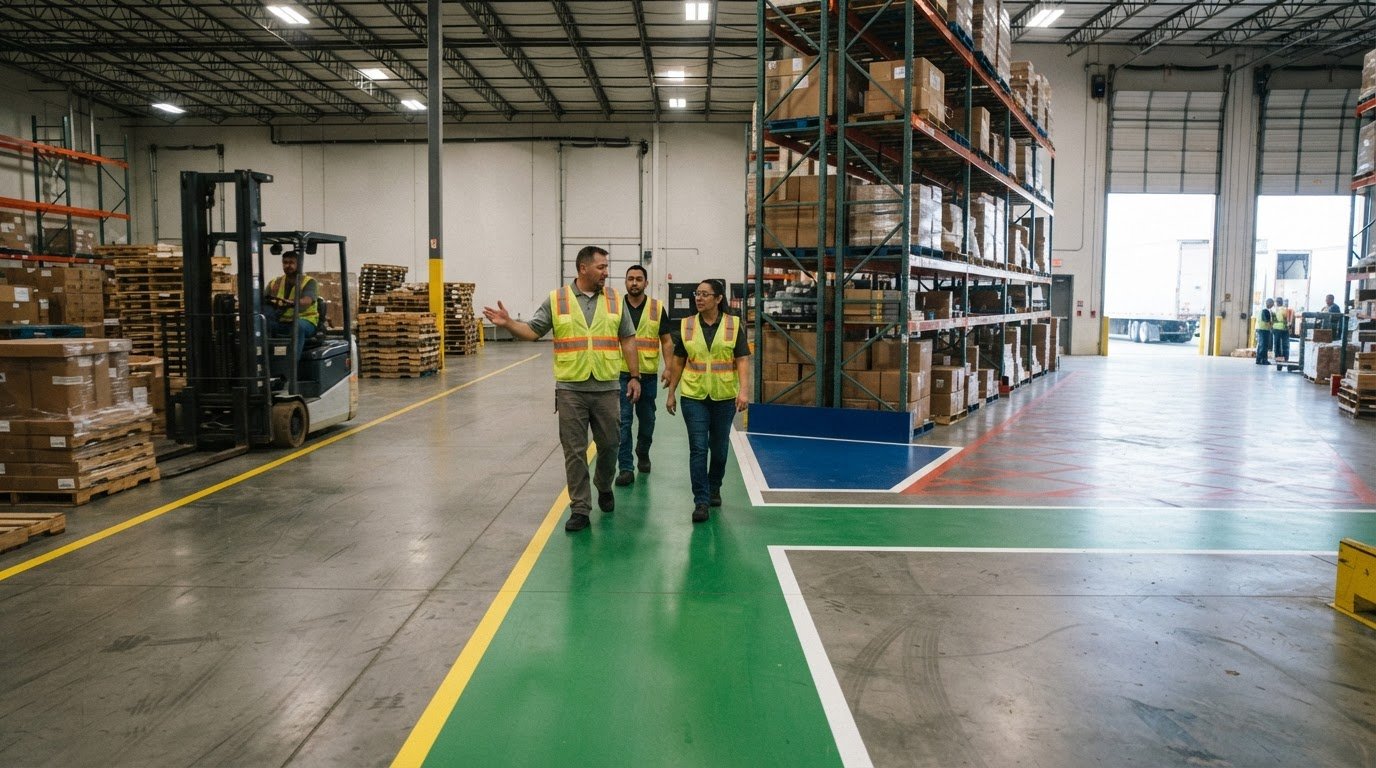
Separating foot traffic from heavy machinery is the most effective way to reduce workplace fatalities. In high-traffic zones, we prioritize the installation of pedestrian walkways and safety aisles to create a clear visual and psychological barrier. This separation reduces company liability by defining exactly where it’s safe to walk. We reinforce these boundaries by creating designated crossing points with high-visibility stenciling (large, bold floor lettering) that alerts both pedestrians and operators to potential conflict points before a near-miss occurs.
Implementing a Standardized Color-Coding System for 2026
A standardized visual language is the bedrock of any successful safety program. While OSHA 1910.144 provides some basic color rules, adhering to the broader ANSI Z535.1 standards ensures your facility speaks a universal language that operators understand instantly. By following these forklift traffic safety marking guidelines, you reduce the cognitive load on your drivers. This allows them to focus on safe maneuvering rather than interpreting vague boundaries. Integrating these specific colors into your facility layout aligns your operations with OSHA’s Powered Industrial Truck requirements, which emphasize the importance of maintaining clear, unobstructed paths.
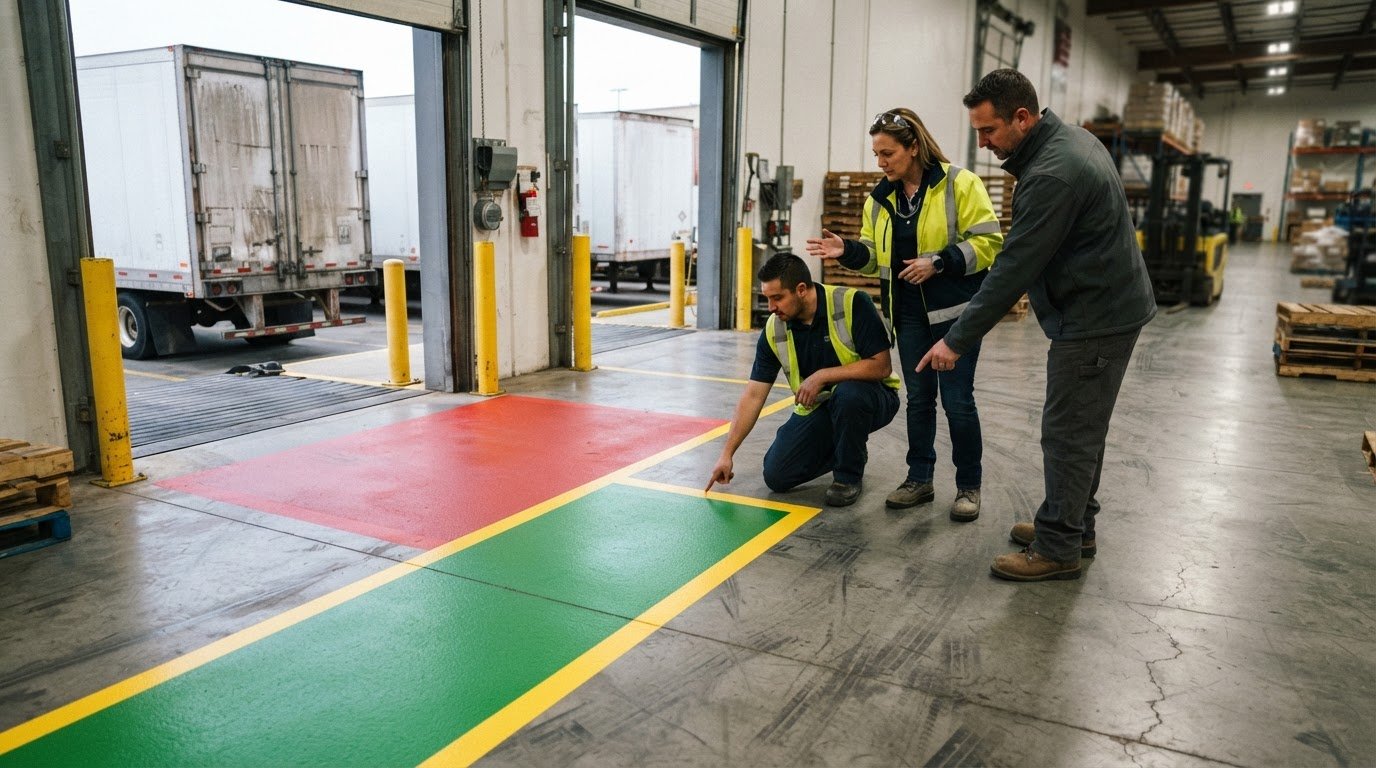
- Yellow: This is the universal standard for traffic lanes, aisles, and physical hazards. It defines the “safe zone” for equipment travel.
- Red: Reserved strictly for fire protection equipment, fire lanes, and emergency stop areas.
- Blue: Used for informational markings and maintenance zones, such as designated forklift parking or staging areas for equipment repair.
- Green: Identifies safety equipment locations, first aid stations, and emergency egress paths.
- Black and Yellow Stripes: These high-contrast markings signal permanent physical hazards, including low-clearance headers or “Watch Your Step” floor transitions.
Specialized Markings for Battery Charging Areas
Standard industrial paint cannot withstand the harsh environment of a forklift battery charging station. Constant exposure to sulfuric acid spills and heavy equipment vibration causes typical epoxy or tape to delaminate and fail. To maintain a compliant and safe workspace, we implement acid-resistant coatings and Novolac epoxy. These specialized chemical treatments provide a durable barrier that protects the concrete substrate from corrosion. We also use high-visibility green epoxy to mark safety showers and eyewash stations within these zones, ensuring they remain accessible and easy to find during an emergency.
Stenciling for Operational Efficiency
Clear lines are only half the battle; stenciling provides the specific instructions needed for a fluid workflow. Directional arrows are essential for managing one-way traffic flow, which significantly reduces the risk of head-on collisions in narrow aisles. We also apply pallet position numbering to aid in inventory management and speed limit stenciling in high-pedestrian transition zones to remind operators to slow down. If you’re unsure if your current layout meets these standards, you can request a professional facility safety consultation to identify gaps in your visual system.

Durability Engineering: Surface Preparation for High-Traffic Lanes
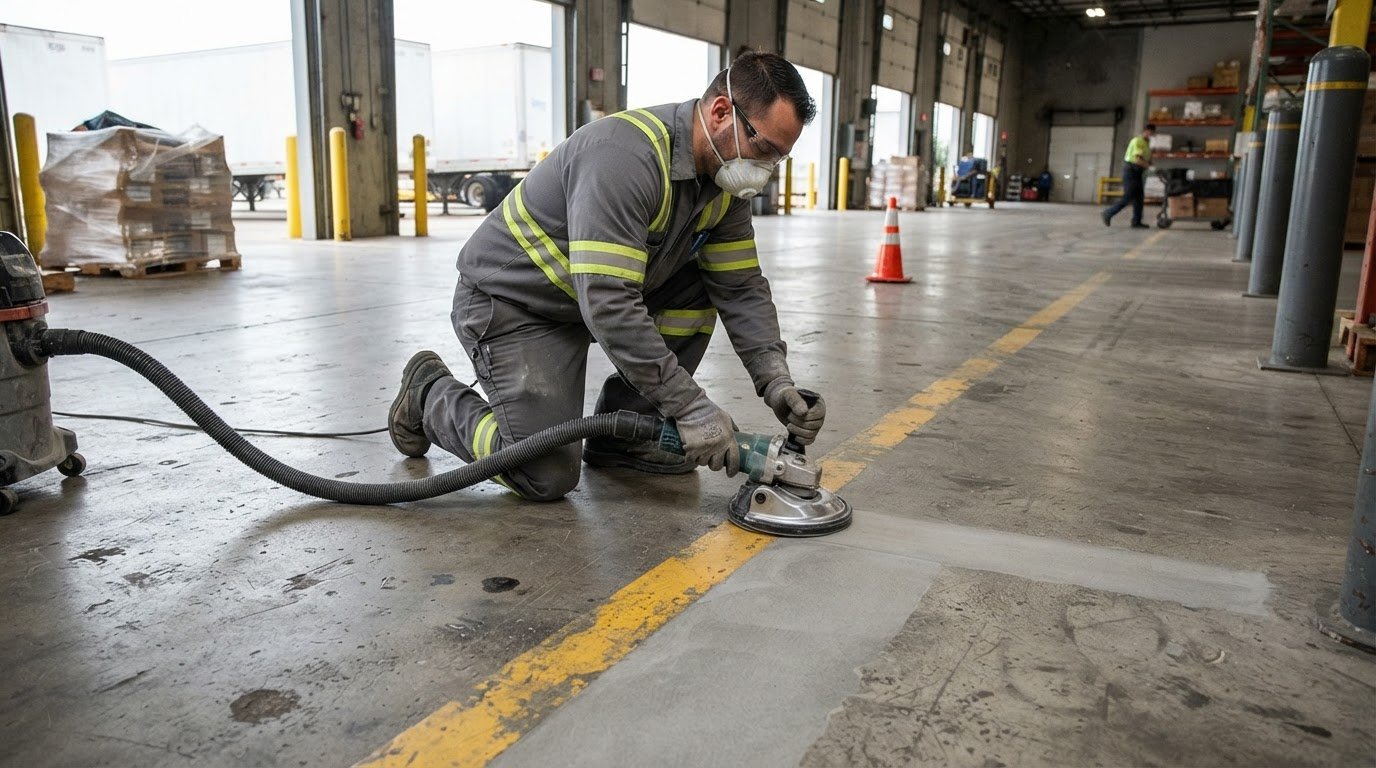
Adhering to forklift traffic safety marking guidelines requires more than just correct color choices; it demands a material that can withstand the physical abuse of a 24/7 industrial environment. Many facilities rely on floor tape for quick fixes, but this often leads to a cycle of constant repair. Forklift tires generate immense friction, and pivot points (areas where equipment turns sharply) create a shearing force that easily destroys adhesive products. We prioritize industrial epoxy warehouse striping because it provides a superior long-term ROI by chemically bonding to the concrete. Professional-grade coatings offer high impact durability and resistance to common warehouse chemicals, ensuring your safety system remains visible despite heavy traffic. Mechanical surface preparation, which involves physically altering the concrete profile to create a permanent bond, is the only way to ensure a 10-year line life in heavy industrial environments.
While the National Safety Council focuses on operator behavior, even the most skilled drivers cannot navigate safely if their visual cues have been ground away by floor traffic. Investing in durable markings reduces the logistical stress of frequent re-striping and maintains your compliance status year-round.
Mechanical Line Removal and Preparation
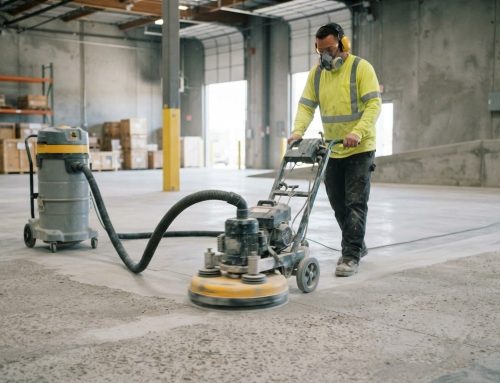
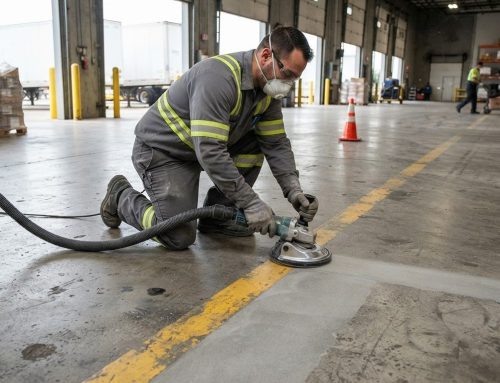
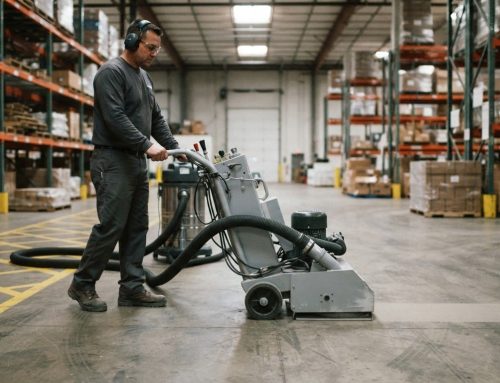
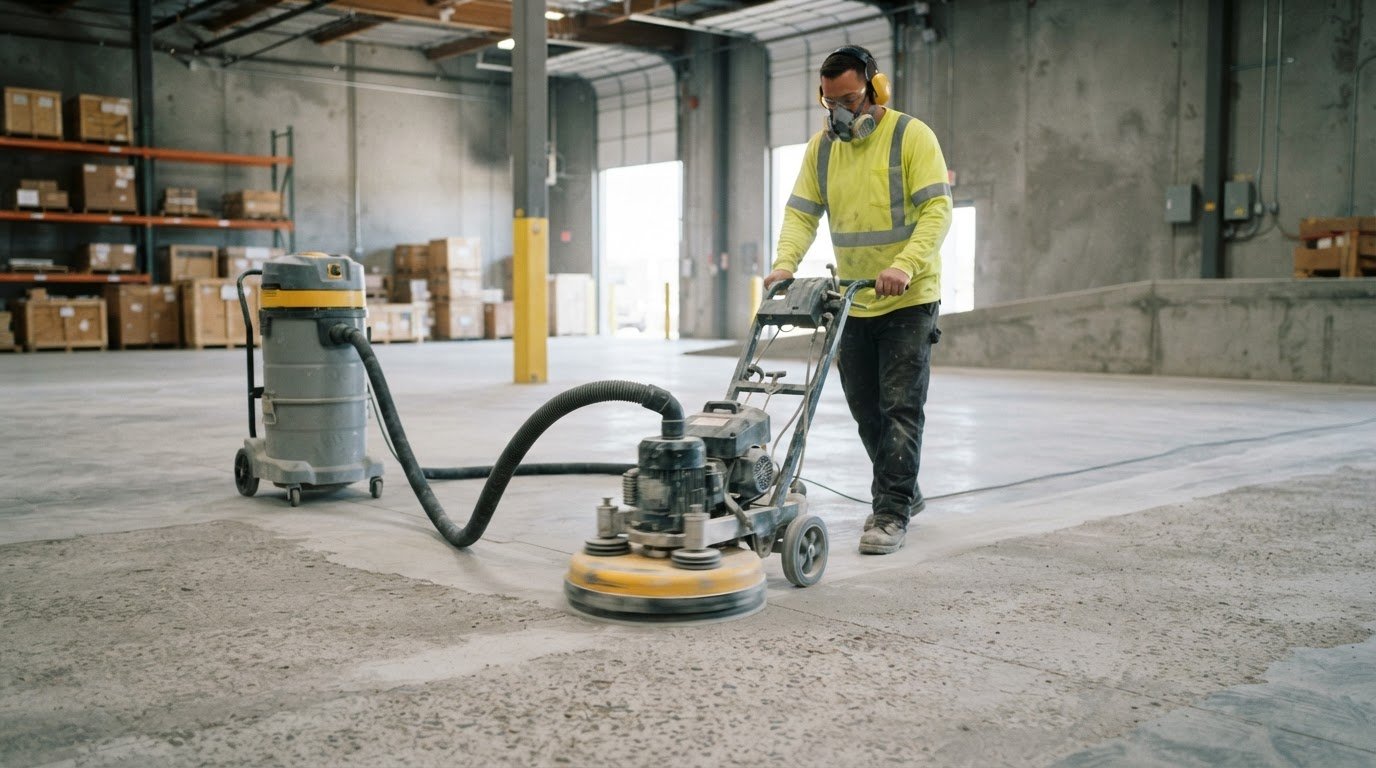
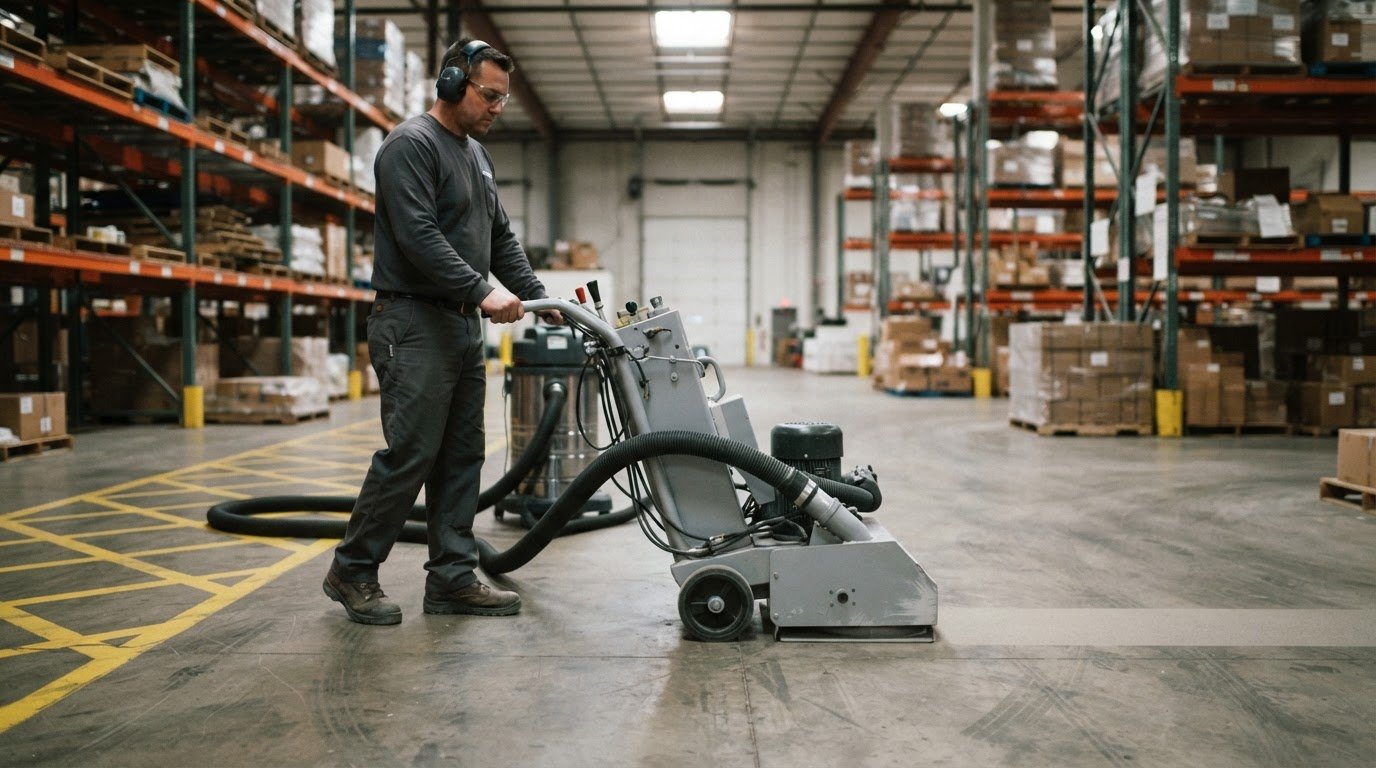
Successful striping depends on the quality of the substrate. We use shot blasting as the gold standard for preparation; this process fires steel abrasive at the floor to remove old coatings and create a textured profile for new epoxy to “grip.” In high-bay racking areas where precision is vital, diamond grinding provides surface leveling to ensure lines are crisp and perfectly aligned. Thorough warehouse line removal of previous markings is a critical step because applying new material over failing paint or tape residue will lead to immediate delamination.
Epoxy vs. Paint: Choosing the Right Material
Material selection must match your facility’s traffic volume. Water-based acrylics are suitable for low-traffic storage areas, but 100% solids epoxy is the necessary choice for active forklift lanes. For loading docks with open doors, we often apply polyurethane topcoats to provide UV resistance and prevent the yellowing or chalking caused by sunlight exposure. We understand that operational downtime is a major concern for 24/7 facilities, so we carefully manage curing times and staging to ensure your workflow continues with minimal disruption. Contact our team for a technical site evaluation to determine which material and preparation method will best serve your facility’s specific needs.
Designing and Executing a Professional Safety Layout
Designing an effective facility layout requires a data-driven approach rather than a simple “paint and pray” method. We begin by conducting a comprehensive traffic flow audit to identify “near-miss” hotspots where equipment and personnel frequently cross paths without clear right-of-way. By mapping these conflict points, we can implement forklift traffic safety marking guidelines that prioritize separation and efficiency. This process includes defining pedestrian-only zones that maximize safety without disrupting the logistical speed of your operations. A well-planned layout acts as a silent supervisor, guiding traffic and reducing the cognitive load on your operators.
Consistency is key when managing large-scale facilities. For sites with loading docks or external staging areas, we integrate parking garage and floor marking systems to create seamless transitions between indoor and outdoor environments. This ensures that safety protocols remain visible and uniform across your entire infrastructure. Once installed, establishing a regular maintenance and re-striping schedule is vital for maintaining long-term compliance and protecting your workforce from the risks associated with faded or obscured safety cues.
Layout Strategies for Automated Warehouses
Modern facilities increasingly rely on a mix of human operators and automated technology. When marking lanes for AGVs (Automated Guided Vehicles) and AMRs (Autonomous Mobile Robots), line precision is non-negotiable. We use high-contrast lines to facilitate sensor optimization, allowing robotic systems to navigate with pinpoint accuracy. Managing hybrid zones where automated and manual traffic intersect requires specialized layout strategies to ensure that human workers can safely predict the movement of robotic equipment. These layouts must be engineered to prevent sensor confusion and maintain a fluid workflow in high-density environments.
The StripeGuys Warhouse Line Striping Advantage
With over 29 years of experience in the field, we understand the complexities of large-scale distribution center projects. Our national coverage capabilities allow us to implement consistent safety standards across multiple sites, providing a single point of contact for nationwide logistics hubs. By leveraging professional warehouse line striping services from StripeGuys Warhouse Line Striping, you ensure a zero-defect execution that meets every technical requirement of the most rigorous forklift traffic safety marking guidelines. We position ourselves as your safety-conscious consultant, ensuring your facility remains organized, efficient, and fully compliant through seasoned expertise and industrial-grade materials.
Securing Your Industrial Safety Infrastructure
Implementing high-performance forklift traffic safety marking guidelines is a critical investment in your facility’s long-term operational health. You’ve seen that durable safety systems require more than just a fresh coat of paint; they demand mechanical surface preparation and a technical understanding of OSHA 1910.176(a) requirements. By transitioning from temporary tape to industrial epoxy coatings, you eliminate the logistical stress of peeling lines and ensure your facility remains compliant under the most rigorous inspections.
StripeGuys Warhouse Line Striping brings over 29 years of industrial experience to every project, offering national coverage for large-scale facilities that require consistent safety layouts across multiple sites. Our deep expertise in OSHA and ANSI compliance ensures that your traffic patterns are logical and your personnel remain protected. We focus on functional outcomes that survive 24/7 forklift traffic while adhering to your specific budgetary constraints and operational needs.
Get a Professional Warehouse Safety Marking Quote from StripeGuys Warhouse Line Striping today to start transforming your warehouse into a zero-accident workspace. We’re ready to help you build a safer, more efficient environment for your entire team.
Frequently Asked Questions
What is the required width for forklift traffic lanes according to OSHA?
OSHA 1910.176(a) requires permanent aisles to be appropriately marked but does not specify a mandatory line width. However, 2 inches is the recognized legal minimum, while a 4-inch to 6-inch width is the industrial best practice for visibility in large facilities. The lane itself should be at least 3 feet wider than the largest equipment or load to provide safe clearance for operators.
Does OSHA require specific colors for warehouse floor markings?
OSHA 29 CFR 1910.144 specifically mandates red for fire protection equipment and yellow for marking physical hazards like stumbling or falling risks. For a complete system, most facilities follow ANSI Z535.1 forklift traffic safety marking guidelines. This standard uses yellow for traffic lanes and green for safety stations, creating a clear visual language that ensures your facility remains compliant during safety inspections.
How often should warehouse safety lines be repainted?
The frequency of re-striping depends on your traffic volume and the material used, but most facilities require an evaluation every 12 to 24 months. Standard traffic paint in high-pivot zones may fail in under a year, while professional epoxy line painting is engineered to last significantly longer. Regular inspections help you identify faded sections before they become a compliance risk or a safety hazard for your team.
Can I use floor tape instead of paint for forklift lanes?
You can use industrial floor tape, but it’s rarely the best choice for high-traffic forklift lanes. The constant friction and shearing force from heavy tires often cause tape to peel or delaminate, creating unsightly debris and potential trip hazards. For long-term reliability and a better return on investment, professional epoxy applications are the industry standard for permanent traffic routes and heavy-duty mechanical handling areas.
What is the best way to mark pedestrian crossings in a forklift area?
Creating high-visibility “zebra” stripes or bold cross-hatching is the most effective way to define pedestrian right-of-way. We recommend combining these patterns with large floor stencils that clearly state “STOP” or “PED X-ING” to alert operators before they reach the intersection. This dual-layer approach provides a strong visual cue that separates foot traffic from machinery, which is essential for maintaining a zero-accident safety record.
How do I remove old floor markings without damaging the concrete?
Mechanical methods like shot blasting line removal or diamond grinding are the most reliable ways to clear old markings without harming the floor’s integrity. These processes physically lift the old material while simultaneously prepping the concrete surface for a new, stronger bond. Avoid using chemical strippers or aggressive manual scraping; these methods often leave behind residue that prevents new epoxy from adhering properly to the substrate.