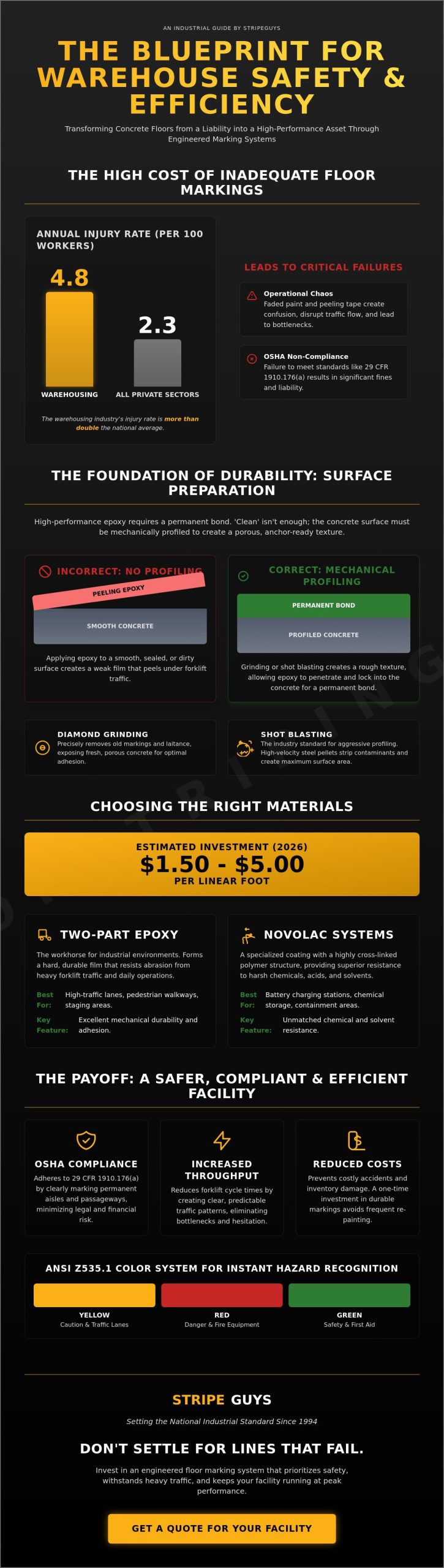
Did you know that the Bureau of Labor Statistics reported a 4.8 out of 100 injury rate for the warehousing industry in 2024? This is more than double the 2.3 average for all private sectors, proving that visual safety isn’t just a suggestion. Most facility managers agree that keeping a floor organized is a constant battle against peeling tape and faded paint. When you search for professional warehouse floor marking near me, you’re likely tired of lines that fail after six months and want a solution that withstands heavy forklift traffic. Since 1994, we’ve seen how poor surface preparation leads to OSHA fines and operational chaos.
This guide promises to help you identify industrial contractors who treat striping as an engineering project rather than a janitorial task. You’ll learn how to secure durable, high-performance epoxy markings that cost between $1.50 and $5.00 per linear foot in 2026. We will preview the critical steps of mechanical concrete profiling, which involves diamond grinding to “rough up” the surface for a permanent bond, and explain how to maintain compliance with 29 CFR 1910.176(a). By focusing on our core triad of safety, quality, and communication, you can transform your facility into a highly efficient, accident-free environment.
Key Takeaways
- Learn how an engineered floor layout reduces forklift cycle times and increases overall facility throughput by creating clear, predictable traffic patterns.
- Understand the necessity of concrete profiling (roughing up the smooth surface) to ensure high-performance epoxy lines don’t peel under the stress of heavy industrial tires.
- Discover how to vet “warehouse floor marking near me” by verifying a contractor’s equipment ownership and their history of navigating OSHA standards since 1994.
- Compare specialized materials like two-part epoxy and Novolac systems to determine which coating provides the chemical resistance and durability required for your specific environment.
- Identify the critical difference between a general painter and an industrial veteran who utilizes shot blasting for permanent line removal and surface preparation.
The Critical Role of Warehouse Floor Markings in Modern Logistics
Industrial floor marking is not a simple janitorial task; it is a comprehensive engineering system designed to manage the high-speed flow of people and machinery. When facility managers search for warehouse floor marking near me, they are often looking for a safety-conscious partner who understands that a single misplaced line can disrupt an entire supply chain. These markings serve as the primary visual language of the facility, dictating how traffic moves and where hazards exist. Since 1994, we’ve seen how professional striping transforms a chaotic floor into a precision-tuned environment.
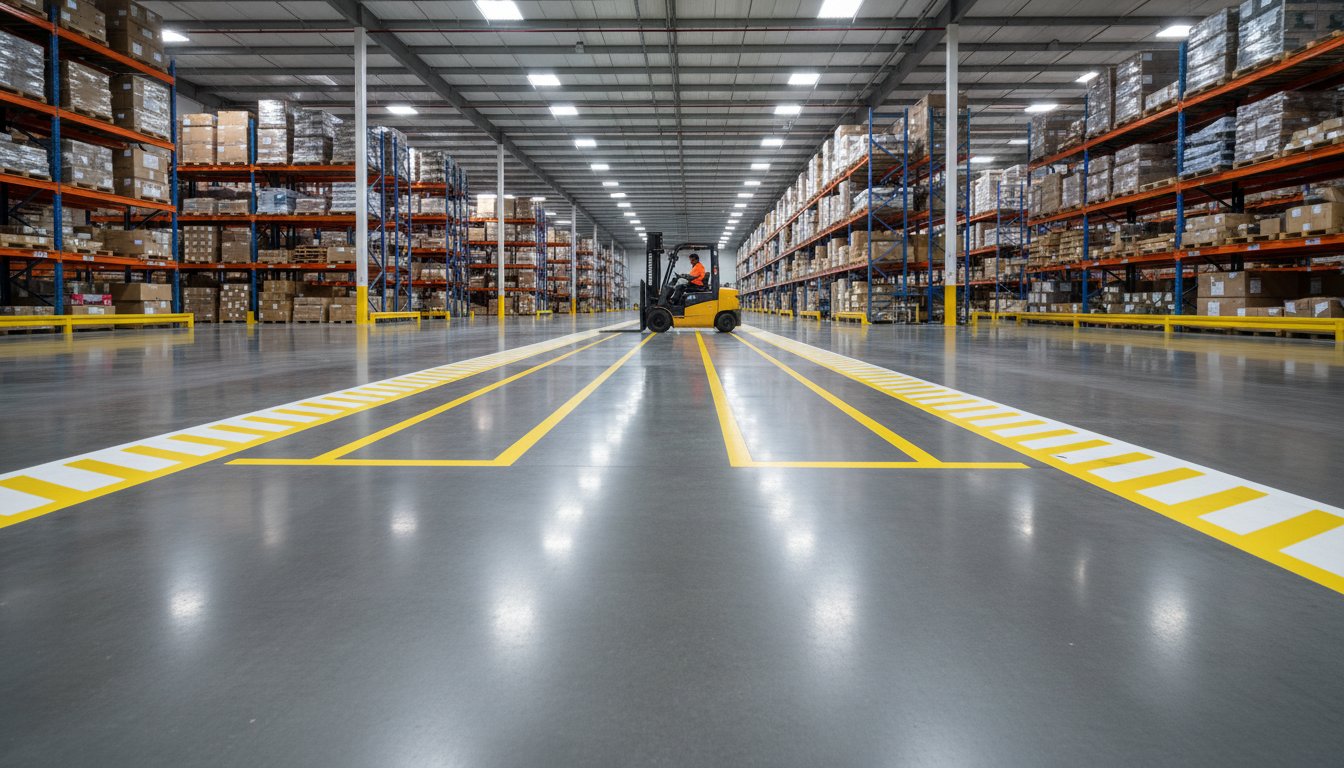
Clear lines have a measurable impact on forklift cycle times and overall throughput. In high-volume distribution centers, Modern warehouse logistics rely on predictable traffic patterns to eliminate bottlenecks. When drivers don’t have to guess where to stage a load or which direction to travel, efficiency increases. Beyond speed, these markings are essential for establishing paths of egress (designated emergency exit routes) and ensuring physical separation between pedestrians and heavy equipment. The National Safety Council reports that workplace injuries cost U.S. employers over $167 billion annually. A significant portion of these costs is tied to preventable accidents in unmarked or poorly organized zones.
OSHA Compliance and Safety Standards
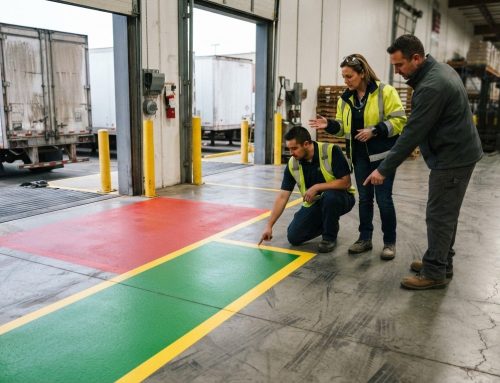
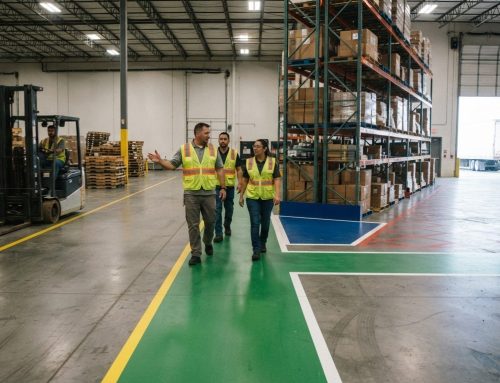
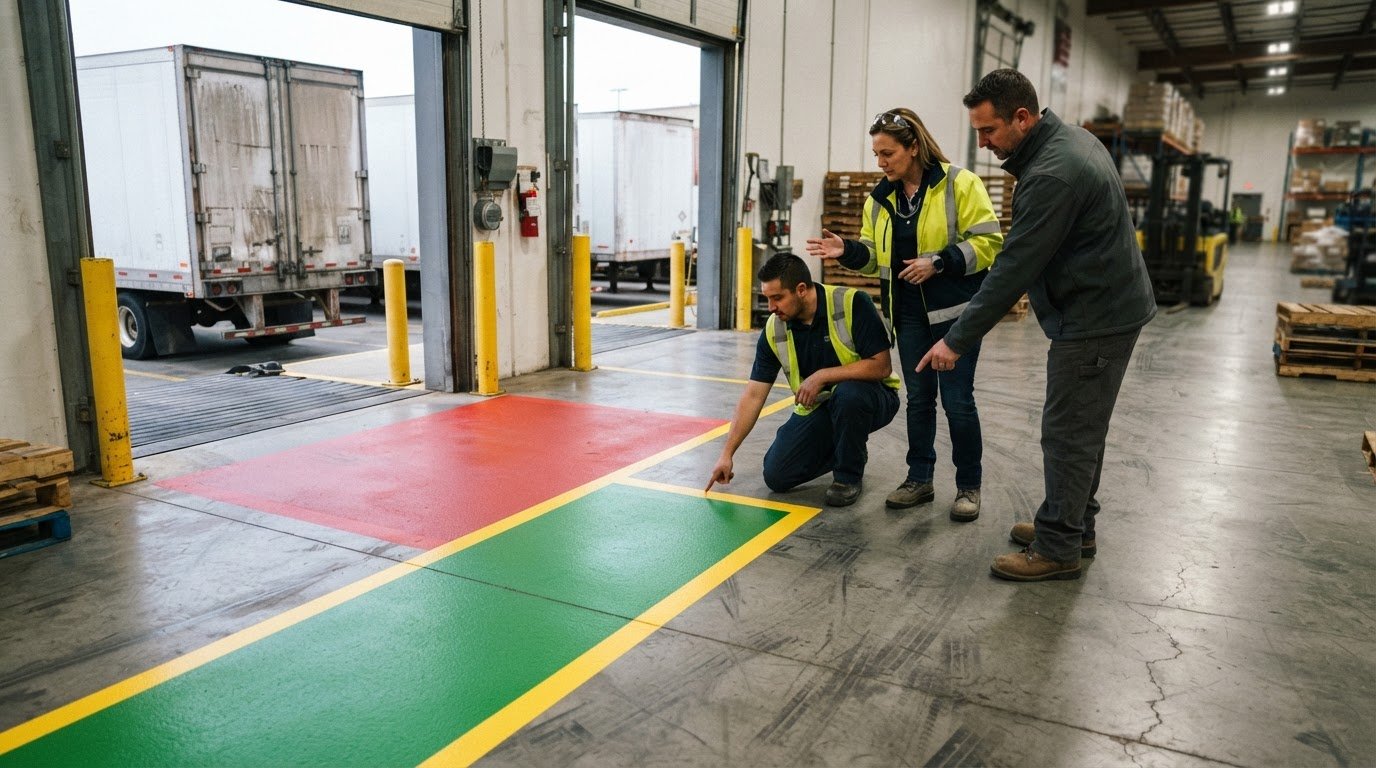
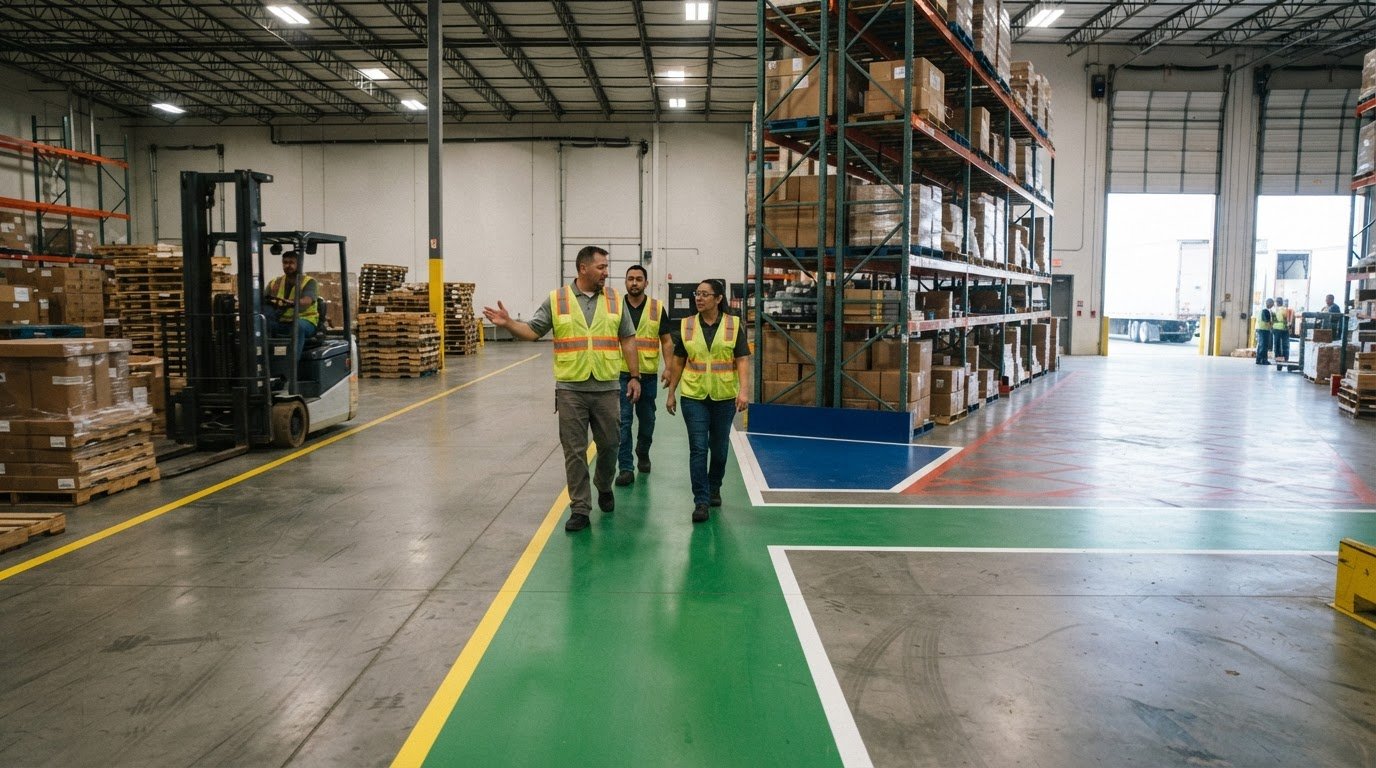
Adhering to OSHA 29 CFR 1910.176(a) is a legal requirement, not an option. This standard mandates that permanent aisles and passageways must be appropriately marked where mechanical handling equipment is used. We utilize the ANSI Z535.1 color system to ensure consistency across your facility. This includes using yellow for traffic lanes and caution areas, red for fire equipment and danger zones, and green for safety stations. Integrating these colors into a 5S lean methodology (sort, set in order, shine, standardize, sustain) helps workers identify hazards instantly. OSHA guidelines recommend that aisles stay at least 4 feet wide, or 3 feet wider than the largest piece of equipment. Ignoring these dimensions leads to non-compliance fines and increased liability.
Operational Efficiency and Traffic Management
Strategic floor striping acts as a silent floor manager. By clearly defining staging areas and loading docks, you reduce the congestion that typically plagues peak hours. Directional arrows are critical for preventing head-on forklift collisions, especially in narrow-aisle configurations. We also use durable stenciling for pallet positions and inventory organization to ensure every square foot of your concrete is utilized effectively. Securing a professional warehouse floor marking near me means hiring a contractor that manages the project from initial layout to the final cure. Our triad of safety, quality, and communication ensures that your facility remains organized, compliant, and ready for 2026 industrial demands.
Industrial Surface Preparation: Why ‘Clean’ Isn’t Enough for Epoxy Lines
Clean is a relative term in an industrial environment. Sweeping or mopping a floor doesn’t prepare it for high-performance epoxy. When you search for warehouse floor marking near me, you need a contractor who understands concrete profiling (the process of roughing up the smooth surface to create surface area). Without this mechanical intervention, even the most expensive epoxy will peel under the weight of a 9,000-pound forklift. Since 1994, we’ve repaired countless budget striping jobs where the paint failed because it was applied to a sealed or dirty surface. If the resin can’t penetrate the concrete, it’s just a temporary film waiting to fail.
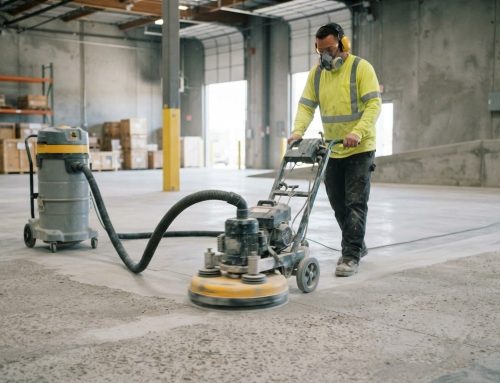
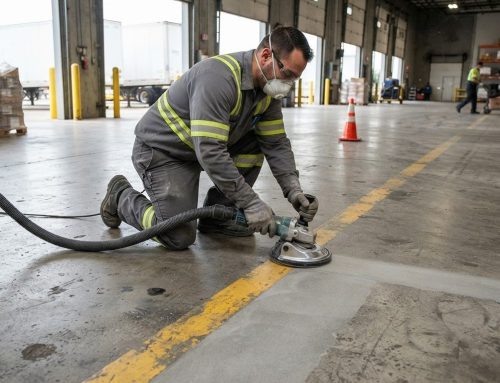
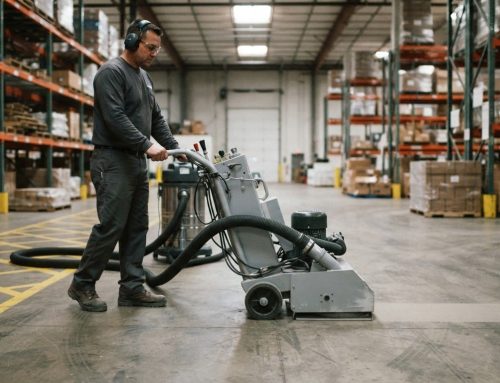
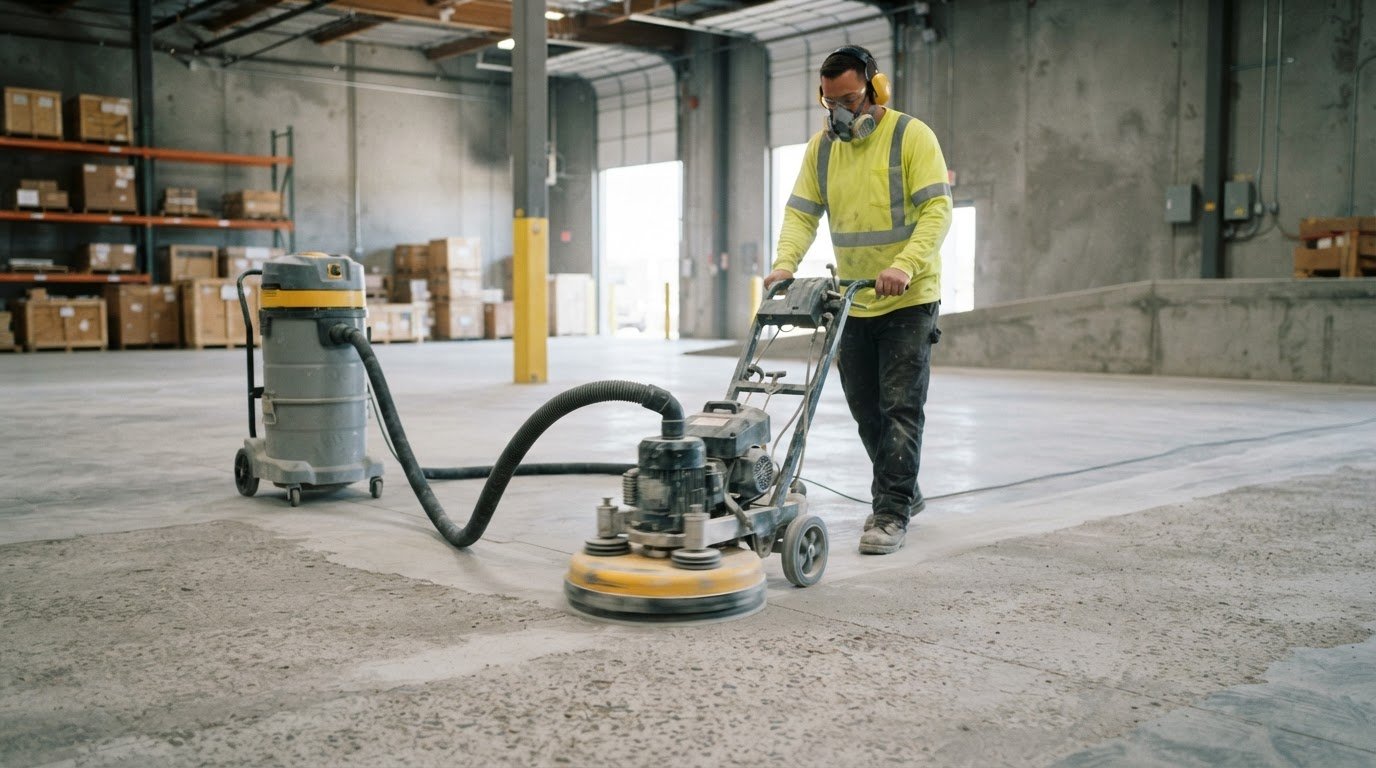
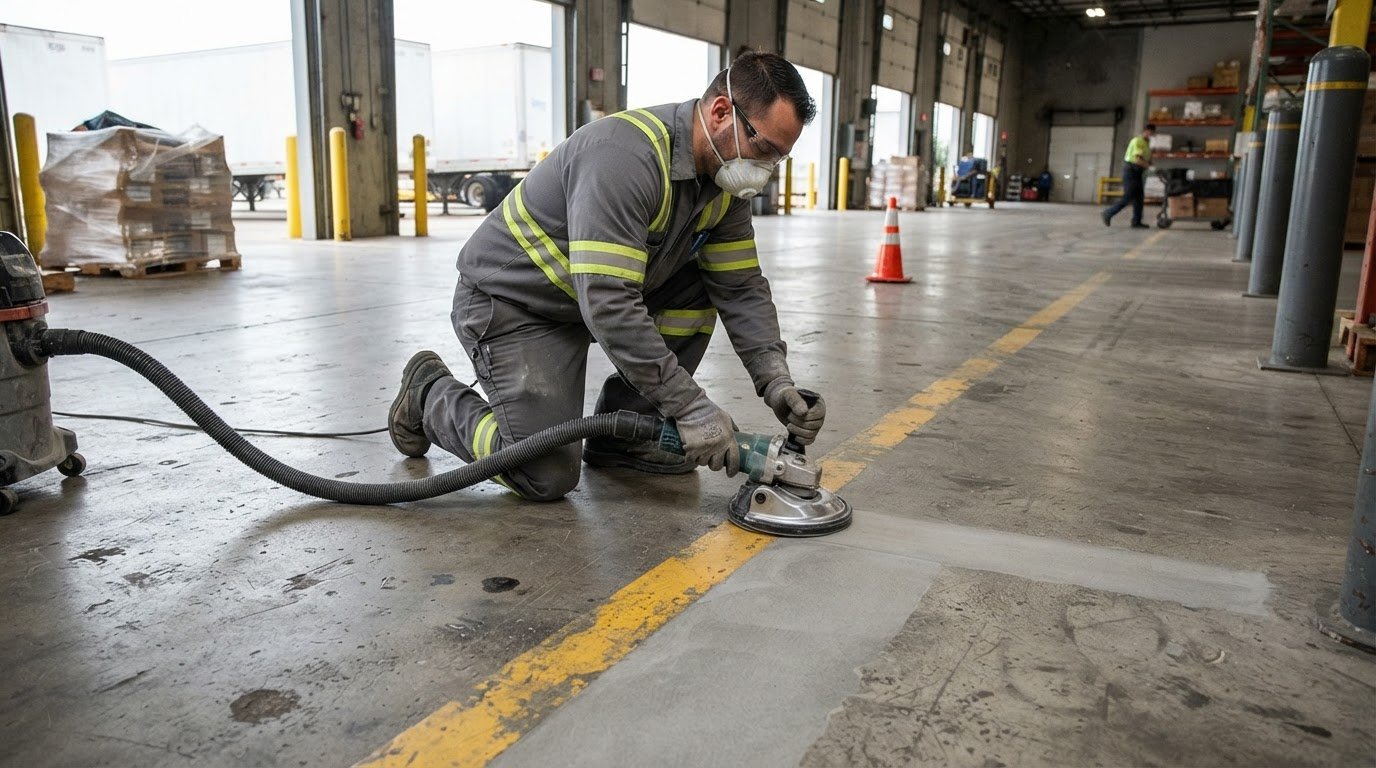
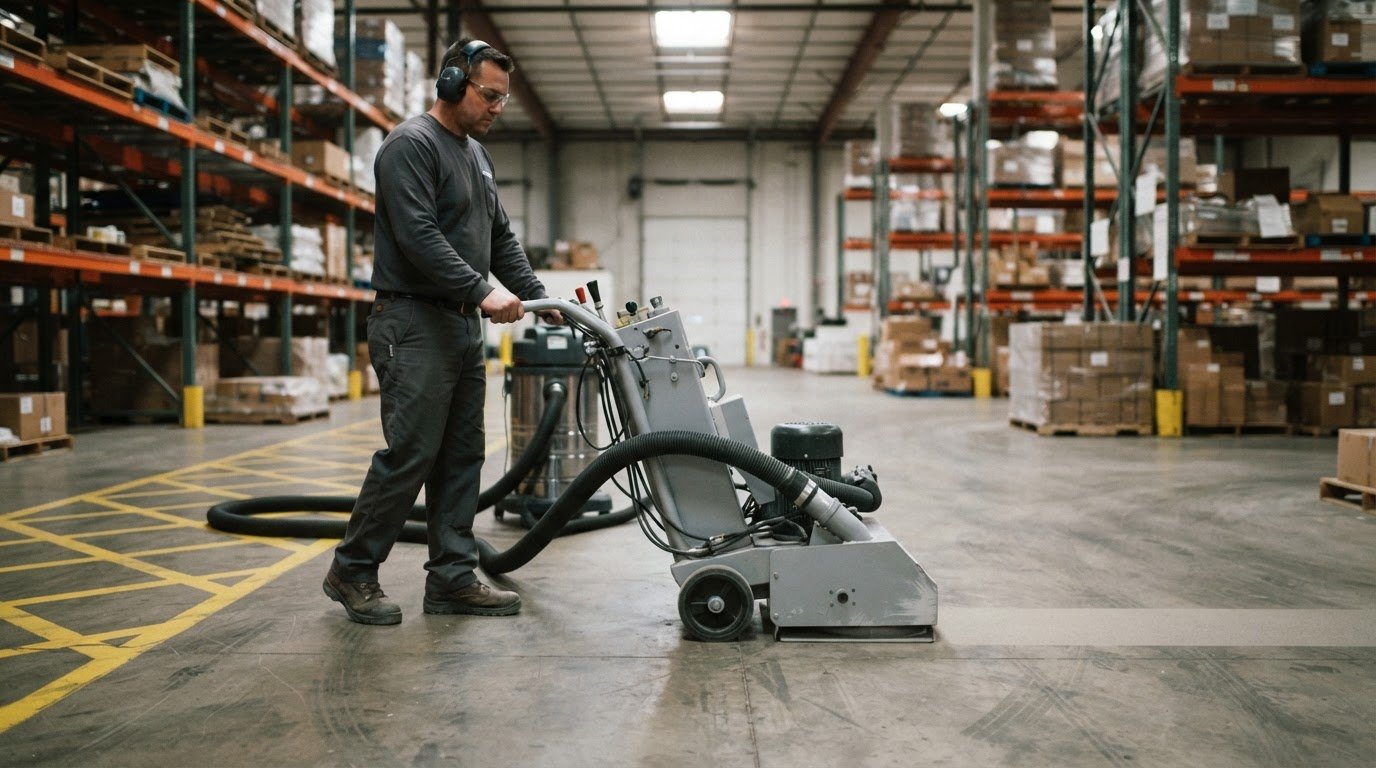
We utilize diamond grinding as a precision method for removing old markings and laitance (a weak, milky layer of cement and sand that rises to the top during the pour). Grinding shaves the surface to expose fresh, porous concrete. For environments requiring an even deeper profile, shot blasting is the industry standard. This method uses high-velocity steel pellets to strip away contaminants and create a textured surface that maximizes adhesion. Proper preparation ensures your facility meets OSHA safety standards by providing lines that don’t fade or chip away under heavy traffic. If you’re ready to upgrade your facility, you can text our team for a site assessment to determine the best prep method for your specific slab.
Mechanical Removal of Old Markings
Improper removal techniques can permanently damage your slab. Scarring occurs when aggressive scraping gouges the concrete, creating uneven surfaces that collect dirt or cause trip hazards. In food-grade or pharmaceutical facilities, chemical strippers are rarely an option due to VOC (volatile organic compound) concerns and contamination risks. We utilize dustless removal systems that capture 99.9% of debris at the source. This allows your operations to continue without the risk of airborne dust settling on your inventory or machinery.
Achieving the Ideal Surface Profile (CSP)
The International Concrete Repair Institute (ICRI) defines Concrete Surface Profile (CSP) levels to standardize surface roughness. For most industrial striping projects, we target a CSP 1 to 3. If your floor was previously treated with a densifier (a chemical used to harden the concrete surface), the pores are likely sealed, making mechanical grinding even more critical. A mechanical bond is the physical interlocking of resin into concrete pores. Without this physical connection, the bond relies solely on chemical adhesion, which is rarely sufficient for forklift environments.
Selecting the Best Materials for High-Traffic Industrial Environments
Material choice determines whether your lines survive a single quarter or a full decade. When evaluating warehouse floor marking near me, facility managers often choose between standard traffic paint and high-performance two-part epoxy systems. Standard paint is a short-term fix that often flakes within 180 days in high-traffic zones. In contrast, two-part epoxy creates a durable chemical bond with the concrete. For environments handling harsh solvents or acids, we specify Novolac epoxy (a highly cross-linked resin designed for extreme chemical resistance). This ensures the integrity of your safety lines even in battery charging areas or chemical processing plants.
To maximize longevity, we often apply a polyurethane topcoat. This layer provides UV stability and additional abrasion resistance, protecting the underlying color from “ghosting” or fading. If your facility can’t afford long periods of downtime, polyaspartic coatings are the solution. These materials offer a rapid return-to-service (fast cure), often allowing forklift traffic to resume in as little as two hours. Adhering to the OSHA Safety Color Code is mandatory for hazard identification, and using the right material ensures those colors remain vibrant and visible for years. Since 1994, we’ve helped clients select resins that match their specific operational stressors.
Epoxy Line Painting vs. Floor Tape
Heavy-duty floor tape serves a purpose for temporary layouts or testing new workflows. However, it’s not a substitute for permanent markings. In 2026, industry best practices suggest that lines should be replaced if more than 25% of the marking is peeling or obscured. Epoxy remains the gold standard for permanent paths of egress because it won’t snag under pallet jacks. While the initial price of epoxy is higher than tape, the 5-year maintenance cycle is significantly lower. You won’t spend every weekend patching peeling corners or re-applying adhesive in high-pivot areas.
Specialized Coatings for Unique Environments
Massive distribution hubs frequently require reflective coatings to maintain visibility in low-light racking areas. For loading docks or wash-down zones, we incorporate anti-slip additives (fine aggregates mixed into the wet resin) to prevent slip-and-fall injuries. Cold storage facilities present a unique challenge, as standard resins won’t cure in sub-zero temperatures. We use specialized low-temperature cure resins that achieve full adhesion at temperatures as low as -20 degrees Fahrenheit. Choosing a specialized contractor ensures your warehouse floor marking near me search results in a long-term safety asset rather than a temporary fix.
How to Qualify Warehouse Striping Contractors for Large-Scale Projects
Selecting a partner for a 500,000-square-foot facility requires more than a quick search for warehouse floor marking near me. It requires a vetting process that prioritizes technical capability over the lowest bid. A dependable industrial veteran should have navigated the industry since 1994, proving they can adapt to changing safety regulations and material technologies. You should specifically ask if the contractor owns their fleet of shot blasters and diamond grinders. Companies that sub-rent equipment often face logistical delays that can push your project past its deadline. Owning the machinery ensures they can control the schedule and the quality of the concrete profiling (the essential process of roughing up the surface for adhesion).
Safety records are another non-negotiable metric for any high-profile project. Inquire about a contractor’s EMR (Experience Modification Rate), which is a numerical indicator used by insurance companies to gauge past injury costs and future risk. A rating below 1.0 indicates a safer-than-average workplace. Ensure the crews arriving at your dock have OSHA 10 or 30-hour certifications. If you manage a portfolio of distribution centers, look for a contractor with national reach. This ensures that a facility in Chicago has the exact same safety markings as one in Dallas, maintaining brand consistency and operational standards across your entire network. You can request a national project consultation to see how our nearly three decades of experience can secure your facility.
The Importance of Night and Weekend Availability
Industrial striping must often happen during off-peak hours to avoid costly downtime. We understand that your facility never truly sleeps. A qualified contractor provides night and weekend availability to ensure that forklift traffic and shipping schedules remain undisturbed. They should be able to mobilize large crews quickly to hit tight windows, such as a 48-hour holiday shutdown. This no-nonsense approach respects your operational needs and avoids the logistical stress of a stalled project. When you search for warehouse floor marking near me, prioritize those who work around your clock, not theirs.
Communication and Project Management
Our triad of safety, quality, and communication serves as the backbone of every project. We prioritize modern accessibility, which is why we encourage facility managers to text us directly for immediate updates rather than waiting for a chain of emails. Before any paint hits the floor, request a detailed site evaluation. A professional should walk your facility to identify oil-soaked concrete or failing sealers that might compromise the mechanical bond of the new lines. This level of transparency ensures that the final result meets your budget and your safety requirements without surprises.
StripeGuys: Setting the National Industrial Standard Since 1994
StripeGuys has operated as a dependable industrial veteran for nearly three decades. We understand that your search for warehouse floor marking near me isn’t just about finding a painter; it’s about finding a safety-conscious consultant who understands the high stakes of your environment. Since 1994, we’ve navigated the evolving standards of industrial safety to provide reliable outcomes for distribution centers, airports, and manufacturing hubs across the United States. Our team doesn’t just apply lines. We engineer visual systems that improve facility flow and maintain strict adherence to your operational budgets.
Transparency is a core component of our service model. We utilize a project-based fee structure to ensure that facility managers know exactly what to expect before the first shot blaster arrives. This approach eliminates the “hidden costs” often associated with less experienced contractors who fail to account for complex surface preparation or specific curing windows. Our identity is rooted in the triad of safety, quality, and communication. This means we prioritize the physical realities of your forklift environment, use the highest-grade resins, and remain aggressively accessible through direct text communication for real-time project updates.
Comprehensive Industrial Services
Our capabilities extend beyond simple striping to cover the entire lifecycle of floor maintenance. This includes everything from parking lot striping and ADA compliance for your exterior to precision warehouse floor marking near me for your interior. We specialize in shot blasting line removal (using high-velocity steel pellets to strip old markings) to ensure a clean slate for new applications. If you’re dealing with outdated or failing layouts, you can learn more about our warehouse line removal services to see how we restore concrete integrity. We also manage parking lot painting and line removal to keep your entire site compliant and organized.
The StripeGuys Difference
The difference between a six-month line and a five-year line lies in the preparation. We excel in concrete profiling (roughing up the smooth surface) using diamond grinding and shot blasting to create a superior mechanical bond. Our state-of-the-art equipment is company-owned, which allows us to maintain total control over project timelines and quality standards. We don’t sub-rent machinery or cut corners on surface prep. Every crew is highly trained to handle the specific challenges of high-traffic forklift zones and chemical-heavy manufacturing floors. Contact StripeGuys today for a professional facility evaluation and let our nearly three decades of experience secure your warehouse floor.
Securing Your Facility for the Future of Logistics
Industrial floor striping is a technical investment that directly impacts your facility’s safety and throughput. Choosing high-performance epoxy and insisting on mechanical concrete profiling (roughing up the smooth surface) ensures your lines withstand the constant friction of heavy forklift tires. When you search for warehouse floor marking near me, you aren’t just looking for a vendor; you’re looking for an industrial partner who understands OSHA standards and the physical realities of a 2026 distribution hub. Professional preparation is the only way to avoid the 25% failure rate often seen with poorly applied tape or paint.
StripeGuys brings nearly 30 years of industrial experience to every project, providing nationwide service for large-scale facilities since 1994. We operate on a foundation of safety, quality, and communication to alleviate the logistical stress of facility managers. Our project-based fee structure and company-owned equipment ensure that your organization remains efficient and compliant without unexpected delays or hidden costs. You can Request a Professional Warehouse Striping Quote from StripeGuys to transform your floor into a durable, safety-focused asset. Let’s get your facility organized today.
Frequently Asked Questions
How long does warehouse floor striping last?
High-performance epoxy striping typically lasts three to five years, which is three to four times longer than traditional traffic paint. The exact lifespan depends on forklift traffic volume and the quality of the initial concrete profiling. Industry standards suggest replacing markings when 25% of the line is obscured or peeling. Since 1994, we’ve found that proper diamond grinding is the most critical factor in maximizing this duration.
Is floor marking required by OSHA?
Yes, OSHA standards 29 CFR 1910.176(a) and 1910.22 require permanent aisles and passageways to be clearly marked where mechanical handling equipment is used. These regulations mandate that walking-working surfaces remain clean and orderly with defined boundaries. Failing to provide these visual cues can lead to significant fines and increased liability for workplace injuries, which cost U.S. employers over $167 billion annually.
What is the best paint for warehouse floors?
Two-part epoxy systems are the industrial gold standard because they create a permanent chemical bond with the concrete. For labs or chemical manufacturing, Novolac epoxy is superior due to its high-density cross-linking and chemical resistance. While standard traffic paint is cheaper, it lacks the durability needed for heavy forklift environments. Searching for warehouse floor marking near me should lead you to contractors who prioritize these high-performance resins over temporary coatings.
How much does professional warehouse striping cost per linear foot?
In 2026, professional warehouse safety striping is priced between $1.50 and $5.00 per linear foot. High-performance epoxy systems sit at the higher end of this range because they require specialized equipment and mechanical surface preparation. This price includes the labor for layout and application. Investing in this tier of service reduces long-term costs by extending the re-striping cycle and preventing OSHA non-compliance penalties.
Can you stripe a warehouse floor without shot blasting?
You can use diamond grinding as a precision alternative to shot blasting for surface preparation. Both methods achieve the necessary Concrete Surface Profile (CSP) of 1 to 3 by “roughing up the smooth surface” to ensure adhesion. We don’t recommend striping on unprepared concrete because the resin will inevitably peel under forklift tires. Our team owns a full fleet of specialized equipment to handle whichever prep method your specific slab requires.
How long does epoxy line painting take to cure?
Standard epoxy typically requires 8 to 12 hours for a tack-free finish and 24 hours for full forklift traffic. If your facility requires a faster return-to-service, we utilize polyaspartic coatings that can cure in as little as 2 hours. We offer night and weekend availability to manage these cure times during your off-peak hours, ensuring your warehouse floor marking near me project doesn’t disrupt daily throughput.
Do you offer nationwide service for multi-location facilities?
Yes, we provide nationwide coverage for distribution centers, manufacturing hubs, and airports across the United States. This national reach ensures that your safety standards and visual layouts remain consistent across every location in your portfolio. Since 1994, we’ve served as a dependable industrial veteran for organizations requiring large-scale project management. Our triad of safety, quality, and communication remains the anchor for every site we stripe.
Can you remove old lines without damaging the concrete?
We utilize dustless shot blasting and diamond grinding to remove old lines without “scarring” or gouging the slab. These mechanical methods are far safer for the concrete than aggressive scraping or harsh chemical strippers. For food-grade facilities, our vacuum-shrouded equipment captures 99.9% of debris. This allows us to perform floor striping removal while maintaining a clean environment, ensuring the new epoxy has a fresh, porous surface for a permanent bond.