Did you know that as of 2026, a single willful OSHA violation for improper floor markings can cost your facility up to $161,323? Even a violation classified as serious carries a penalty of $16,131, which transforms a simple maintenance oversight into a massive financial liability for your operations. We understand that facility managers across the region are tired of seeing their safety lines chip and fade under heavy forklift traffic only months after application. You need a solution that prioritizes durability over temporary aesthetics to keep your team safe and your budget intact.
Investing in professional warehouse floor striping Ohio services ensures your facility meets the strict requirements of OSHA 29 CFR 1910.22(b). This guide explains how professional-grade materials and mechanical surface preparation (the process of cleaning and profiling concrete for better adhesion) optimize safety and operational flow in large-scale industrial environments. You’ll learn the specific 2026 standards for aisle widths, the essential OSHA color coding system, and why mechanical line removal is the only way to achieve a permanent bond. We’ll also cover how 24/7 service options can eliminate the risk of operational downtime during your next safety upgrade.
Key Takeaways
- Navigate OSHA 1910.22 and 1910.176(c) standards to maintain full compliance and protect your workforce from preventable accidents.
- Compare the technical performance of industrial epoxy versus acrylic traffic paint to select the most durable material for your specific traffic volume.
- Optimize your facility’s logistical flow by implementing professional warehouse floor striping Ohio using standardized industrial color codes.
- Identify why mechanical surface preparation, including shot blasting and diamond grinding, is the critical foundation for long-term marking adhesion.
- Leverage 24/7 project scheduling to complete essential safety upgrades without disrupting your facility’s primary operational hours.
Warehouse Floor Striping in Ohio: Maximizing Industrial Efficiency
In high-volume logistics hubs, every square foot of concrete represents a financial asset that must be optimized for maximum throughput. Professional warehouse floor striping Ohio serves as the visual infrastructure that dictates how efficiently a facility moves freight from the receiving dock to the shipping lanes. Without clear boundaries, even the most advanced distribution centers descend into chaotic environments where forklifts and pedestrians compete for space, leading to avoidable accidents and costly bottlenecks.
The Logistics Impact of Clear Floor Markings
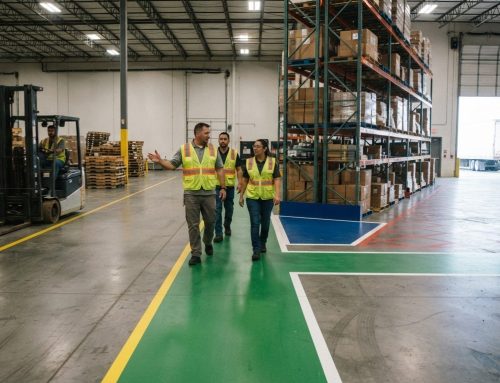
Precision layout planning transforms a cluttered floor into a streamlined operational path. By clearly defining staging areas, loading zones, and pallet positions, facility managers can significantly reduce “search time” (the labor hours wasted by personnel looking for specific inventory or equipment). Implementing a standardized color-coded system allows workers to identify functional zones at a glance, which speeds up cross-docking operations and inventory turnover. While some facilities attempt to use Warehouse Floor Marking Tape for temporary needs, industrial-grade professional warehouse line striping services provide the permanent durability required for heavy forklift traffic.
StripeGuys brings over 29 years of industrial experience to every project, functioning as a safety-conscious consultant rather than just a paint contractor. We analyze your specific traffic flow to eliminate “dead zones” and ensure that your staging areas are sized correctly for your largest equipment. This proactive approach to facility layout ensures that your warehouse floor striping Ohio investment directly supports higher inventory throughput.
Safety Standards and Operational Continuity
Operational efficiency is inseparable from employee safety. Organized floor markings are the primary defense against forklift-to-pedestrian collisions, which remain a leading cause of industrial injuries. We prioritize the use of non-slip additives in our industrial coatings to maintain traction in high-traffic aisles, even when floors are damp or dusty. This focus on functional outcomes ensures that your safety markings remain visible and effective for years, rather than months.
Maintaining a 24/7 logistics operation requires a partner who respects your timeline. We provide around-the-clock service availability to ensure that your facility upgrades happen during off-peak hours or scheduled maintenance windows. This commitment to extreme accessibility means you don’t have to choose between OSHA compliance and meeting your shipping deadlines. Our team handles the technical preparation and application while your facility continues its mission without interruption.
Comparing Materials: Industrial Epoxy vs. Standard Floor Paint
Selecting the right material for warehouse floor striping Ohio is a decision that dictates your maintenance budget for the next five years. While standard acrylic traffic paint is a common choice for initial cost savings, it lacks the structural integrity to withstand the high shear forces (the sliding pressure applied by heavy machinery) typical in industrial hubs. In high-traffic facilities, forklifts can grind standard paint into dust within months. This leads to faded lines that compromise safety and require frequent, disruptive re-applications.
Industrial epoxy line painting differs from standard paint because it creates a cross-linked chemical bond with the concrete substrate. This process ensures the marking becomes a part of the floor rather than a superficial layer. According to OSHA 1910.22 General Requirements, all permanent aisles and passageways must be appropriately marked. Using a durable epoxy system ensures these markings remain visible even under 24/7 operational cycles, preventing the “ghosting” effect where old, faded lines confuse traffic flow.
High-Performance Epoxy Line Painting
The primary advantage of Durable epoxy warehouse striping solutions is their extreme resistance to abrasion and impact. For specialized zones like forklift battery charging stations, we implement Novolac or acid-resistant coatings. These materials are engineered to withstand electrolyte spills (battery acid) that would instantly dissolve standard floor paint. While epoxy requires longer curing times than water-based paints, the long-term ROI is significantly higher due to the reduced need for maintenance downtime.
Specialized Coatings for Unique Environments
Not every industrial space is a standard ambient-temperature warehouse. Cold storage facilities and low-light distribution centers require reflective glass bead additives to enhance visibility for equipment operators. For outdoor assets, we provide UV-stable coatings that won’t chalk or peel when exposed to direct sunlight. Our expertise extends to Parking lot and truck court line striping, where materials must endure both heavy vehicle loads and harsh Ohio weather cycles. If you’re unsure which material fits your facility’s specific traffic profile, you can request a technical material consultation with our team.

The Critical Role of Surface Preparation and Line Removal
Ninety percent of industrial floor striping failures are the direct result of inadequate surface preparation. Applying high-performance epoxy over existing contaminants (oil, grease, or failing paint) prevents the coating from achieving a mechanical bond with the concrete substrate. For long-lasting warehouse floor striping Ohio, we adopt a “clean slate” philosophy. This ensures every new line is anchored into the concrete itself, rather than just sitting on top of a dirty surface.
The Shot Blasting Advantage
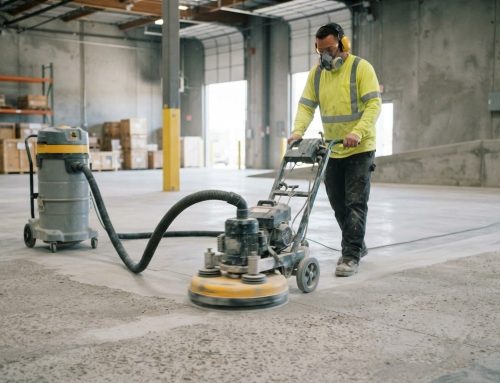
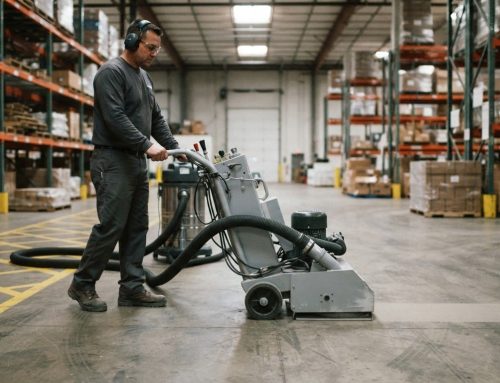
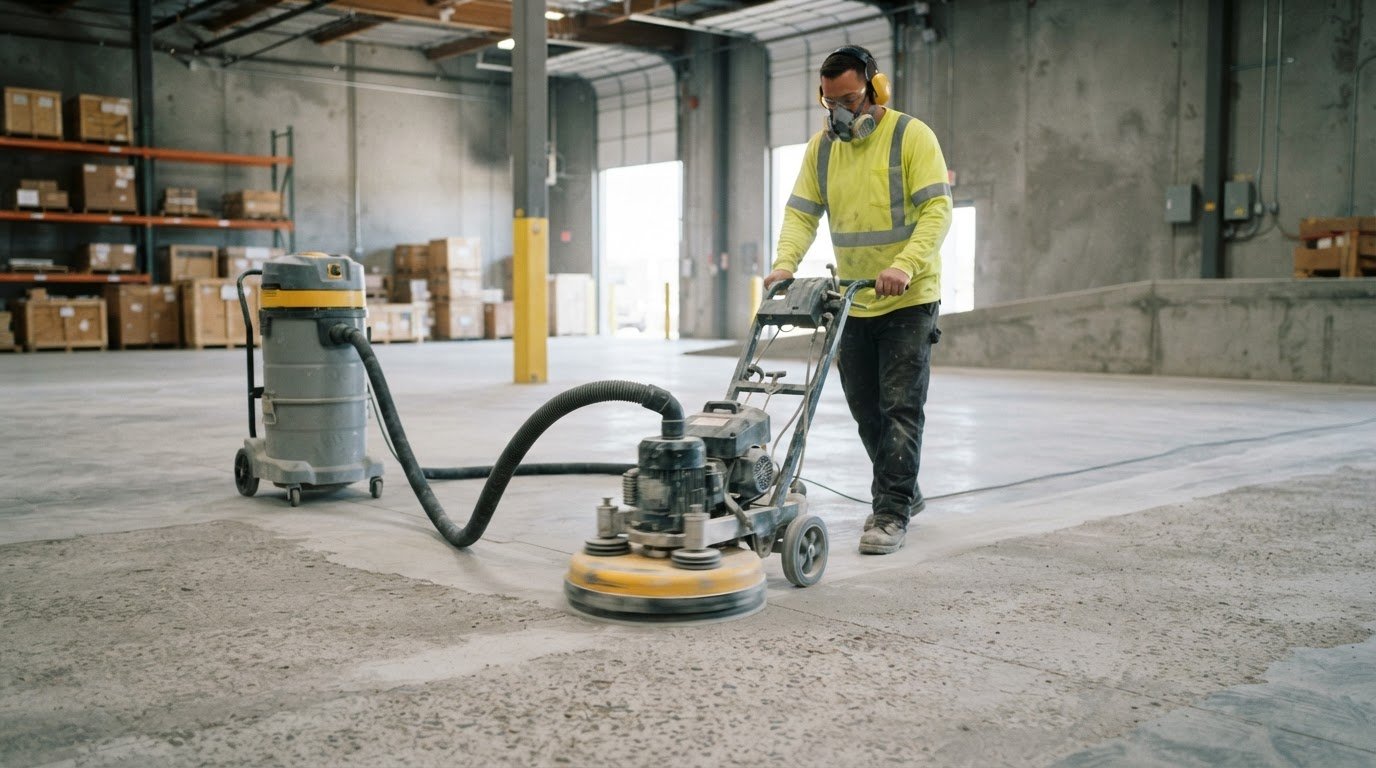
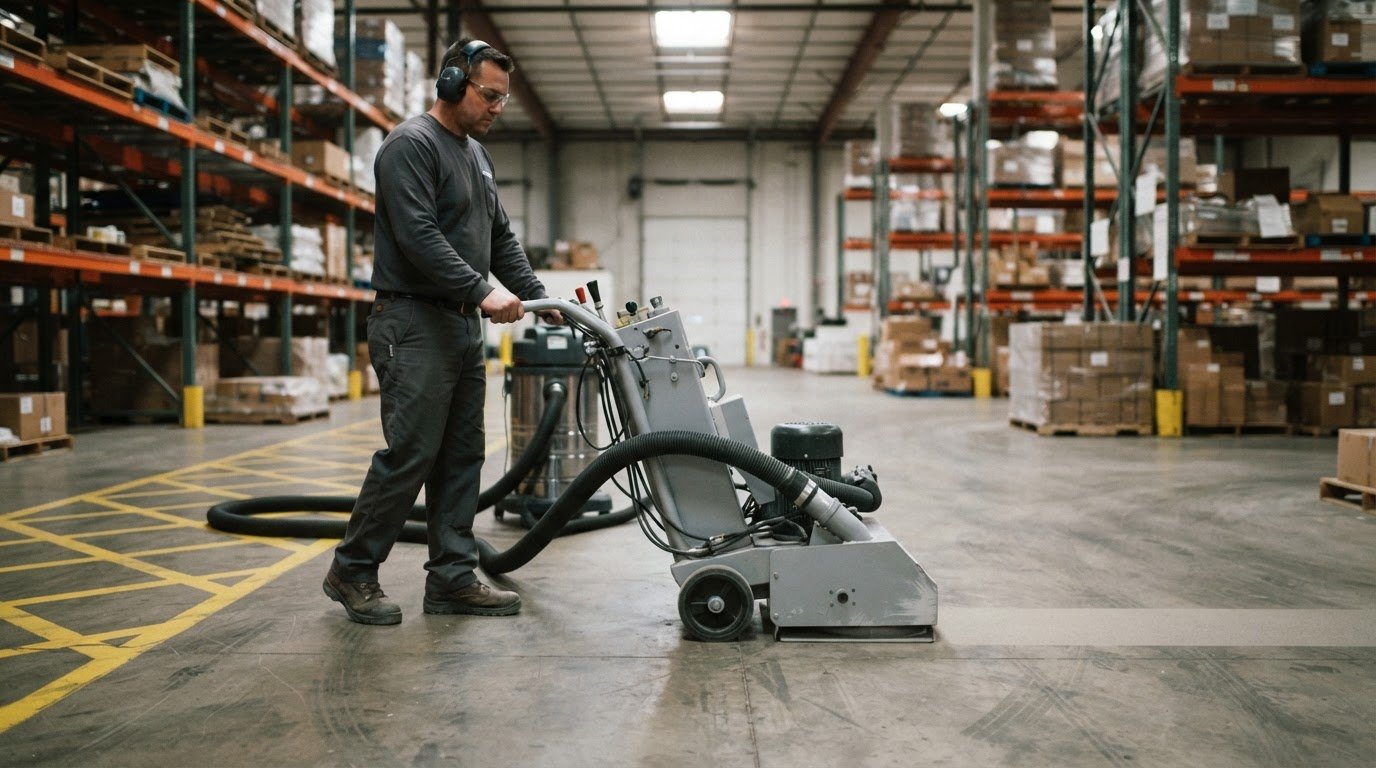
Mechanical removal techniques like shot blasting are the industrial standard for a reason. Shot blasting uses high-velocity steel abrasives to strip away old markings and simultaneously create a “profile” (a textured surface that looks like fine sandpaper) for the new epoxy to bite into. This process is far superior to chemical stripping, which often leaves behind residues that interfere with adhesion. For facilities with strict air quality requirements, such as food-grade or medical warehouses, we utilize dust-collection systems to ensure a clean, contamination-free environment. Adhering to National Floor Safety Institute Standards ensures that the resulting surface is not only durable but also compliant with rigorous safety benchmarks.
Step-by-Step Facility Preparation
A disciplined preparation sequence is the only way to guarantee the 29-year standard of reliability our clients expect. Our process follows these critical phases:
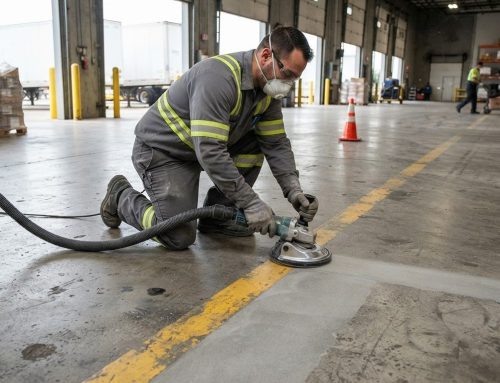
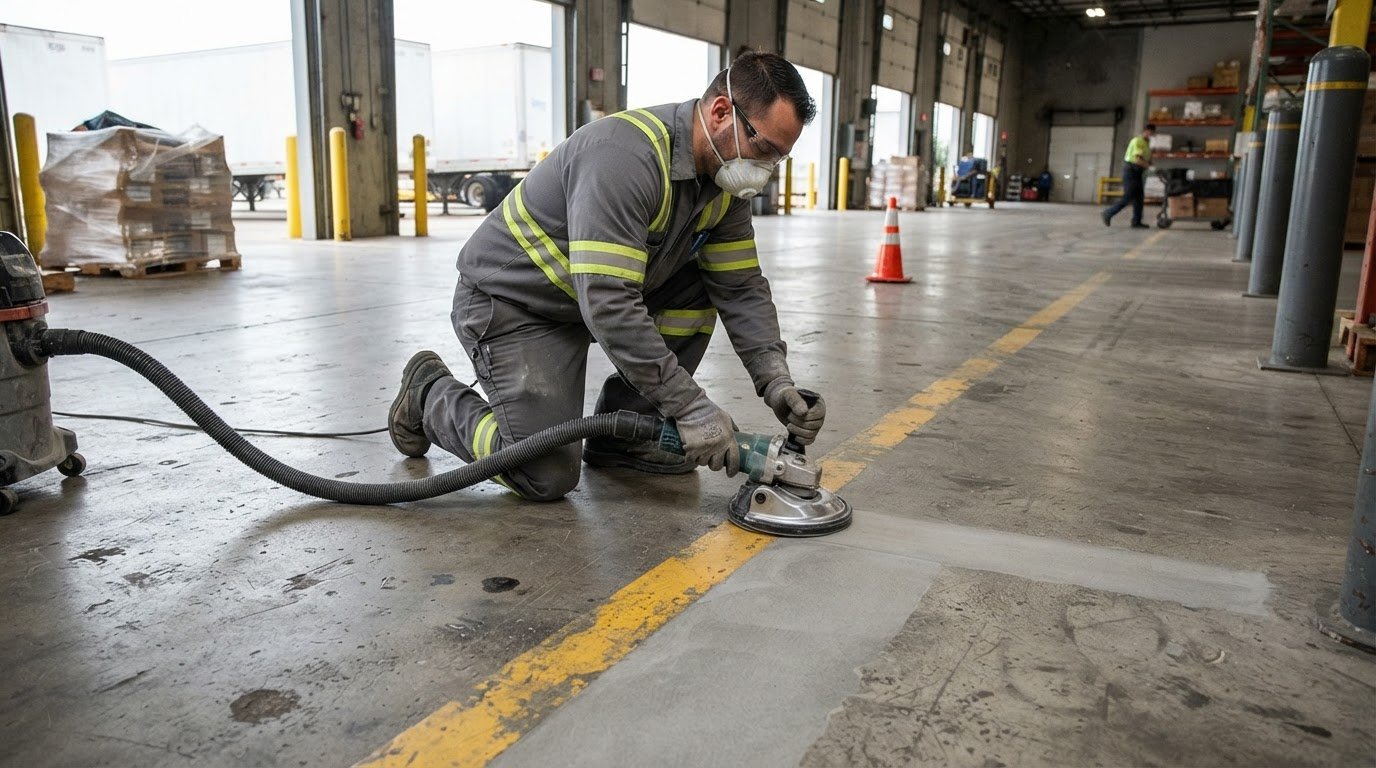
- Step 1: Mechanical removal. We utilize shot blasting or diamond grinding to remove old, flaky paint and open the pores of the concrete.
- Step 2: Concrete cleaning and pH testing. We verify the surface is chemically neutral and free of deep-seated oils to ensure compatibility with our industrial primers.
- Step 3: Precise layout. Using your facility’s engineered blueprints, we snap chalk lines to define exact traffic lanes and staging areas.
- Step 4: Application. We apply industrial-grade primers followed by high-build topcoats to lock in the markings for years of heavy forklift use.
Proper preparation transforms a temporary cosmetic fix into a permanent safety infrastructure investment. If your current lines are chipping or peeling, it is likely a preparation failure. You can schedule a site evaluation to determine the best mechanical removal method for your warehouse floor striping Ohio project based on your facility’s specific slab condition.
Implementing OSHA-Compliant Safety Markings and Walkways
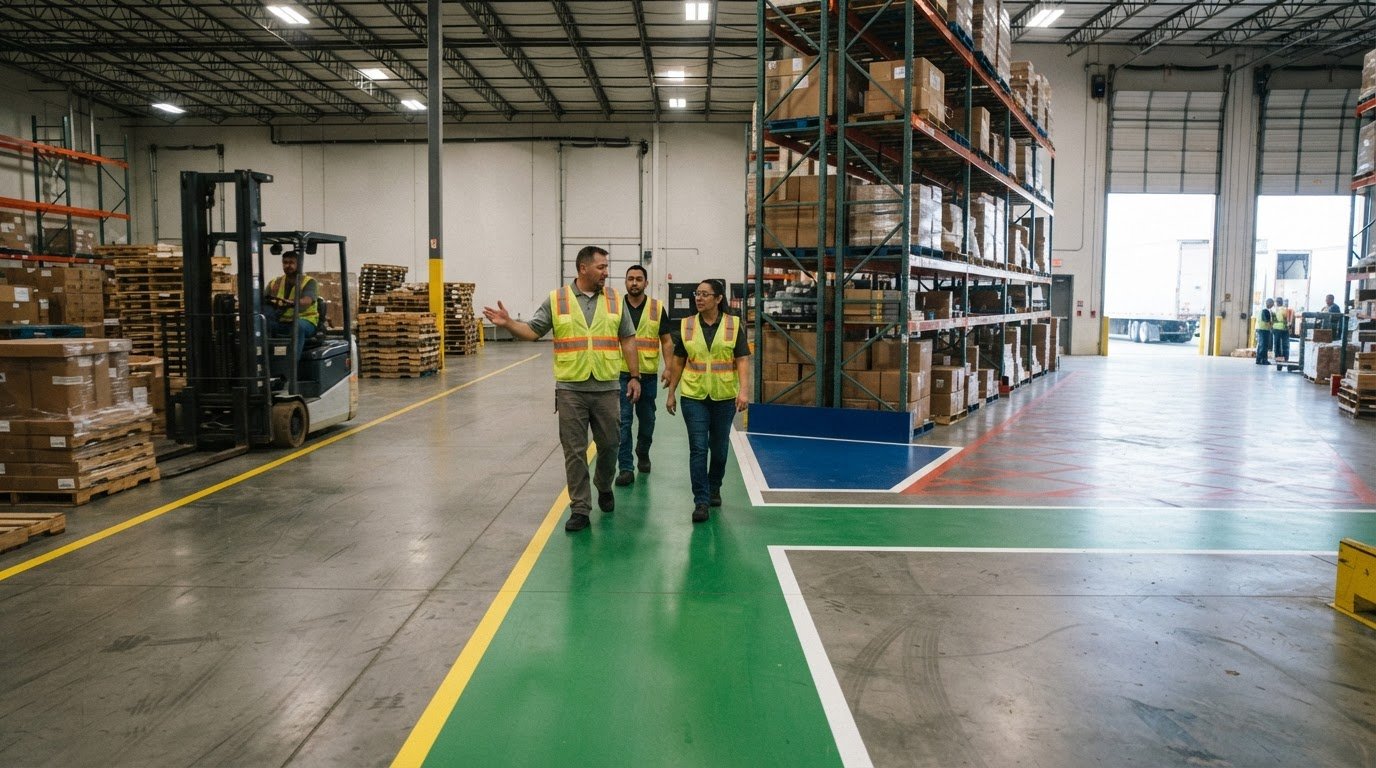
Achieving a high-performance floor involves more than just durable epoxy; it requires strict adherence to federal safety regulations. For facility managers overseeing warehouse floor striping Ohio, compliance with OSHA 1910.176(c) and 1910.22 is the primary benchmark for operational safety. These standards require that all permanent aisles and passageways stay appropriately marked to ensure clear clearance for mechanical handling equipment. To maintain a standardized environment, we implement the recommended industrial color code: yellow for traffic lanes and aisles, red for fire protection equipment or danger zones, and white for general equipment and fixtures not otherwise coded.
Pedestrian Safety and Aisle Marking
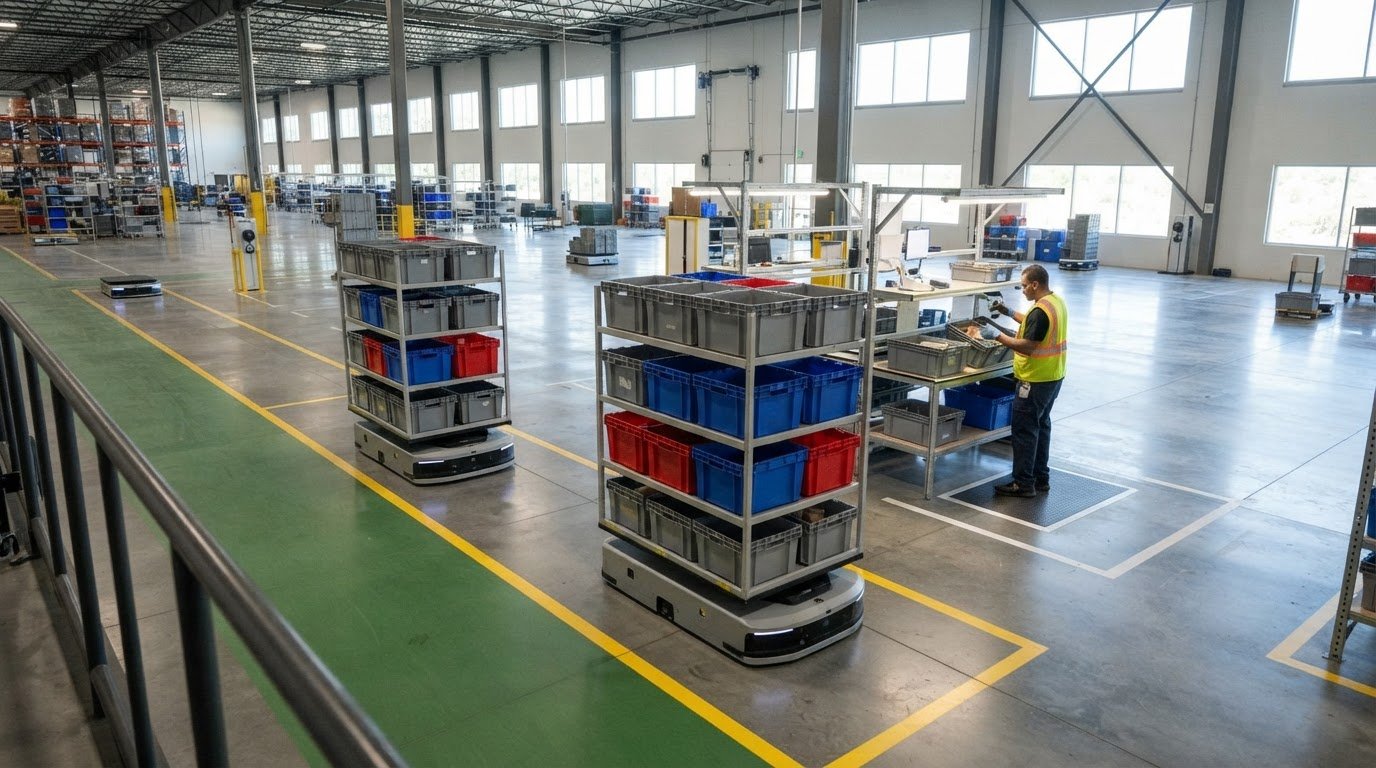
Separating foot traffic from heavy machinery is a logistical necessity that prevents life-altering accidents. We design safety walkways and pedestrian aisle striping that meets the minimum width requirement of four feet for personnel passage. For aisles involving mechanical equipment, we ensure the path is at least three feet wider than the largest piece of machinery. We utilize diagonal hatching and solid borders to create “No-Go” zones around high-risk areas, such as electrical panels and emergency exits. This visual barrier provides an immediate, non-verbal cue that keeps unauthorized personnel out of hazardous forklift intersections and loading zones.
The Importance of Tenure: 29 Years of Compliance
Navigating the complexities of safety stenciling for fire lanes and hazard zones requires a partner with a deep historical perspective. StripeGuys leverages 29 years of industrial experience to function as a safety-conscious consultant, helping you avoid the financial impact of OSHA penalties that can reach $161,323 for willful violations. Our team provides precise stenciling for fire extinguisher locations and emergency egress paths to ensure your facility remains inspection-ready at all times. As of 2026, OSHA floor marking standards mandate that all permanent industrial passageways remain clearly delineated to prevent mechanical handling equipment from encroaching on personnel paths, with fines for non-compliance now exceeding $161,000 for willful neglect.
Our commitment to your facility’s safety includes a proactive layout review to identify potential bottlenecks before they cause an accident. We offer 24/7 service availability to complete these critical safety upgrades during your lowest traffic periods, which minimizes the operational impact on your shipping schedule. This combination of technical expertise and aggressive accessibility ensures that your warehouse floor striping Ohio investment supports both your safety goals and your production targets without compromise.
Secure Your Facility’s Safety Infrastructure
Maintaining a high-volume industrial workspace requires a commitment to both regulatory compliance and operational durability. You’ve learned that successful warehouse floor striping Ohio projects depend on mechanical surface preparation (the process of profiling concrete for better adhesion) to ensure that industrial epoxy creates a permanent bond. By choosing high-build materials over standard traffic paint, you protect your facility from the premature failure caused by heavy forklift traffic and chemical exposure.
Adhering to modern OSHA standards for aisle widths and color coding protects your workforce and ensures long-term operational continuity. StripeGuys brings over 29 years of industrial striping expertise to every project, specializing in the complex logistics of large-scale distribution centers. We provide nationwide service for high-profile commercial facilities, offering the technical precision and 24/7 availability your organization demands.
Get a professional quote for your industrial striping project and take the first step toward a safer, more efficient workspace today.
Frequently Asked Questions
How long does warehouse floor striping last in high-traffic Ohio facilities?
High-performance epoxy markings typically last three to five years even in facilities with constant forklift activity. In contrast, standard acrylic paint often fails within six months under the same conditions. Longevity is determined by the mechanical bond created during surface preparation. Proper shot blasting ensures the coating penetrates the concrete pores, preventing the chipping and peeling common in high-traffic Ohio logistics hubs.
What is the best material for warehouse line marking: paint or epoxy?
Industrial epoxy is the superior choice for permanent facility markings due to its chemical resistance and structural integrity. While water-based traffic paint is cheaper initially, it lacks the cross-linked bond needed to withstand the shear forces of turning machinery. Epoxy systems provide a high-build finish that resists abrasion and chemical spills, making it the industrial standard for long-term warehouse floor striping Ohio projects where durability is the priority.
Does OSHA require specific colors for warehouse floor striping?
OSHA 29 CFR 1910.22 requires that permanent aisles and passageways be appropriately marked, but it does not mandate specific colors. However, following the standardized industrial color code is essential for safety. Most facilities use yellow for traffic lanes, red for fire hazards, and white for general equipment. Using these recognized standards ensures your facility remains compliant with federal safety guidelines and reduces the risk of pedestrian accidents.
Can you remove old warehouse lines without damaging the concrete floor?
Yes, old warehouse lines can be removed cleanly using mechanical methods that do not compromise the structural integrity of the slab. Shot blasting and diamond grinding are the most effective techniques for removing failing paint or epoxy. These processes strip away the old coating while simultaneously cleaning the concrete surface. This leaves a smooth, porous profile that is ideal for the adhesion of new, high-performance safety markings.
How long does it take for epoxy floor lines to cure before forklifts can drive on them?
Most industrial epoxy systems require a cure time of 24 to 48 hours before they can support heavy forklift traffic. While the lines may feel dry to the touch within a few hours, the chemical cross-linking process takes longer to reach full hardness. We offer 24/7 service availability to schedule application during weekend or holiday shutdowns, ensuring your facility is ready for full operation by the start of the next shift.
What is the difference between shot blasting and grinding for line removal?
Shot blasting uses high-velocity steel abrasives to impact the surface, which is ideal for removing thick coatings and creating a deep anchor profile. Diamond grinding uses rotating abrasive segments to shave off thin layers of paint or smooth out rough concrete. Both methods are effective, but we select the specific technique based on your slab’s condition and the type of material being removed for your warehouse floor striping Ohio project.