

For a major hub airport, a faded runway marking is more than a maintenance oversight; it’s a critical safety breach that risks grounding operations and violating federal law. You know that constant re-striping drains your operational budget and creates unnecessary downtime. It’s frustrating to watch standard waterborne paints succumb to jet fuel and de-icing fluids just months after application. This guide explains why epoxy line painting for airports is the industry’s most reliable solution for achieving a three-to-five-year service life while maintaining strict FAA and ICAO compliance.
We’ll examine the technical benefits of epoxy’s chemical resistance, the necessity of proper surface preparation like shot blasting, and the specific FAA AC 150/5370-10H standards you must meet to ensure long-term visibility. With over 29 years of industrial experience, we understand that markings on taxiways and runways must withstand extreme mechanical loads. You’ll learn how to transition from reactive maintenance to a durable, high-visibility marking strategy that keeps your facility compliant and your runways open.
Key Takeaways
- Understand how two-component resin systems create a molecular bond with runways to withstand jet blast and heavy aircraft tonnage.
- Discover how professional epoxy line painting for airports ensures full adherence to FAA 150/5370-10H standards for long-term safety and visibility.
- Learn why achieving the correct Concrete Surface Profile (CSP) through mechanical preparation is the only way to prevent Foreign Object Debris (FOD) and marking failure.
- Explore the advantages of thick-film application (15 to 30 mils) in extending the service life of markings to three to five years.
- Identify phased application methods that allow for high-stakes infrastructure updates without causing significant operational downtime or airport closures.
Why Epoxy Line Painting is Essential for Modern Airport Infrastructure
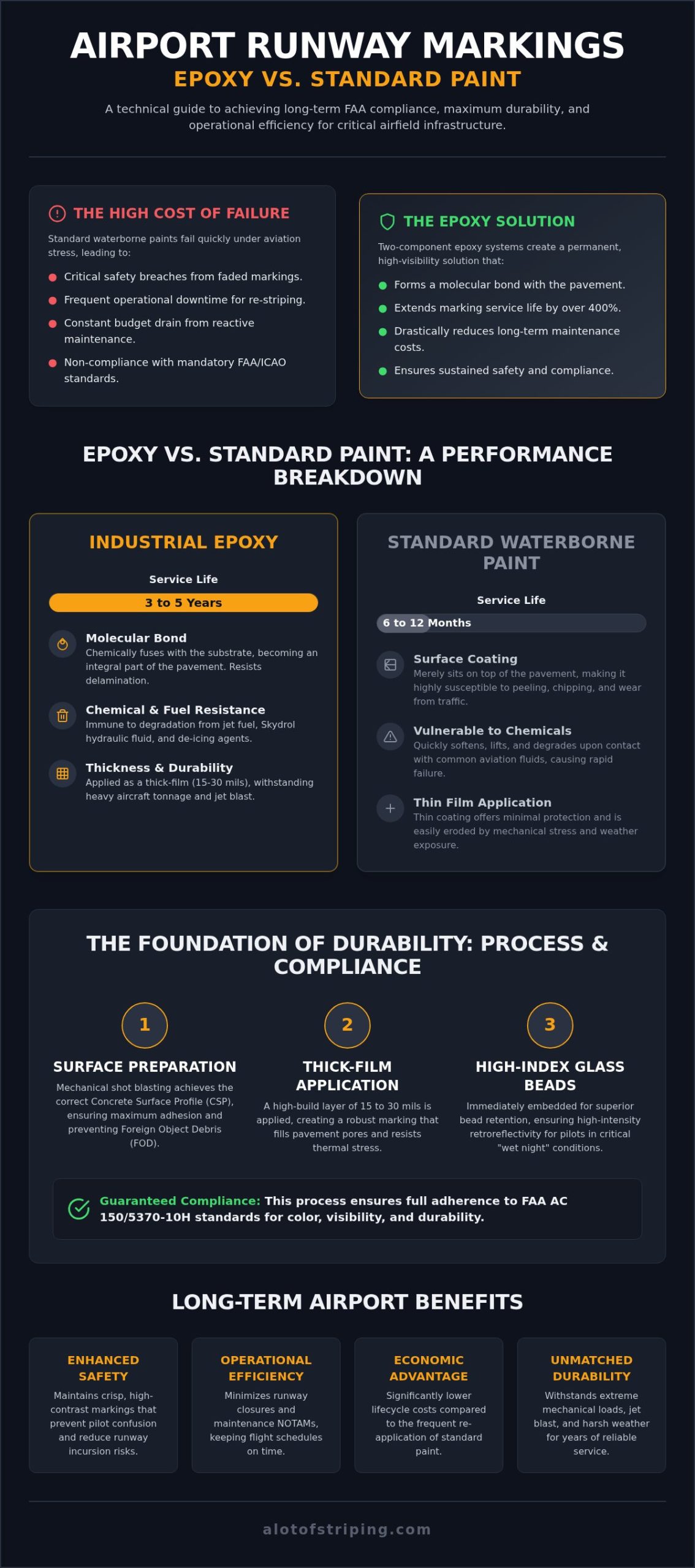
Epoxy isn’t just a surface coating; it’s a high-performance industrial system engineered for the most demanding environments on earth. Unlike standard traffic paint, epoxy is a two-component resin system (consisting of a resin base and a hardener) that creates a permanent chemical bond with the substrate. This extreme adhesion is vital because airport pavements face unique stressors. High-frequency traffic and heavy tonnage from commercial aircraft strip away inferior coatings in months. Additionally, jet blasts create intense thermal and mechanical pressure that only high-adhesion epoxy line painting for airports can reliably withstand.
When evaluating different pavement marking materials, the primary differentiator is the “useful life” of the product. Standard waterborne paints often require refreshing every 6 to 12 months in high-wear zones. In contrast, industrial epoxy markings typically last 3 to 5 years. This longevity is a safety necessity. Faded markings lead to pilot confusion and ground control errors, which increases the risk of runway incursions. Maintaining crisp, high-contrast lines is the first line of defense in airfield safety management.
Meeting FAA and ICAO Marking Standards
Compliance with FAA AC 150/5370-10H is a mandatory requirement for any federally funded airport project. These regulations dictate the exact performance specifications for pavement markings, including precise color chromaticity. Pilot recognition depends on the specific shades of White, Yellow, and Red remaining consistent across all airfields. To meet these standards, we apply a thick-film epoxy and immediately top it with specialized glass beads. This process ensures high-intensity reflectivity during “wet night” conditions, providing pilots with the visual cues they need when visibility is at its worst.
The Economic Case for Long-Life Markings
While the initial application of epoxy involves technical complexity, the lifecycle cost is significantly lower than traditional alternatives. By extending the time between striping cycles, you reduce the administrative costs associated with bidding and managing frequent maintenance contracts. Durable markings also directly impact operational efficiency. Because epoxy lasts years longer than paint, you’ll issue fewer “notices to airmen” (NOTAMs) for maintenance closures. Keeping runways and taxiways open for longer periods protects the airport’s revenue and ensures flight schedules remain on time without the logistical stress of constant repairs. For facility managers looking to extend this durability to hangar and cargo bay floors, you can explore Industrial and Commercial Flooring Installation to find high-performance resinous solutions.
The resilience of industrial epoxy stems from its unique chemical composition. Unlike standard paints that merely sit on top of the pavement, epoxy resins undergo a cross-linking process during the curing stage. This reaction creates a molecular bond with the substrate, ensuring the marking becomes an integral part of the runway or taxiway surface. This adhesion is critical for maintaining epoxy line painting for airports, as it prevents the delamination often seen with waterborne products. We typically apply these systems in a “thick-film” specification, ranging from 15 to 30 mils. This high-build nature allows the material to fill pavement pores, creating a smoother, more durable finish that resists the stresses of thermal expansion and contraction.
Reflectivity is another area where epoxy outperforms traditional materials. The resin’s dense structure provides superior bead retention, meaning the glass spheres responsible for night visibility stay embedded longer under heavy traffic. Adhering to FAA airport marking regulations requires consistent retroreflectivity levels that thin-coat paints simply cannot sustain over several years. By choosing a UV-stable epoxy system, airport managers ensure that markings remain bright and compliant even under intense solar exposure, reducing the risk of premature fading.
Resistance to Skydrol and Aviation Fuels
A significant advantage of epoxy is its immunity to corrosive aviation fluids. Skydrol, a common hydraulic fluid, is notorious for softening and lifting standard traffic paints within hours of contact. Industrial epoxy serves as a chemical barrier that won’t degrade when exposed to fuel spills or de-icing agents. For specialized areas like ground support equipment zones, we often recommend acid-resistant coatings to protect against battery acid and other harsh chemicals. This level of protection prevents “paint lifting” and ensures that safety boundaries remain intact regardless of chemical exposure.
Mechanical Durability Under Heavy Tonnage
Runway markings must endure the massive shear forces generated by aircraft tires during high-speed landings and takeoffs. Epoxy’s high compressive strength and impact resistance prevent the chipping and flaking that lead to Foreign Object Debris (FOD), a major safety concern for jet engines. The material’s toughness allows it to absorb these mechanical loads without losing its bond to the pavement. If your facility requires markings that can survive millions of pounds of rolling weight, you can consult with our technical team to discuss specific application thicknesses for your heaviest traffic zones.
Surface Preparation: The Secret to Zero-FOD Marking Failure
High-performance epoxy is only as reliable as the surface beneath it. If you apply a resin system to a contaminated or smooth substrate, the bond will fail. This failure often results in delamination, which creates dangerous debris on the airfield. Effective epoxy line painting for airports requires more than just high-quality resin; it demands a clean, profiled substrate. We prioritize achieving the correct Concrete Surface Profile (CSP), typically a CSP of 3 to 5, to ensure the epoxy can mechanically lock into the pavement. We also perform rigorous moisture testing before application. High moisture content in the slab leads to osmotic blistering (where water vapor pressure forces the coating to bubble), which ruins the installation’s integrity.
Eliminating “ghosting” is another critical step in our preparation process. Ghosting occurs when old markings are partially visible under new ones, or when the removal process leaves a scarred shadow that confuses pilots. We ensure old lines are completely eradicated. This provides a clean slate for new layouts and prevents visual confusion during critical flight operations.
Mechanical Removal: Shot Blasting vs. Grinding
Shot blasting is our preferred method for large-scale airport projects. It uses steel shot to pelt the surface, removing laitance (the weak, milky layer of cement dust) and opening the pores of the concrete. While grinding is useful for small areas, it can sometimes “polish” the surface, which reduces adhesion. Our warehouse line removal expertise allows us to scale these mechanical techniques for massive taxiway and runway surfaces. This ensures every square inch is prepped for a permanent bond that won’t chip or flake under pressure.
Managing Foreign Object Debris (FOD) During Construction
Safety protocols on an active airfield are non-negotiable. Loose debris like dust or metal shot can be ingested by jet engines, leading to catastrophic failure. We use modern, vacuum-shrouded equipment that captures 99% of dust and shot at the point of impact. This self-contained system keeps the tarmac clean during the removal and preparation phases. After prep is complete, we conduct multi-stage final inspections to verify that no loose material remains before the epoxy line painting for airports begins. This meticulous approach protects your equipment and ensures a flawless application.
Contact our specialists today to schedule a technical site evaluation for your next airfield marking project.
Operational Logistics: Minimizing Downtime in National Airport Projects
Managing the logistics of epoxy line painting for airports requires a military level of precision. Closing a primary runway at a national hub can disrupt flight schedules across the entire country, which is why we prioritize a phased application strategy. This method involves segmenting the airfield into manageable zones (dividing the work area into specific blocks) to allow the majority of taxiways to remain operational while we work. We also utilize rapid-cure epoxy formulations engineered for a fast return to service. These specialized resins reach full hardness in a fraction of the time required by standard coatings, ensuring that your tarmac is ready for heavy tonnage without extended maintenance windows.
Success in these high-stakes environments depends on a contractor with national mobilization capabilities and a veteran track record. With over 29 years of industrial experience, we understand the complexities of moving specialized crews and equipment to major hubs across the country. Our team operates with a no-nonsense attitude that values your operational needs. We focus on functional outcomes, ensuring that every marking is applied correctly the first time to avoid the logistical stress of corrective maintenance.
Coordinating with Air Traffic Control (ATC)
Communication is the foundation of airfield safety. Our striping crews maintain constant radio contact with ground control to ensure seamless movement across active zones. We strictly follow all protocols for temporary closures, including the placement of lighted “X” markers to clearly signal closed runways to pilots. Safety is the priority for both aircraft and personnel. We apply our pedestrian walkways expertise to designate safe zones for ground crews, ensuring workers remain visible and protected while operating near active taxiways.
Selecting a National Industrial Marking Partner
Choosing a partner with 29 years of experience provides a shorthand for reliability in an industry where failure is not an option. We present ourselves as a safety-conscious consultant invested in the efficiency of your facility. There is a significant benefit to hiring a single-source contractor capable of handling both tarmac markings and epoxy warehouse striping for your hangars and cargo buildings. This unified approach ensures consistent quality across your entire infrastructure. You can request a professional consultation for your airport marking project to see how our seasoned team manages these complex requirements.
Secure Your Airfield with Industrial-Grade Precision
Transitioning to high-performance resin systems is a strategic investment in both airfield safety and infrastructure longevity. By prioritizing mechanical surface preparation and adhering to FAA-compliant application standards, you eliminate the risks of Foreign Object Debris (FOD) and premature marking failure. Phased application strategies ensure your facility remains operational while achieving a service life of three to five years. This durable approach keeps your runways clear and your ground control operations efficient under the most demanding conditions.
Investing in professional epoxy line painting for airports reduces the long-term administrative burden of frequent maintenance cycles. With over 29 years of industrial expertise and the capability for national mobilization, we provide the seasoned reliability required for high-profile aviation projects. We are specialists in FAA-compliant markings who understand the high stakes of your environment. It’s time to move beyond temporary paint and implement a permanent marking solution that stands up to jet blast and heavy tonnage.
Get a Quote for Professional Airport Epoxy Striping today and ensure your infrastructure meets the highest operational standards.
Frequently Asked Questions
How long does epoxy line painting last on a high-traffic runway?
Epoxy line painting for airports typically provides a service life of three to five years even on the busiest runways. This durability far exceeds standard waterborne paints, which often fail within six to twelve months under the stress of heavy aircraft tonnage. The resin’s molecular bond (the permanent attachment between the coating and the pavement) ensures that markings remain intact. This longevity minimizes the frequency of maintenance closures and operational downtime for national hubs.
What is the difference between epoxy and thermoplastic for airport markings?
The primary difference lies in the chemical composition and application method. Epoxy is a two-component resin system that creates a permanent chemical bond with the pavement. Thermoplastic is a heat-applied plastic that sits on the surface. While both are durable, epoxy offers superior resistance to corrosive aviation fluids like Skydrol and de-icing agents. This chemical immunity prevents the “paint lifting” often seen with other materials in high-spill zones like taxiways and aprons.
Is epoxy line painting FAA compliant for all airport zones?
Yes, industrial epoxy is fully compliant with FAA AC 150/5370-10H standards for pavement markings. It is an approved material for runways, taxiways, and aprons because it meets strict requirements for color chromaticity and retroreflectivity. To maintain compliance, the application must include specialized glass beads for enhanced night visibility. Our team ensures all markings meet these federal specifications to guarantee pilot safety and prevent regulatory non-compliance during airfield inspections.
How long is the curing time before an aircraft can land on new epoxy lines?
Curing times vary based on the specific resin formulation and environmental conditions. While standard epoxy may take several hours to harden, modern rapid-cure formulations allow for a return to service in as little as two to four hours. This speed is essential for minimizing runway downtime (the period a runway is closed for maintenance) at high-traffic airports. We use specialized equipment to monitor surface temperatures, ensuring the resin reaches the necessary hardness before aircraft landings.
Can epoxy be applied over old paint markings?
Applying epoxy directly over old paint isn’t recommended because the new coating will only be as strong as the failing layer beneath it. For a successful installation, we perform mechanical line removal using shot blasting to reach the bare substrate. This process creates the required Concrete Surface Profile (CSP) for maximum adhesion. Removing old markings also eliminates “ghosting” and ensures the new epoxy line painting for airports bonds molecularly with the pavement.
What are the visibility requirements for airport epoxy markings at night?
Airport markings must meet specific retroreflectivity standards to ensure pilot recognition in low-light and wet conditions. This is achieved by embedding specialized glass beads into the wet epoxy film during application. These beads reflect aircraft landing lights back to the cockpit, providing a clear visual path. FAA regulations mandate consistent reflectivity levels across all critical zones. Our thick-film application (typically 15 to 30 mils) provides a stable foundation that keeps these beads securely in place.


