

The difference between a permanent safety line and a peeling mess isn’t the quality of the paint; it’s the texture of the floor underneath. If you’ve ever watched freshly applied stripes flake away under forklift traffic, you know that simple cleaning isn’t enough to secure a bond. Achieving the correct concrete surface profile for epoxy paint is the only way to prevent premature failure and the logistical headache of repeated downtime. We understand that deciphering technical ICRI Guideline No. 310.2R-2013 standards can feel like an unnecessary hurdle when you’re just trying to maintain a safe, efficient facility.
It’s frustrating to invest in floor markings only to see them fail within months due to poor mechanical adhesion (the physical grip between the coating and the concrete). This guide will help you master these technical requirements to ensure your industrial epoxy floor markings never peel or fail under heavy traffic. You’ll learn how to select the right CSP level for your specific needs, understand why the industry has shifted to mechanical preparation like shot blasting, and navigate OSHA silica dust regulations (29 CFR 1926.1153) to keep your facility compliant and your maintenance costs low.
Key Takeaways
- Understand how mechanical bonding creates the “teeth” necessary for coatings to withstand the daily stress of heavy industrial machinery.
- Identify the specific concrete surface profile for epoxy paint required for your facility, focusing on why CSP 3-5 is the standard for durable warehouse striping.
- Evaluate the benefits of shot blasting versus diamond grinding to select a preparation method that balances technical precision with minimal operational downtime.
- Master quality control procedures, including the water drop test and ASTM D4259 standards, to verify a slab is ready for a permanent bond.
- Implement professional preparation standards to lower long-term maintenance costs and maintain OSHA-compliant safety boundaries in high-traffic zones.
What is Concrete Surface Profile (CSP) and Why Does It Determine Epoxy Success?
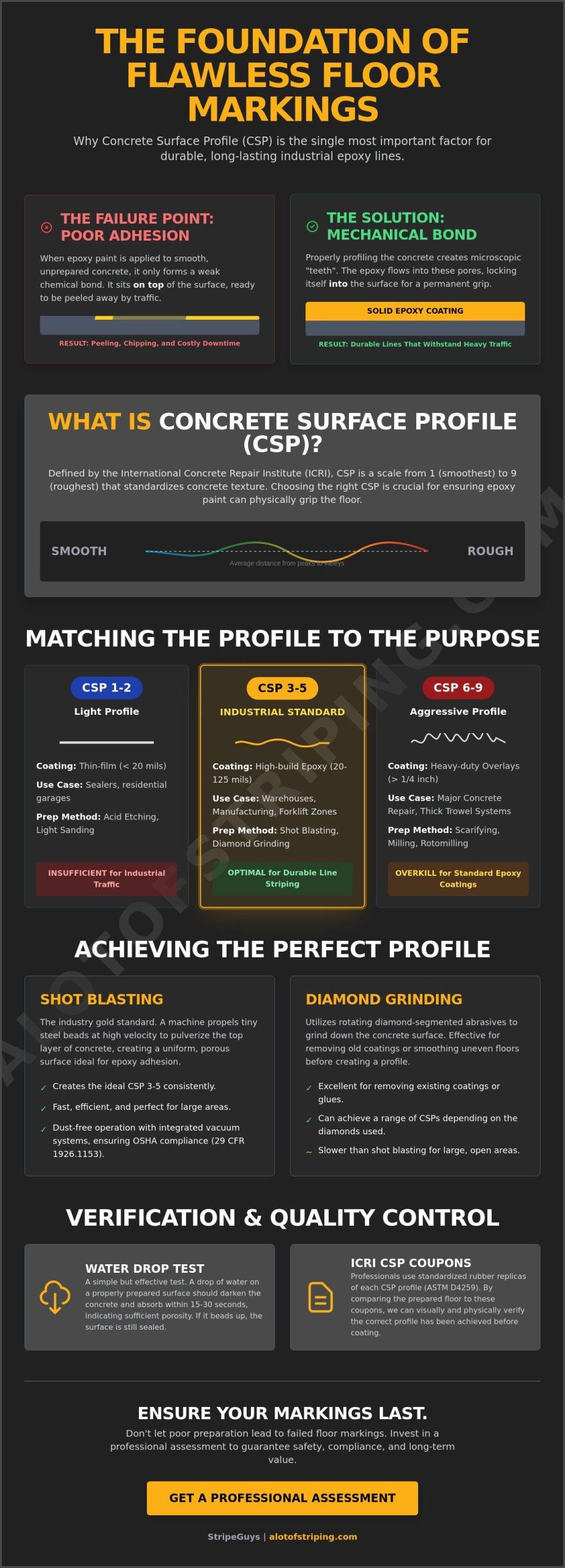
Concrete Surface Profile, or CSP, is a standardized measure of the average distance from the peaks to the valleys on a concrete surface. Think of it as the topographical map of your industrial floor. The International Concrete Repair Institute (ICRI) established Guideline No. 310.2R-2013 as the definitive benchmark for this measurement. This standard provides a common language for contractors and facility managers to ensure a slab is sufficiently prepared for its intended coating. Without the correct concrete surface profile for epoxy paint, the material simply sits on top of the slab rather than becoming an integrated part of the floor structure.
The science behind a lasting floor is mechanical bonding. Epoxy needs physical “teeth” to grip the substrate. When concrete is properly profiled, the liquid resin flows into microscopic pores and craters. As it cures, it locks into these irregularities, creating a permanent anchor. Failing to achieve this profile leads to delamination, where the coating peels away in sheets. In a busy facility, this isn’t just an aesthetic issue. It’s a significant safety hazard that leads to obscured boundaries and increased trip risks.
Mechanical Bond vs. Chemical Adhesion
Industrial environments demand more than basic cleanliness. While chemical cleaners might remove surface oils, they don’t create the physical texture required for high-performance coatings. Mechanical bonding is superior because it drastically increases the total surface area available for the epoxy to grab. A higher profile means more contact points and a stronger overall grip. Concrete surface profile is the structural foundation of any high-performance epoxy system.
The Impact of Traffic on Bond Requirements
In a high-velocity warehouse, floor markings face constant punishment. Forklift tires generate immense shear forces during tight turns or sudden braking. If the bond is weak, these forces will tear the epoxy away from the concrete substrate. The thickness of your coating dictates the required roughness:
- Thin-film coatings: Require a lighter CSP 1-2.
- High-build epoxy: Typically needs a CSP 3-5.
This is why epoxy warehouse striping requires intensive mechanical preparation. Ensuring the right concrete surface profile for epoxy paint is your insurance against the high cost of repairs and operational downtime.
The International Concrete Repair Institute (ICRI) defines the standard for surface preparation through a numerical scale from 1 to 9. Each number represents a specific degree of roughness, measured from the peaks to the valleys of the concrete. For facility managers, understanding the concrete surface profile for epoxy paint is about matching the prep method to the intended traffic load. CSP 1 and 2 are achieved through light methods like acid etching or basic sanding. While these might suffice for a residential garage, they’re unsuitable for industrial environments where heavy machinery would quickly shear the coating away.
On the other end of the spectrum, CSP 6 through 9 involve aggressive methods like heavy scarification or milling. These profiles are reserved for structural repairs or thick, heavy-duty overlays that exceed 1/4 inch in thickness. Most industrial projects live in the middle of this scale. To verify these standards on-site, we use ICRI CSP coupons (standardized rubber replicas of each profile) to compare the prepared slab against the required technical specification. This ensures transparency and quality control before any material is applied.
The Sweet Spot: CSP 3 for Industrial Line Striping
For most high-traffic facilities, CSP 3 is the ideal target. It provides the necessary mechanical “teeth” for a permanent bond without causing excessive paint consumption or “wicking” where the paint spreads too thin. Visually, a CSP 3 surface resembles medium-grit sandpaper. It’s rough enough to feel but uniform enough to maintain clean, crisp lines. Working with an experienced warehouse line striping company ensures that this profile is achieved consistently across the entire floor, preventing the localized peeling that often occurs when prep is rushed.
When to Go Rougher: CSP 4 and 5
Certain areas of a plant require a more aggressive concrete surface profile for epoxy paint. Battery charging stations and chemical laboratories often utilize high-build systems or acid resistant coatings that need a deeper anchor. These rougher profiles (CSP 4-5) are also necessary when dealing with older concrete that has a thick layer of laitance (a weak, milky layer of cement dust and sand on the surface). Removing this layer is critical to reaching the sound concrete underneath. If you’re unsure which profile your facility requires, you can request a technical surface assessment to determine the best preparation path for your specific traffic patterns.
Preparation Methods: Achieving the Right Profile for Epoxy Paint
Mechanical preparation is the only reliable way to achieve the required concrete surface profile for epoxy paint in an industrial setting. While some outdated guides suggest acid etching, we strictly avoid it. Acid etching often leaves behind chemical residues that interfere with bonding and introduces moisture into the slab, which can lead to future delamination. Mechanical methods provide a consistent, measurable result that ensures your safety markings survive the constant friction of heavy traffic.
For the most aggressive removal needs (CSP 4-9), we utilize scarifying. These machines use rotating, multi-pointed cutter wheels to “peel” away failed floor systems or exceptionally thick existing coatings. It’s a high-impact process necessary for extreme cases where the concrete surface must be significantly reconstructed to accept a new bond.
Shot Blasting for High-Production Warehouses
Shot blasting is the industry benchmark for large-scale facilities requiring a CSP 3-7. The process uses centrifugal blast wheels to propel steel shot at high speeds against the floor, effectively removing surface contaminants and laitance in a single pass. This is a dustless operation because the equipment simultaneously vacuums the shot and debris back into a separator, recycling the steel for continued use. For high-volume projects like parking lot line striping in multi-level garages, shot blasting offers the highest efficiency and the most predictable bond strength.
Diamond Grinding for Precision and Aesthetics
Diamond grinding uses planetary grinders equipped with diamond-segmented heads to shave the concrete surface. This method is the precision tool of choice for achieving a CSP 1-3, which is ideal for thin-mil epoxy applications. It’s particularly effective for smoothing uneven slabs and preparing pedestrian walkways where a uniform, clean finish is prioritized. To maintain facility cleanliness and comply with OSHA silica standards, we use high-efficiency HEPA dust extraction systems that capture particles at the source. This allows your team to continue their work without the risk of airborne contaminants.
Selecting the right equipment depends on your specific floor condition and operational requirements. If you’re ready to secure your facility with safety lines that won’t flake or peel, contact our technical team for a project consultation.
Verification and Quality Control: Testing Your Concrete Surface Profile
Verification is the final insurance policy for your industrial floor. Following the guidelines of ASTM D4259 (the standard practice for abrading concrete) ensures that the mechanical preparation has actually achieved the target profile. Without testing, you’re merely guessing if the surface is ready for a permanent bond. We prioritize these technical checks to eliminate the risk of delamination and ensure your safety markings withstand the rigors of heavy forklift traffic.
The Water Drop Test is a quick field method used to check surface porosity. We place small droplets of water on the prepared slab and observe the absorption rate. If the water beads on the surface, your concrete surface profile for epoxy paint is likely insufficient or blocked by contaminants. If the water absorbs within 30 to 60 seconds, the pores are open and receptive to the epoxy resin. We also utilize tape adhesion testing on small sample sections to verify the physical bond strength before committing to the application across the entire facility.
Moisture testing is a critical companion to CSP verification. We use ASTM F1869 (the calcium chloride test) to measure the moisture vapor emission rate from the slab. Even a perfect mechanical profile can’t overcome high vapor pressure that pushes the coating off from underneath. Combining these tests provides a comprehensive view of the slab’s readiness, ensuring that the environment is chemically and physically optimized for long-term success.
Field Testing Procedures for Facility Managers
Facility managers can perform a simple scratch test with a hardened steel tool to evaluate surface hardness. If the tool easily gouges the concrete, you’re likely seeing laitance (a weak, milky top layer of cement and sand) that hasn’t been fully removed. This layer lacks the structural integrity to support industrial coatings. CSP verification must happen in multiple zones of the warehouse to account for slab variance because concrete density and wear patterns often fluctuate across large footprints.
Partnering with Industrial Prep Experts
Professional grade equipment consistently outperforms small rental units in maintaining a uniform CSP across thousands of square feet. Our teams leverage over 29 years of field experience to match the concrete surface profile for epoxy paint to your specific traffic load and chemical exposure. This expertise prevents the common mistake of over-preparing or under-preparing the slab. Every project concludes with a rigorous final checklist focusing on three pillars: Profile, Porosity, and pH levels. This disciplined approach ensures your floor markings remain OSHA-compliant and durable for years to come.
Secure Your Facility with Professional Preparation Standards
Securing a permanent bond requires more than just picking the right paint; it demands a technical commitment to substrate preparation. You now understand how ICRI standards and mechanical methods like diamond grinding create the necessary anchor for high-performance coatings. Achieving the correct concrete surface profile for epoxy paint is the only way to prevent the logistical stress of failed floor markings and repeated maintenance downtime. By following ASTM verification protocols, you ensure your facility remains safe and compliant under the most demanding traffic conditions.
Don’t leave your facility’s safety to chance or contractors who cut corners on preparation. We bring 29+ years of industrial striping experience and nationwide coverage to every project, serving as specialists in OSHA-compliant safety markings that stay bonded to the slab. Our no-nonsense approach prioritizes your operational needs and budgetary constraints while delivering professional results. We understand the high stakes of your environment and provide the seasoned expertise required to get the job done right the first time.
Request an Industrial Floor Evaluation from StripeGuys to ensure your next striping project is built on a foundation of industrial authority. Your warehouse layout is a critical asset, and we’re here to help you protect it with lines that truly last.
Frequently Asked Questions
Can I use acid etching instead of grinding for industrial epoxy lines?
No, acid etching is generally insufficient for industrial environments. Chemical methods don’t provide the deep mechanical “teeth” required for a concrete surface profile for epoxy paint to withstand forklift shear forces. Additionally, acid can leave behind neutralizing salts or trapped moisture that causes the epoxy to delaminate within months of application.
How do I know if my concrete has a CSP 3 profile?
You identify a CSP 3 profile by comparing the prepared slab to standardized ICRI CSP coupons. These rubber replicas serve as a physical benchmark for the average depth of the peaks and valleys on your floor. Visually, a CSP 3 surface should look and feel similar to medium-grit sandpaper, providing a uniform texture without deep pits or cratering.
What happens if the concrete surface profile is too rough for thin epoxy?
If the profile is too aggressive for thin-mil epoxy, the coating will “wick” into the valleys and leave the peaks exposed. This leads to a blotchy appearance and premature wear because the paint isn’t thick enough to bridge the deep texture. We always match the preparation method to the specific thickness (mils) of the intended coating to avoid this structural failure.
Is shot blasting better than diamond grinding for warehouse line removal?
Shot blasting is the superior choice for high-volume shot blasting line removal because it handles large footprints quickly and leaves an ideal CSP 3-5 profile. Diamond grinding is better suited for smaller, precision areas or when you need to smooth out uneven concrete without creating deep texture. For most warehouse environments, the speed and dustless operation of shot blasting make it the gold standard.
Does new concrete need a surface profile before painting?
Yes, new concrete absolutely requires mechanical profiling. Fresh slabs often have a layer of laitance (weak cement dust) and curing compounds that prevent epoxy from penetrating the pores. We typically wait at least 28 days for the concrete to fully cure before using mechanical methods to remove these surface barriers and establish a lasting bond.
How long does mechanical surface preparation take for a typical warehouse?
The duration depends on the method and facility size, but a professional shot blasting crew can typically prepare 5,000 to 10,000 square feet per shift. Diamond grinding is a slower, more deliberate process that might cover 2,000 to 4,000 square feet in the same timeframe. We coordinate these schedules to minimize your operational downtime while ensuring the technical standards are met.


